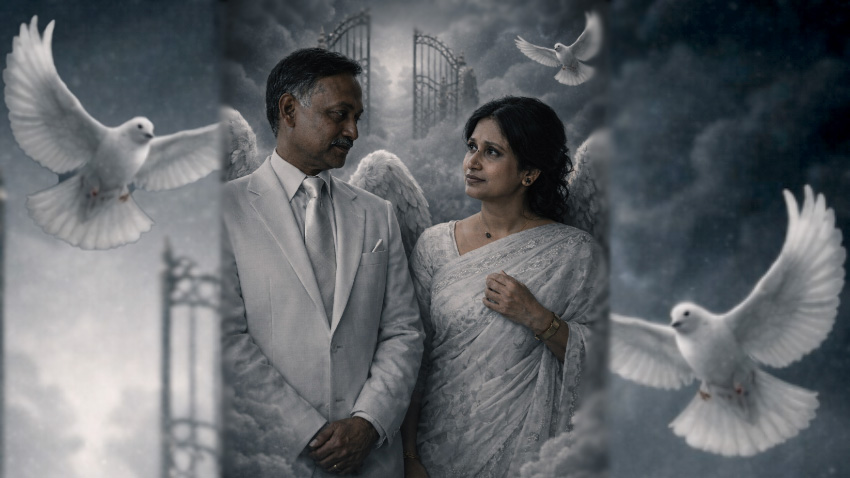
As I write this piece, a tribute to the unflinching Begum Khaleda Zia, who has left us, the television channels are showing live the streams of people heading towards her Janaza – a sight illustrating the unassailable position she held in the hearts of millions.
A housewife turned politician whose passing away brings people from all spheres together can be deemed the ultimate accolade.
The scenes aired in colour and with the aid of state of the art cameras evoke memories of another funeral in 1981, seen by us in black and white.
When the body assassinated President Ziaur Rahman was being taken for burial, the nation came together to weep, giving him a farewell which only made the conspiracy against him meaningless.
It was after the death of President Zia that the country saw the focus fall on Begum Zia, who, until then, had confined herself to the role of a house manager, bringing up two children.
As a ten year old, the memory from 1981 remains etched in mind because at that time both her two sons were also between 10 and 16 years.
The moderator of the most popular television variety show ‘Jodi Kichu Mone Na Koren’, the late Fazle Lohani, met Begum Zia and the two sons some time after the death of President Zia and it’s through that televised interview that the widow of Ziaur Rahman came under spotlight.
In a time when the country was struggling at all fronts, her candid interview of a frugal lifestyle struck a chord with millions of middle-class Bangladeshis.
From the home to the streets:
The Shakespeare line from Twelfth Night: some are born great, some achieve greatness and some have greatness thrust upon them may be applied in the case of Begum Zia.
Bangladesh went under an authoritarian regime in 1982 and thus began the protracted struggle to bring the nation back on a democratic trajectory.
Begum Zia took to the streets!
Disproving many detractors who had dismissed her as ‘too soft’, she crafted her own brand of defiant rhetoric – reserved, sophisticated and trenchant.
But never did we see her resort to vulgar tirades or obscene diatribes.
Speaking about her, Md Yeasin, a citizen heading towards the last rites, observes: “even in her rage, she was composed and reserved which endeared her to millions.”
Her name will be etched in history of Bangladesh because she became the first elected PM after democracy was restored in 1991, he adds.
While the fairness and neutrality of several elections have been questioned, the parliamentary election of 1991, which brought her and her party to power, will always remain above criticism, remarks Zahirul Islam, a journalist.
A symbol of stoicism and fortitude:
No government in the world is perfect and, it’s a mix of flaws and successes that mark any government and Begum Zia’s tenure also had highs and some lows.
But if today she is reverently remembered with millions heading towards her janaza then it’s for her resolve to stand tall in the face of adversity and misfortune.
She lost her husband at 35, then her younger son, was incarcerated, separated from her elder son, refused permission for free movement, accused and then convicted in several cases and made to become an object of ridicule.
Yet, when it seemed that everything was against her, the Begum did not capitulate or relinquish her principles or poise.
Talking about her immense popularity, Abdullah Reza, a journalist, comments: “one of the main reasons is that she never planned to leave the country to find safety and comfort overseas.”
This decision to remain in Bangladesh and accept whatever situation that came her way added to her charisma.
As press officer for the British High Commission in Dhaka, I had the privilege to catch a glimpse of Begum Zia in 2009 during the visit of Lord West of Spithead, who was then the UK state minister for security and counter terrorism.
The image of the dignified politician, Begum Zia, in opposition then, was the epitome of restrained rhetoric.
At her passing, the term most associated with her is ‘uncompromising’.
Much of her social acceptance comes from the fact that she never swayed from her principle and, after the events of July August 2024, her stance was vindicated, said, Shahnoor Karim, a social analyst.
From a different perspective, the country saw a December of two deaths, one of Osman Hadi and the other of Begum Zia which have left a void but have also solidified the resolve of the nation to remain united to move ahead with a purpose.
Deaths create emptiness, but deaths also trigger moments of profound reflection.
As we look at Begum Zia’s life, we see a woman who refused to be labelled and restricted, a woman who was a defiant voice on the streets, a leader who left mark as a statesman, a human being who refused to be intimidated by relentless abasement and degradation and, above all, a Bangladeshi who, despite the trials and tribulations, decided to choose Bangladesh as her one and only home.
We bid her farewell with the words of John Donne: “Death, be not proud, though some have called thee Mighty and dreadful, for thou art not so!”