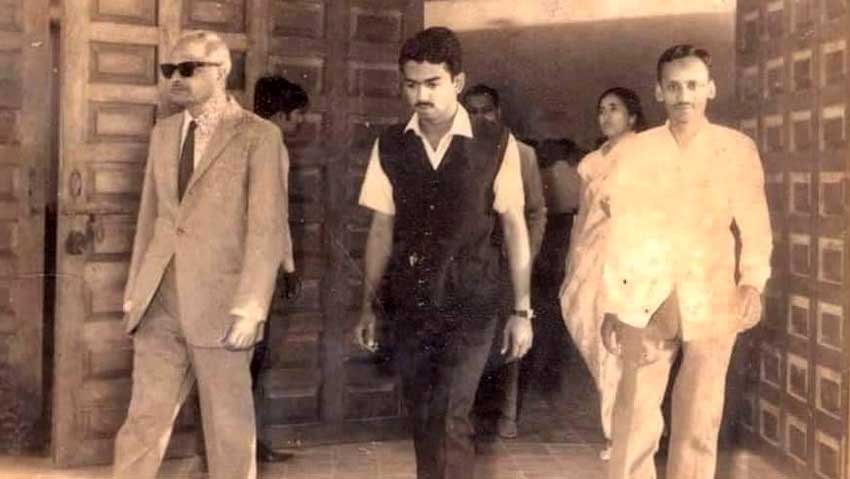
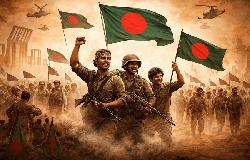
This is a story which is tooted in Bengali nation’s wounds. In the vast tapestry of country’s Liberation War, few stories are as intimate, piercing and deeply human as that of Magfar Uddin Chowdhury Azad. His life and the unbreakable bond with his mother, Safiya Begum became more than personal tragedy. They became symbols of the countless silent sacrifices that shaped a nation. Their story, later immortalised in Anisul Hoque’s celebrated novel Maa.
Magfar Uddin Chowdhury Azad grew up in a world of comfort. The Chowdhury residence in Dhaka’s Eskaton, spread across nearly two bighas, was among the most prominent homes of the neighbourhood. Azad, the only son, was effortlessly charismatic: stylish, academically accomplished, and generous. He loved cinema, idolised Elvis Presley, and rarely watched a movie without a lively group of cousins and friends around him.
Yet beneath that polished surface lay a private sorrow. In 1960, while Azad was a sixth-grader at St. Gregory’s, his father took a second wife. His mother, Mosammat Safiya Begum, quietly left their home and moved to her sister’s flat on B.K. Das Road in old Dhaka. Azad remained with his father, but visited his mother as often as he could. After his aunt’s death, Safiya Begum moved again, this time to a modest home near the Jurain shrine.
In 1967, after completing his intermediate exams, Azad left for Karachi University to study History. According to accounts shared by his close friend Abul Bashar, Azad thrived there besides building friendships and excelling academically. But through every achievement, one promise stayed alive that he would build a home where he and his mother could live together again.
Azad returned to Dhaka in 1970, degree in hand. He rented a house in Moghbazar for his mother, cousins and for Bashar who had accompanied him home. Azad enrolled in a master’s programme in Department of International Relations at University of Dhaka and Bashar joined the Morning News. Azad completed his MA in early 1971.
When the Liberation War began, many of Azad’s friends slipped across the border for training and returned as members of the legendary Crack Platoon (sector-02). Their daring guerrilla operations shook Dhaka, beginning with the raid at Hotel Intercontinental.
Friends urged him: “Come with us, Azad. You know guns. You can handle yourself.”
But Azad always answered: “My mother has no one but me. If she allows me, I will go.”
One night, over a simple dinner, he finally asked for her permission. Safiya Begum looked into her only child’s eyes and said softly: “Baba, you must fight.” That single sentence changed his life.
Soon after, Azad joined the guerrilla network, participating in several operations, including the celebrated attack on Siddhirganj Power Station. These events documented in freedom fighter accounts and later referenced by Crack Platoon commander Nasir Uddin Yousuf.
On 29 August 1971, Azad sat playing cards with relatives and friends Abul Bashar, Jewel and Kazi Kamal at Moghbazar house. Around 2 AM, Pakistani soldiers encircled the house.
Azad’s cousin, Golam Gaws Azam Chanchal, later recalled: “They broke the doors, dragged us out, beat us when we could not answer their questions. They found phosphorus and a .32 pistol. When they asked who was Azad, he tried to protect us by giving his full formal name.”
It didn’t work. Major Sarfaraz struck him across the face. In panic, Kazi Kamal grabbed a sten gun and fled through the chaos of bullets. The others, including Azad, were blindfolded and taken to the notorious MP Hostel torture cell in Dhaka's Nakhalpara, a site repeatedly mentioned in Crack Platoon narrations and historical interviews.
On August 31, Azad’s mother and cousin went to Ramna Police Station where detainees were sometimes brought for short periods. What they saw broke them. Azad’s body was bruised, swollen and bloodied. His mother barely recognised him.
“What can I do, Amma?”, he whispered. “They beat me so much. They keep asking for names.”
She asked quietly: “Did you tell them?”
“No… but if they beat me again, I cannot bear it.”
She placed a trembling hand on his shoulder: “Have patience, Baba. Endure it silently.”
Before she left, he said: “I haven’t eaten in two days.”
She promised to return with food. The next morning, September 01, she brought tin containers of rice, fish, chicken and beef. She waited until 2 PM. Azad never came out. That night, she sat before her dinner, pushed the plate away, and said: “My son has not eaten rice. I will not eat either. I will eat rice only when he returns.” It was a vow she kept until her death.
Historical positions indicate that on September 04, 1971, Pakistani forces executed Azad with several members of Crack Platoon. His body was never found. His mother waited fourteen years sleeping on the floor, refusing rice, clinging to the fading hope that one day he would return.
She died without knowing where her son was buried. On the epitaph of this noble woman, “Here rests Safiya Begum, beloved Mother of Shaheed Azad” is carved. Her wait ended only in eternity.
Years later, freedom fighter and guerrilla commander Nasir Uddin Yousuff shared Azad’s story with writer Anisul Hoque. Moved by its raw humanity, Hoque wrote Maa, published in February 2003.
The novel became a national phenomenon. By 2020, it had reached its 100th edition, very rare in Bangla literature.
Critics praised it widely. Scholar Sardar Fazlul Karim wrote: “I speak of two mothers: Maxim Gorky’s Mother and Anisul Hoque’s Maa. To me, both have become true, universal mothers.”
Indian writer Sarojini Sahoo noted: “One of the best novels of the Indian subcontinent. It made my eyes watery. Its strength lies in its humanity.”
Writer Shekhar Imtiaz reflected: “Gorky’s Mother gave me courage in youth. Hoque’s Ma gives me pain in maturity; pain for the history we forget.”
More than fifty years after his death, Azad is remembered not only as a brave guerrilla fighter but as a devoted son whose courage grew from a mother’s love.
His life, and his mother’s lifelong vigil, continues to echo across classrooms, Liberation War archives and the pages of Maa. For a generation born long after 1971, Azad’s story remains one of the clearest examples that refuses to fade.
The price of freedom was paid not only on battlefields but also in silent kitchens, dark police stations, and the trembling prayers of mothers who never stopped waiting.
-The writer is a Postgraduate Student of International Relations at University of Dhaka & General Secretary of Japan Study Club—DUIRJSC.