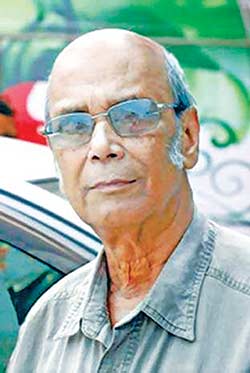
With words rendered from his poetic soul, Syed Shamsul Haque transformed day into night and vice versa. He wrote poems, novels, short stories, plays and song straight from his heart, narrating in candid yet nuanced manner. From realism to psychoanalysis to magic realism and eco-criticism, his sabyasachi, an honorary title, a Bangla-Sanskrit term which means one who can perform many tasks together.
Born on 27 December, 1935 in Kurigram to Syed Siddique Husain, a homeopathic physician, and Halima Khatun, Syed Shamsul Haque was the eldest of the eight children. He finished his school in his hometown. Then, he ventured towards one of the biggest cultural hubs of the subcontinent -- Mumbai. There he worked for a film production house. Later, he returned to Bangladesh and completed higher secondary from Jagannath College. He enrolled in the Department of English at University of Dhaka, but he didn't deem it necessary to complete his Baccalaureate; rather he pursued an avowed literary career and undertook writing his first novel Deyaler Desh.
Known to his literary circle as 'Haque bhai', Syed Shamsul Haque simultaneously wrote poems, short stories, lyrics and plays. He even wrote on the techniques of writing in the prominent weekly magazine, Bichitra. His first poetry collection, Boishakhe Rochito Panktimala, was published in 1970. He was one of the finest exponents of the Modernist movement in our literature. For his charismatic technique and experimentation, he was awarded the prestigious Adamji Award just at the advent of our liberation war.
He experimented with local dialects in his poetry. His poetry collection Poraner Gohin Vitor and novel Khelaram Khele Ja are wonderful examples of rendering local dialects into literature. He landscaped the psyche of rural Bengal with wonderful metaphors and jargons that set example to other contemporary writers.
He spent seven years in London, working with BBC Bangla. From there he would contribute significantly during the Liberation war in 1971. It was during this time when he penned some of his best plays such as Nuruldiner Sarajibon and Payer Awaj Pawa Jay. They aptly articulated the ignorance and misuse of religion. Moreover, they explored our vision in a vulnerable world infested with bigotry and intolerance.
One of his incomparable talents was in translating plays of Shakespeare. Keeping the original text and the poetic value almost intact, he translated in solidarity of the English language with Bangla. To this day, Haque's translation of Macbeth is praised by critics and readers all alike. It is quite rare to find a writer who can translate Shakespeare like him.
Syed Samsul Haque was also a very prominent lyricist. Famous songs such as 'Hayre Manush Rangin Fanush' and 'Jar Chaya Poreche Monero Aynate' were very famous in '80s and '90s and to this day. He also wrote songs for famous Bangla films such as Achen Amar Moktar, Hayre Manush Rongin Fanush, etc. In fact, he rented a small house in Sadarghat on the river Buriganga for writing songs and poems.
Perhaps inspired by Gabriel Garcia Marquez's Macondo and R.K. Narayan's Malgudi, Syed Shamsul Haque created his own world Joleshwari. His hometown Kurigram would serve the same purpose, and the influence could be found in his famous dialogue in Nurldiner Sarajibon: Jaago Bahe Konthe Shobai. He used magic realism in his first novel, Rokto Golap.
For his contributions to Bangla literature, Syed Shamsul Haque was awarded Bangla Academy Award in 1966 (the youngest among all to receive it), Ekushey Padak in 1984 and Independence Day Award in 2000 by the Government of Bangladesh. He was suffering from lung disease last year and was hospitalized. The ambidextrous writer breathed his last on 27 September, 2016 at the age of 81, leaving his fans and well-wishers in great mourning.





