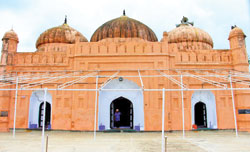
In Atishkhana Mahalla near Lalbag fort, a mosque with high boundary walls and large cupolas contrasts the hustle and bustle of a packed street of old Dhaka. It gives the passers-by a serene experience and an opportunity to glimpse into history for a while. The sight is locally known as Khan Mohammad Mirdha mosque, which, according to an inscription placed in its frontal façade, was built in 1706. The deputy governor Farrukh Shah ordered the chief Quazi of the then Mughal Dhaka, Quazi Ebadullah, to build it. He in turn employed Khan Mohammad Mirdha for the construction of the mosque, and it derived its name from him.
The mosque was erected on a high podium, 16 feet above the ground, so it could be seen from the dense urban settlement nearby. The podium has a substructure called 'Tahakhana', and it also had small rooms and continuous veranda, which are covered by a vaulted roof. The stairwell that leads to the platform or the prayer hall is 9 feet wide. Black basalt stones are used for the stairwell, joined by metallic clamps. There are two octagonal projected spaces in the eastern side, perhaps for small gathering and hobnobbing before and after prayer.
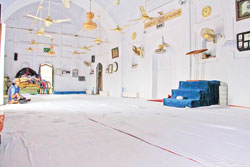
The main prayer hall, smaller than the platform, is located on the northern side. It measures 48 feet in length and 24 feet in width. Three arched entrance doorways welcome the musalli or worshippers inside, and three mihrab niches are visible after entering the prayer hall. It has three onion shaped domes, the central one being bigger than the side ones. There are four minarets or corner turrets at each corner, rising above the parapet. The pilaster minarets border each entrance and the projection of the mihrab at the back of the western wall.
The mosque is a blend of different architectural techniques. The Mughals invited various professionals and experts from their homeland, who had to depend upon the local materials and craftsmen for construction. The Mughal builders in Bengal used red powdered bricks with lime stone mixture in many other mosques due to the absence of red sand stone in Bengal. But Khan Mohammad Mridha mosque is an exception; the Mughals used only imported red sand stones in the construction of this magnificent architecture to give the essence of red sand stone architecture of the imperial Delhi kingdom. There is a large garden in the eastern portion of the site. A gardener appointed by the Archaeological Department is in charge of the upkeep of the garden. A well in the northern part of the garden was once used for ablution by the worshippers before prayer, but it is abandoned now. An old palm tree towering over the garden gives the entire site a nice look.
The mosque, today, is in relatively good condition as it is listed by the Archaeological Department as an ancient site, and its maintenance is jointly carried out by the department and a local committee. But the mosque is not open all the time, except for prayer hours. If it was open round the clock, the visitors would get a chance to see one of the best preserved mosques of the Mughals anytime they want.





