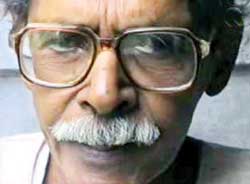
Binoy Majumdar was a bright, unconventional, ambiguous and controversial poet whose life and work await chapters of penetrating research. Binoy is an extremely rare poet - it is hard to find a parallel in the western hemisphere. The intense purity with which geometry, mathematics, science and logistics fill the bone-marrow of his poetry, marks his rare genre. Despite being a fine and talented engineer, a brilliant, innovative mathematician and an even more brilliant poet, Binoy led a rather distraught and disoriented life of extreme poverty. Failed by one-sided love (for Gayatri Chakraborty), he lost his mental composure and attempted suicide several times in his life. At times, he would turn violently schizophrenic. In the 1990s, the state government of West Bengal, upon request from fellow poets, provided some support. It didn't restore his physical and mental health.
Binoy Majumdar was born in Myanmar on the 17th of September 1934. His family later moved to what is now West Bengal in India. Binoy loved mathematics from his early youth. He completed Intermediate from the Presidency College of the University of Calcutta. Although he graduated with a degree in mechanical engineering from Bengal Engineering College, Calcutta, in 1957, Binoy turned to poetry later in life. He was fluent in English and Russian and translated a number of science texts from the Russian to Bengali. When Binoy took to writing, the scientific training of systematic observation and enquiry of objects found a place, quite naturally, in his poetry. His first book of verse was Nakshatrer Aloy. However, Binoy Majumdar's most famous piece of work to date is Phire esho, Chaka, which was written in the format of a diary. The book is dedicated to Gayatri Chakravorty Spivak, a fellow-Calcuttan and contemporary of Majumdar.
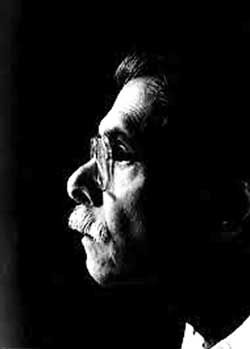
Binoy has often been regarded by critics as a true successor of Jibanananda Das, the poet who revolutionized Bengali Poetry in the post-Tagore era. Like Jibanananda, Binoy drew his material from bountiful nature, the fields and the jungles and the rivers and the fauna of Bengal. But Binoy's originality lay in his attempt to relate the various elements of nature to one another through objective logic and scientific enquiry. In this respect, some critics like Aryanil Mukherjee, refer to the genre of his work as scientific field journal. Binoy Majumdar was also bold and revolutionary in his depiction of sexuality.
He abundantly used vivid imagery which were sensually potent and Freudian in essence. In a series of pieces, where he gives an explicit and graphic description of sexual intercourse. Binoy, once again, lays strong emphasis on the physiology of the process, and takes to a journalistic narration. Binoy has always been somewhat obscure among readers of Bengali Poetry. He was quite ahead of his time in breaking norms of contemporary literature. Some of his poems are difficult to decipher at the first go, and require multiple readings.
His writings are unconventional because they often appear as neutral scientific reportage, and not poetry in its usual romaticized self. In this, Binoy readers can perhaps trace back his background as a Mathematician. Binoy builds up all his imagery, nuances, lyricism, and poetic discovery on the skeleton of scientific reasoning and factual observations. Binoy died in his maternal home in Shimulpur, West Bengal in 2006.
The writer is a freelance contributor.





