



| HEADLINE |

|

China deal opens new opportunities for South Korean entertainment industry


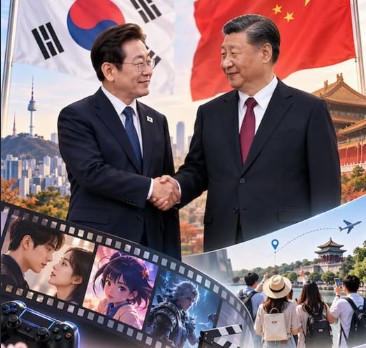
China is opening new opportunities for South Korean entertainment companies after years of restrictions, following progress on a major services and investment agreement between the two countries.
South Korean President Lee Jae Myung and Chinese President Xi Jinping oversaw the progress during their meeting on the sidelines of the Asia-Pacific Economic Cooperation (APEC) summit in Shenzhen on November 18.
Under the agreement, China has agreed to grant South Korean films and games most-favoured-nation (MFN) treatment, ensuring that South Korean businesses receive treatment no less favourable than that given to companies from other countries.
Beijing has also agreed to apply non-discrimination principles when reviewing South Korean films and online games.
The agreement will expand opportunities for cooperation in the entertainment industry, including television dramas, animation, entertainment programmes and documentaries. The two countries have agreed to expand joint production arrangements beyond films to cover these areas.
Productions officially recognised as joint projects under the agreement will be treated as domestic content in both countries. This could allow eligible South Korean productions to benefit from China's domestic content rules and avoid certain quotas imposed on foreign productions.
The agreement also includes provisions to expand access to China's tourism market. South Korean travel agencies operating in 23 designated regions in China will be allowed to arrange overseas travel packages for Chinese nationals and foreign residents living there.
The two countries have substantially concluded follow-up negotiations on services and investment under their bilateral free trade agreement (FTA). Their bilateral trade in services and investment is currently worth around $38.8 billion.
The negotiations began in March 2018 as a follow-up to the FTA, which came into effect in December 2015. They took eight years and eight months to reach a substantive conclusion.
The agreement is expected to provide South Korean businesses with a more stable basis for entering China's content, tourism, finance and retail markets.
The development has raised hopes of easing China's long-standing restrictions on South Korean cultural content, which have affected the country's entertainment industry since 2016.
The restrictions followed tensions over South Korea's deployment of the US Terminal High Altitude Area Defence (THAAD) missile defence system. South Korean films, television programmes and live performances subsequently faced barriers in the Chinese market, although Beijing has never formally acknowledged imposing an official ban.
However, the latest agreement does not guarantee an immediate return of large-scale K-pop concerts in China. South Korean entertainment companies and industry representatives remain cautious about whether the new commitments will translate into practical changes.
Films will still have to undergo China's content review process before release, while the agreement does not specifically guarantee approval for large-scale K-pop performances.
Technical details, translations and legal reviews also need to be completed before the expanded agreement can be formally signed.
The development is nevertheless being viewed as a potential step towards improving cultural and economic relations between the two countries after years of restrictions and strained ties.
sks









Published by the Editor on behalf of the Observer Ltd. from Globe Printers, 24/A, New Eskaton Road, Ramna, Dhaka.
Editorial, News and Commercial Offices : Aziz Bhaban (2nd floor), 93, Motijheel C/A, Dhaka-1000.
Phone: PABX- 41053001-06; Advertisement: 41053012; 01793317829, 01550707291, 01550707296
E-mail: [email protected], [email protected]. [email protected], [email protected], [email protected], [email protected], Online-email: [email protected]


