



| HEADLINE |

|

Nearly 1,500sq km of land lost to river erosion in 50 years
Published : Monday, 23 November, 2026 at 7:07 PM
Observer Online Report


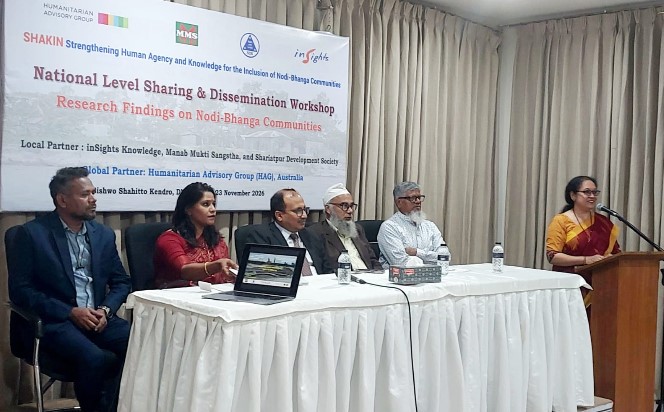
River erosion has forced around 26 per cent of climate-displaced people in Bangladesh to leave their homes, while nearly 1,500 square kilometres of land have been lost to the disaster over the past 50 years, according to a research report.
The findings were presented at a discussion meeting titled ‘Rehabilitation, Civil Rights and Livelihood Security of People Affected by River Erosion’ at Bishwo Shahitto Kendro in Dhaka on Monday (November 23).
The study, titled ‘Sakin’, was jointly conducted by inSights Knowledge, Manab Mukti Sangstha (MMS) and Shariatpur Development Society (SDS) in Sirajganj and Shariatpur districts, with funding from the Humanitarian Advisory Group (HAG).
The report said river erosion not only deprives people of their homes and livelihoods but also disrupts their social ties, civil rights, psychological well-being and sense of identity.
InSights Knowledge Chairperson Nahid Siddiqui, who chaired the meeting, said the psychological distress caused by river erosion had long-term consequences for displaced people.
She stressed the need for safe housing, sustainable livelihoods, continuity of social protection, access to education and healthcare, and the participation of affected communities in decision-making, alongside river management and emergency assistance.
Department of Social Services Director General Shah Mohammad Mahbub said losing an address and identity was often a greater concern for people displaced by river erosion than losing property. Many of them, he added, were deprived of their civic identity and access to government services.
“We are developing a family tree and identifying family information for the distribution of Family Cards. We will be able to identify where a person came from, their origins and their family roots. This will help us identify people displaced by river erosion,” he said.
Presenting the research findings, InSights Knowledge adviser Suman Ahsanul Islam said river erosion was not merely a disaster involving the loss of land and homesteads. It also affected livelihoods, identity, social relationships, mental well-being and civil rights, creating long-term challenges for affected communities.
He said the research aimed to ensure that the lives, livelihoods, civil rights and future security of people affected by river erosion received as much attention as riverbank protection.
- MaT

Loading...
Loading...
Also read








Editor : Iqbal Sobhan Chowdhury
Published by the Editor on behalf of the Observer Ltd. from Globe Printers, 24/A, New Eskaton Road, Ramna, Dhaka.
Editorial, News and Commercial Offices : Aziz Bhaban (2nd floor), 93, Motijheel C/A, Dhaka-1000.
Phone: PABX- 41053001-06; Advertisement: 41053012; 01793317829, 01550707291, 01550707296
E-mail: [email protected], [email protected]. [email protected], [email protected], [email protected], [email protected], Online-email: [email protected]


