



| HEADLINE |

|

The history behind Bangladesh’s iconic red winter quilts (lep)
Published : Monday, 23 November, 2026 at 11:32 AM
Observer Online Report


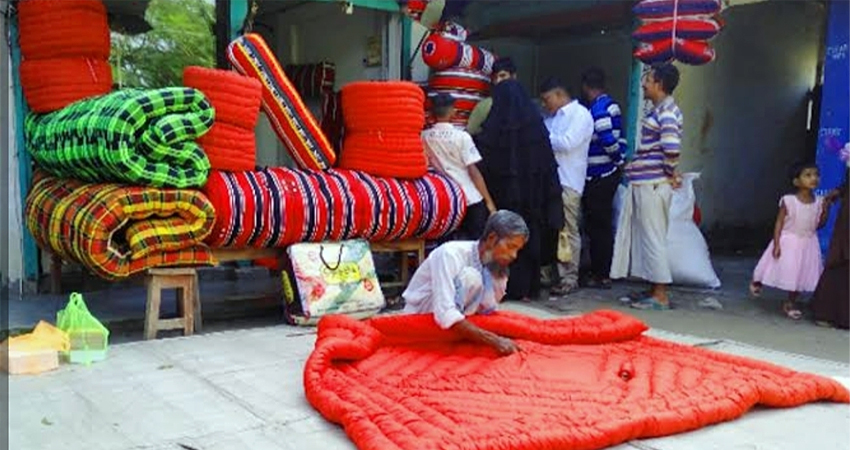
Collected Photo
From royal velvet to silk and eventually everyday cotton, the fabrics used to make traditional winter quilts (lep) in Bengal have changed over the centuries, yet their signature red colour has remained constant.
Waking up under the warmth of a bright red lep on a crisp winter morning—or seeing them aired out in the sun on rooftops and courtyards across villages and cities—remains an enduring part of Bengali winter nostalgia. Even as modern blankets, duvets, and synthetic comforters gain popularity, stacks of red cotton-filled quilts at neighbourhood bedding shops continue to hold their appeal.
Behind this familiar hue lies a blend of Nawabi-era heritage, fragrant attar, and practical habits passed down through generations.
Origins in the Nawabi Era
According to historical accounts and media reports, the tradition of wrapping quilts in red fabric dates back to the Nawabi period in Bengal. At the time, Murshidabad emerged as a renowned centre for quilt-making, supplying fine bedding across undivided Bengal.
Historical lore suggests that during the reign of Murshid Quli Khan—Nawab of Bengal, Bihar, and Orissa—long-staple karpas cotton was deseeded, dyed red, dried, and stuffed into red velvet covers. To add a touch of aristocracy and fragrance alongside warmth, makers also infused the quilts with attar (traditional perfume).
Later, during the rule of Murshid Quli Khan's son-in-law, Nawab Shuja-ud-Din, silk replaced velvet as the preferred outer fabric. While the material shifted, the tradition of using red remained intact.
From Royal Luxury to Everyday Homes
Because velvet and silk were expensive and out of reach for ordinary people, artisans gradually began using affordable red cotton cloth. What began as an emblem of aristocratic luxury slowly became an everyday winter essential in households across Bengal.
Bedding merchants in Old Dhaka also trace the custom of making red quilts back to the Nawabi era, noting how the practice spread throughout the region and retained its popularity across generations.
Practicality and Commercial Appeal
Beyond heritage, practical considerations also contributed to the lasting preference for red cloth. Since heavy cotton quilts cannot be washed frequently, dark red fabric helps conceal dust and stains accumulated over months of use, keeping the bedding looking clean for longer.
Some traders also point out that bright red quilts catch the eye of passersby from a distance, offering a natural visual advantage for shopkeepers—though historians note there is no definitive documentary proof behind these practical explanations.
Changing Times, Unchanged Tradition
Today, quilts in a wide variety of colours, patterns, and modern fabrics are readily available in the market. Yet the classic red lep retains its distinct identity and steady demand—sustained by a combination of Nawabi legacy, everyday utility, and centuries-old habit.
Aired out under the morning sun and wrapped around families at dusk, the red lep continues to represent not just winter warmth, but a living piece of Bengali lifestyle and memory.
-EM

Loading...
Loading...
Also read








Editor : Iqbal Sobhan Chowdhury
Published by the Editor on behalf of the Observer Ltd. from Globe Printers, 24/A, New Eskaton Road, Ramna, Dhaka.
Editorial, News and Commercial Offices : Aziz Bhaban (2nd floor), 93, Motijheel C/A, Dhaka-1000.
Phone: PABX- 41053001-06; Advertisement: 41053012; 01793317829, 01550707291, 01550707296
E-mail: [email protected], [email protected]. [email protected], [email protected], [email protected], [email protected], Online-email: [email protected]


