



| HEADLINE |

|

When fools rule, the wise are silenced
Published : Saturday, 21 November, 2026 at 12:00 AM
ARNAB ASHRAF


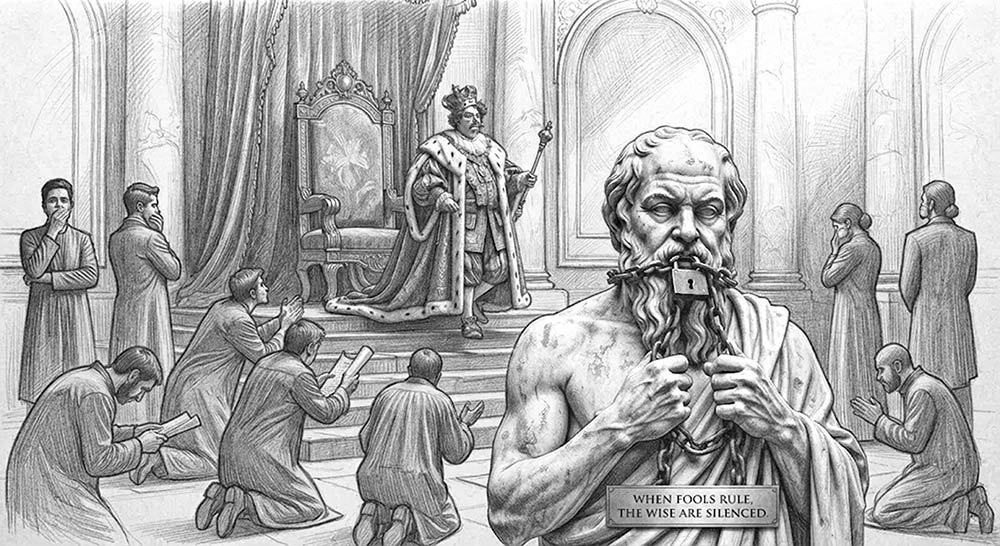 When incompetent, arrogant, and intellectually insecure individuals rise to positions of power, one of their first instincts is often to silence those who possess wisdom and independent thinking. Instead of welcoming intelligence, they perceive it as a threat; instead of encouraging constructive criticism, they treat it as an act of disloyalty; and instead of rewarding competence, they surround themselves with people who know how to flatter.
One of the primary reasons incompetent leaders suppress intelligent people is their own insecurity. A person who lacks wisdom, vision, and intellectual depth may feel uncomfortable in the presence of someone who possesses these qualities.
And rather than improving their own capabilities, these leaders attempt to diminish the influence of those who expose their weaknesses. They mistake intellectual independence for arrogance and honest disagreement for rebellion. The irony is that a truly capable leader recognises talent as an asset.
Professional competence, intellectual ability, and personal integrity become less important than loyalty to those in power. People are promoted because they are capable of doing the job. They are promoted because they are willing to defend the decisions of their superiors.
The honesty becomes risky. And the flattery becomes rewarding.
Suppressing intellectuals does not always require imprisonment, censorship, or physical intimidation. The most effective weapon is character assassination. Instead of answering a critic's arguments, those in authority attack the critic's motives, reputation, background, or personal character.
Honest individuals are labelled troublemakers, pessimists, disloyal employees, or enemies of progress. Their contributions are ignored. Their credibility is questioned. And their influence is systematically reduced.
The most damaging consequence of incompetent leadership is the rise of sycophants. A competent person tells a leader what needs to be heard. A flatterer tells a leader what they want to hear.
It creates an artificial atmosphere of success while serious institutional problems remain unresolved. A government, organisation, or institution cannot function effectively when its decision-makers receive praise instead of honest information. A leader surrounded by flatterers may enjoy constant applause, but that applause can become the soundtrack of institutional decline.
The history provides powerful examples of individuals who suffered because their ideas challenged established authority. Socrates was sentenced to death; his commitment to questioning accepted beliefs; and examining moral assumptions made him a controversial figure. Galileo Galilei faced the Roman Inquisition because his astronomical arguments challenged established religious interpretations of the universe; and he was forced to recant and spent the remainder of his life under house arrest. Giordano Bruno was executed in Rome following a trial involving his philosophical and theological beliefs.
Yet, their stories remind us of the dangers that emerge when institutions become intolerant of challenging ideas. In modern times, authoritarian systems have also attempted to control universities, independent journalism, scientific research, literature, and cultural expression. The lesson is clear: Societies that fear intellectual freedom eventually undermine their own capacities.

Even intelligent individuals are dismissed as arrogant. Independent thinkers are treated with suspicion. Honest critics are portrayed as enemies. Loud voices and empty slogans receive more attention.
One of the greatest misconceptions of incompetent leadership is the belief that silence means agreement. When intellectuals, professionals, and honest citizens stop speaking, those in power may interpret their silence as public approval. But people remain silent for many reasons. Some fear professional consequences. Some worry about their families and personal security.
A genuinely capable leader does not fear intelligent people. They recognise that independent thinkers, experienced professionals, and constructive critics are essential to effective leadership.
No individual, political party, government, or institution should be considered beyond criticism. A healthy society must reward merit rather than personal loyalty, protect academic freedom, encourage independent journalism, and ensure that professional advancement depends on competence and integrity. Most importantly, disagreement must not automatically be interpreted as disloyalty.
Power can make an individual influential. But it cannot make that individual intelligent. Position can establish authority. But it cannot guarantee respect. Fear can silence people temporarily. But it cannot transform ignorance into wisdom.
Every leader, institution, and movement must be judged by competence, integrity, evidence, accountability, and the consequences of its actions.
Finally, the greatest tragedy is not that fools sometimes rise to power. It is that the society may begin rewarding their ignorance.
The writer is a journalist

Loading...
Loading...



Editor : Iqbal Sobhan Chowdhury
Published by the Editor on behalf of the Observer Ltd. from Globe Printers, 24/A, New Eskaton Road, Ramna, Dhaka.
Editorial, News and Commercial Offices : Aziz Bhaban (2nd floor), 93, Motijheel C/A, Dhaka-1000.
Phone: PABX- 41053001-06; Advertisement: 41053012; 01793317829, 01550707291, 01550707296
E-mail: [email protected], [email protected]. [email protected], [email protected], [email protected], [email protected], Online-email: [email protected]


