



| HEADLINE |

|

Govt mulls curbs on family ownership in drastic telecom reforms
New policy to prioritise fibreisation, infrastructure sharing and protection against internet shutdowns. Three major licensing tiers proposed to simplify the sector and attract investment
Published : Monday, 16 November, 2026 at 12:00 AM
Mizanur Rahman


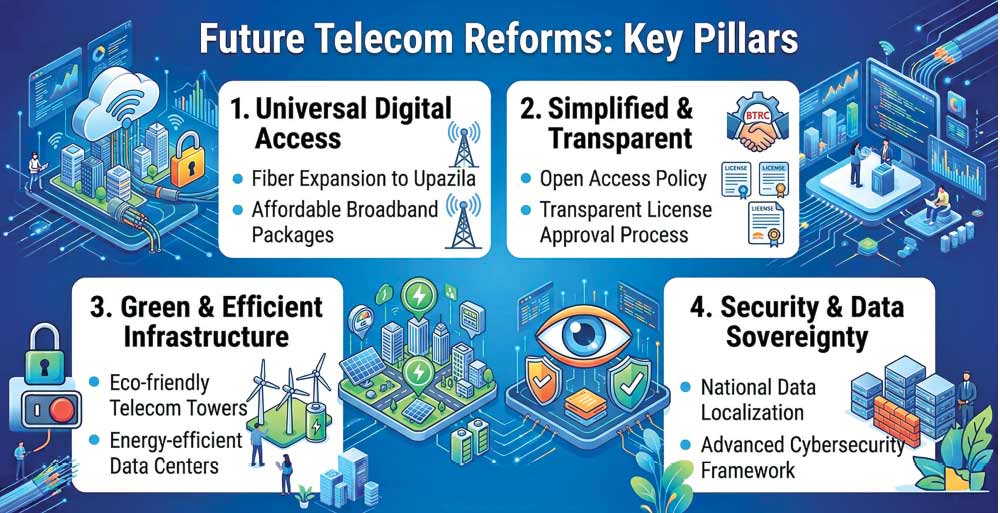 The government is planning a major overhaul of Bangladesh's telecommunications sector, seeking to replace its longstanding complex, multi-layered licensing system with a simplified and investment-friendly framework.
The proposed reform aims to bring more than 30 fragmented licences under a few major licensing categories, integrate international gateway-related services, make fibreisation and infrastructure sharing mandatory, and introduce legal safeguards against artificial internet shutdowns.
The new policy is also expected to impose stricter restrictions on ownership and control by the same family across different layers of the telecommunications ecosystem, while placing greater emphasis on service quality, broadband speed and investment opportunities.
To this end, the Posts and Telecommunications Division has initiated the process of formulating the 'Telecommunications Network and Licensing Policy, 2026', reviewing the existing 'Telecommunications Network and Licensing Policy, 2025'.
A five-member high-level committee has been formed to prepare the draft policy, with a deadline of seven working days to submit its report.
The decision was announced through an office order signed by Mohammad Shahidullah, Senior Assistant Secretary of the Posts and Telecommunications Division, on November 11.
Three major licensing categories proposed: One of the key features of the proposed policy is a restructuring of the existing licensing framework.
At present, more than 30 types of licences and approvals are involved in different layers of the telecommunications sector. The fragmented system has created multiple layers of regulatory requirements, operational complexities and barriers to investment.
Under the proposed reform, the entire telecommunications ecosystem is expected to be reorganised into a few broad licensing categories. These include:
Access Network Service: This category will cover telecommunications and internet services delivered directly to end users. It will primarily involve network operations that connect consumers to mobile and broadband services.
National Infrastructure and Connectivity: This category will cover domestic telecommunications infrastructure, fibre-optic networks and connectivity between different networks. The objective is to reduce duplication of infrastructure and ensure more efficient utilisation of existing network facilities.
International Gateway/Connectivity: This category will bring international telecommunications and internet connectivity services under a more integrated framework, reducing unnecessary licensing layers and operational complexities in international connectivity. Three international services may be integrated.
Another significant proposal involves restructuring the licensing arrangements for International Internet Gateway (IIG), International Gateway (IGW) and Interconnection Exchange (ICX) services.
Currently, these services operate under separate licensing arrangements, covering international internet bandwidth connectivity, international voice calls and interconnection among different operators.
The government is planning to bring these services under a single integrated pipeline after the existing licences expire.
The proposed integration is expected to simplify international connectivity management, reduce operational costs and improve efficiency in the sector.
However, the transition process and the way existing licensees will be accommodated under the new framework will depend on the final policy decisions.
Fibreisation and infrastructure sharing to be mandatory: The proposed policy is also expected to make fibreisation and active infrastructure sharing mandatory.
Instead of allowing multiple companies to separately build and operate similar infrastructure, the government wants to encourage shared use of existing network facilities.
Such a move could reduce the cost of infrastructure development and accelerate broadband expansion, particularly in rural and remote areas.
Greater use of fibre-optic networks is also expected to facilitate the delivery of high-speed internet services across the country.
Mandatory active infrastructure sharing could improve network utilisation and lower entry barriers for new operators and investors.
Legal safeguards against internet shutdowns: Ensuring uninterrupted internet connectivity is another important area of the proposed reform.
The new policy is expected to include legal obligations to prevent artificial disconnection of internet services or deliberate internet blackouts.
The initiative aims to strengthen the reliability and continuity of telecommunications services and protect consumers from arbitrary disruptions.
The proposed framework will also introduce stricter rules to prevent individuals or companies belonging to the same family from exercising ownership or control over multiple layers of the telecommunications industry.
The objective is to ensure fair competition, prevent conflicts of interest and discourage excessive concentration of market power in the hands of a single business group.
Focus on service quality and fresh investment: The government expects the proposed licensing reforms to improve the quality of telecommunications services, particularly broadband internet speed, network reliability and service continuity.
At the same time, a more transparent licensing system and opportunities for direct investment are expected to attract new domestic and foreign investors.
Reducing the number of licences and simplifying regulatory procedures could also make it easier for new entrepreneurs to enter the telecommunications market.
Committee to review legal framework: The five-member committee will be headed by the Joint Secretary (Telecom) of the Posts and Telecommunications Division. A Deputy Secretary or Senior Assistant Secretary (Telecom) of the division will serve as its Member Secretary.
Representatives at the director or higher level from the Bangladesh Telecommunication Regulatory Commission (BTRC), the Department of Telecommunications (DoT) and Bangladesh Telecommunications Company Limited (BTCL) will serve as the other members.
The committee will review the Bangladesh Telecommunications Act, 2001, the Bangladesh Telecommunications (Amendment) Act, 2026, the Secretariat Instructions 2024, the Rules of Business 1996, including its 2026 amendments, and the incumbent government's election manifesto.
Based on the review, it will prepare a comprehensive draft of the new policy within seven working days and submit it to the Posts and Telecommunications Division.
If implemented, the proposed changes could significantly reshape the country's telecommunications business model, infrastructure management and competitive landscape.
However, the final structure of the licensing categories, integration of existing licences, infrastructure-sharing requirements, ownership restrictions and safeguards against internet shutdowns will depend on the committee's recommendations and subsequent government policy decisions.

Loading...
Loading...
Also read



Editor : Iqbal Sobhan Chowdhury
Published by the Editor on behalf of the Observer Ltd. from Globe Printers, 24/A, New Eskaton Road, Ramna, Dhaka.
Editorial, News and Commercial Offices : Aziz Bhaban (2nd floor), 93, Motijheel C/A, Dhaka-1000.
Phone: PABX- 41053001-06; Advertisement: 41053012; 01793317829, 01550707291, 01550707296
E-mail: [email protected], [email protected]. [email protected], [email protected], [email protected], [email protected], Online-email: [email protected]


