



| HEADLINE |

|

Chinese co gets nod for 3rd LNG terminal
Published : Friday, 13 November, 2026 at 12:00 AM
Business Correspondent


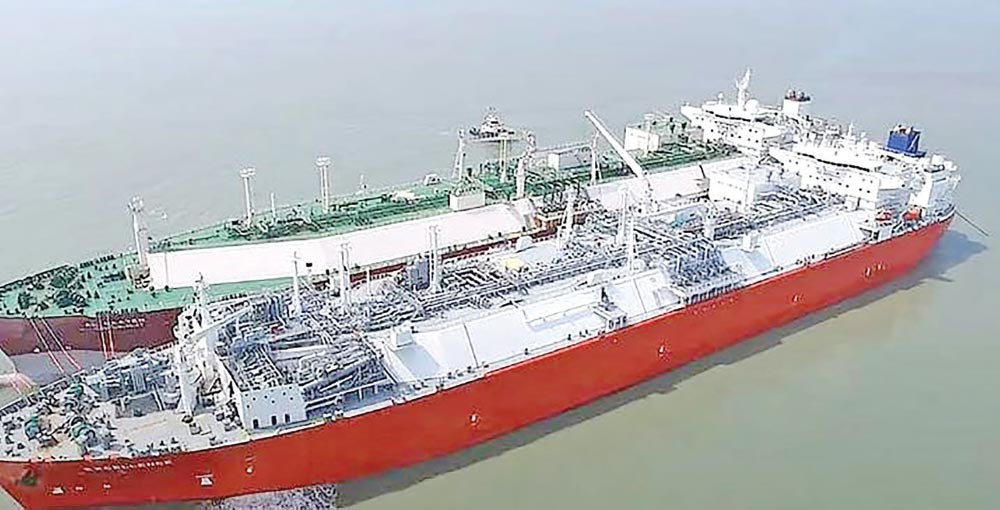 A Chinese state-owned company has secured government approval to build and operate Bangladesh’s third floating LNG terminal at a cost of up to Tk 13,161 crore over 20 years, despite earlier concerns over the proposed project expenditure.
China National Energy Engineering and Construction Co Ltd (CNEE) will develop the floating storage and regasification unit (FSRU) at Kutubjom in Moheshkhali, Cox’s Bazar, under a government-to-government (G2G) arrangement. The project will cost Tk 12,324 crore under a 15-year agreement or Tk 13,161 crore under a 20-year deal.
Tk 13,161cr project approved despite earlier cost concerns
The approval came at a meeting of the Cabinet Committee on Government Purchase (CCGP), chaired by Finance Minister Amir Khosru Mahmud Chowdhury, on Thursday. The Finance Ministry disclosed the decision following the meeting.
The approval comes after the government returned an earlier proposal from the Chinese company in October, with discussions expected to focus on bringing down the project cost. However, the proposal has now been cleared without any reduction in the quoted expenditure.
According to documents from the Energy and Mineral Resources Division, CNEE was recommended as the selected bidder for the project. However, the approved proposal does not specify the final daily terminal charge, regasification capacity or a detailed timeline for commercial operation.
CNEE initially submitted its proposal on June 19, offering a daily regasification capacity of 600 million cubic feet (mmcfd), with a maximum capacity of 750 mmcfd. The company sought a daily terminal fee of $342,000 under a 15-year contract.
The proposed charge is considerably higher than the fees Bangladesh pays for its two existing floating LNG terminals. Excelerate Energy receives $254,000 per day, while Summit LNG receives $249,115. The proposed fee for the new facility is therefore around 35 to 37 per cent higher.
In a revised proposal submitted towards the end of October, CNEE reportedly indicated that the terminal could begin commercial operations by 2028. However, the approved documents do not spell out a firm implementation schedule.
GROWING DEPENDENCE ON IMPORTED LNG
The proposed terminal comes as Bangladesh struggles to meet its growing demand for natural gas. Daily demand stands at around 3,800 mmcfd, while domestic production and imported LNG together supply approximately 2,700 mmcfd under normal conditions, leaving a shortfall of about 1,100 mmcfd.
The country currently operates two floating LNG terminals, both located in Moheshkhali. Excelerate Energy's facility has a regasification capacity of 600 mmcfd, while Summit LNG can process 500 mmcfd.
Any disruption at either facility can put considerable pressure on the national gas supply system, highlighting the need for additional import infrastructure.
Against this backdrop, the government plans to establish three to four more floating LNG terminals, with potential investors from China, the United States and South Korea expressing interest.
On September 7, US Ambassador to Bangladesh Brent T Christensen emphasised the need for a transparent and competitive process for FSRU projects during a meeting with Commerce Minister Khandaker Abdul Muktadir at the FBCCI office in Dhaka.
The ambassador said US companies were keen to invest in Bangladesh. In response, the commerce minister said proposals from American companies would receive the highest priority if they could demonstrate their ability to build terminals within the shortest possible time.
Despite interest from several countries, the first approval for the proposed third terminal has gone to China's CNEE.
FIVE LNG CARGOES APPROVED FOR 2027
Alongside the terminal project, the government has approved the import of five LNG cargoes from Oman and Malaysia in 2027 to strengthen the country's gas supply.
At Thursday's CCGP meeting, the committee recommended the import of three cargoes from Oman's OQ Trading Limited (OQT) and two from Malaysia's Pentitude Energy Sdn Bhd.
The three OQ Trading cargoes will be imported under Bangladesh's existing long-term and short-term agreements with Oman, with three separate side letters to be signed under the G2G arrangement.
For the two cargoes from Malaysia's Pentitude Energy, the agreed price is $0.18 per million British thermal units (MMBtu) below the Japan-Korea Marker (JKM) benchmark. The agreement also allows the number of cargoes to be increased or reduced by mutual consent.
In addition, the Cabinet Committee on Economic Affairs gave in-principle approval to three proposals for direct LNG purchases from Japan's Markets, the UAE's ADNOC Trading and Nigeria's Ozimadu and Merites Oil Marketing Limited.
The proposal involving Japan's Markets concerns short-term LNG purchases by Petrobangla, while the other two involve direct procurement from the respective companies.
The purchases will be made under the direct procurement provisions of the Public Procurement Act, without competitive tenders. However, the proposals have received only in-principle approval, with their prices and quantities to be placed before the CCGP for final approval.
The two cabinet committees have thus approved or given in-principle consent to five LNG procurement proposals amid concerns over energy supplies following the conflict in West Asia.
The CCGP also approved proposals relating to date imports ahead of Ramadan, fertiliser procurement and purchases for several infrastructure development projects.
While the new terminal and additional LNG imports are expected to strengthen Bangladesh's energy security, the proposed terminal fee and overall project cost raise questions about the financial implications of expanding the country's dependence on imported gas.

Loading...
Loading...
Also read



Editor : Iqbal Sobhan Chowdhury
Published by the Editor on behalf of the Observer Ltd. from Globe Printers, 24/A, New Eskaton Road, Ramna, Dhaka.
Editorial, News and Commercial Offices : Aziz Bhaban (2nd floor), 93, Motijheel C/A, Dhaka-1000.
Phone: PABX- 41053001-06; Advertisement: 41053012; 01793317829, 01550707291, 01550707296
E-mail: [email protected], [email protected]. [email protected], [email protected], [email protected], [email protected], Online-email: [email protected]


