



| HEADLINE |

|

Joint efforts key to solving national problems: Mahdi Amin
Published : Thursday, 5 November, 2026 at 7:35 PM
Observer Online Report


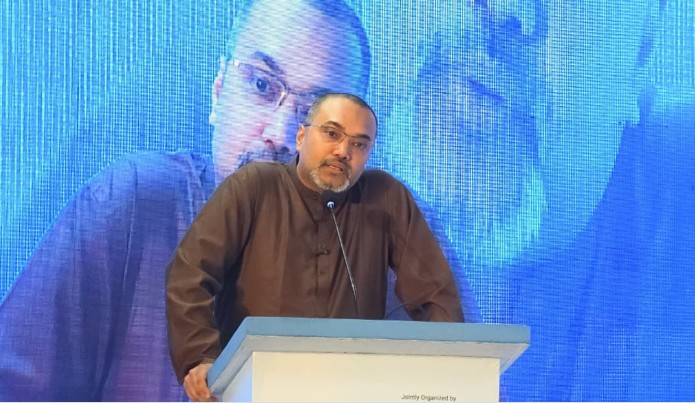
Prime Minister’s Adviser on Education and Primary and Mass Education Mahdi Amin has said that effective solutions to the country's existing real-world problems are possible only through coordinated efforts among industry, academia and the government.
The spokesperson for the Prime Minister's Office said there is no alternative to public-private partnerships and collaboration between academia and industry for the overall development of the education system. The primary objective of teaching, research and any project should be to find effective solutions to real-world problems.
He said the country still depends on imported products, foreign consultants and international assistance to address various challenges, although it is entirely possible to develop local solutions by utilising the country's bright and talented minds.
Mahdi Amin made the remarks while addressing the 'Bangladesh AI Business Summit 2026' as the chief guest at the Bangladesh-China Friendship Conference Centre in the capital on Thursday (November 5).
The session, titled 'Connecting Industry and Academia: AI's Transformation Towards Business Innovation', was jointly organised by the Ministry of Science and Technology and the Dhaka Chamber of Commerce and Industry (DCCI).
Mahdi Amin also said, the government was providing various startup funds and grants to promote innovative ideas emerging from educational institutions. He added that initiatives were also underway to provide seed capital for promising ventures by people working outside the formal education system and in the informal economy.
He said the government would build a sustainable national industrial ecosystem by bringing together large industries and small and medium-sized entrepreneurs.
Referring to the July Mass Uprising, he said the government, which took office with a direct public mandate after a prolonged struggle, was committed to ensuring equality, human dignity and social justice.
Political identity should not be the primary consideration in achieving these goals, he said, adding that everyone must work together in the national interest and to protect the country's sovereignty.
The Prime Minister's adviser called on academia and industry to work together to develop local solutions to various challenges, including traffic congestion, increased agricultural productivity, modern farming based on weather forecasts and higher industrial production.
He said there was no obligation for such innovative solutions to come exclusively from universities in Dhaka. Many leading universities and talented students outside the capital were also developing promising initiatives.
He stressed the need to establish effective links between local businesses and industries and educational institutions at the district level.
Highlighting the growing influence of artificial intelligence, robotics and machine learning across the world, Mahdi Amin said technological changes might reduce some traditional jobs but would also create numerous new employment opportunities, ranging from data annotation to AI applications.
He said substantial employment opportunities could be created for young people if the curriculum were made more relevant to changing times and practical needs.
The government's primary goal is to ensure that technology is used for human welfare through a positive and responsible approach, he added.
Referring to Prime Minister Tarique Rahman's two fundamental objectives for the education system, the adviser said the first was to develop students into good citizens and ideal human beings who uphold ethics, social values and human dignity.
The second objective was to equip students with professional skills so they could make the most of opportunities in the workplace or as entrepreneurs.
Not everyone needs to become a doctor, engineer or researcher, he said, adding that many people might have particular talents in sports, culture and technical education.
In this regard, he said the new government had decided to create alternative career opportunities for students who fall behind in SSC and HSC examinations through technical education and language training.
The government's responsibility is to ensure equal opportunities based on merit and ability and help every citizen realise their potential, he added.
Speaking about brain drain, Mahdi Amin said many talented engineers, scientists, researchers and professionals from different fields were living abroad and successfully working at leading universities and multinational companies.
This demonstrated that the country did not lack talent; rather, the main challenge was the failure to create suitable opportunities and platforms at home for talented people to develop their potential, he said.
To address the situation, the government was taking specific initiatives to transform 'brain drain' into 'brain circulation', Mahdi Amin said.
He added that the government would create opportunities for talented Bangladeshis living abroad to contribute directly to the country's development.
Elaborating on the proposed new ecosystem, he said initiatives would be taken to enable expatriate entrepreneurs to invest in Bangladesh easily and allow researchers and teachers to conduct joint research with local universities.
The government was also working to create a strong environment where successful international academics could return to the country and work comfortably, he added.
Mahdi Amin said the immense energy, enthusiasm and talent of the younger generation were the country's greatest strengths.
He said the government's top priority was to transform the country's large youth population into an effective workforce and a generation of entrepreneurs through appropriate policies and incentives during this period of demographic dividend.
Calling on all to unite in building a transparent and accountable state that reflects the aspirations of young people, he said other government departments would also work with the private sector to reform and implement policies through coordinated efforts, following the example of the partnership between the Ministry of Science and Technology and the private sector.
The seminar was moderated by former DCCI president Rizwan Rahman.
Others who spoke at the event included Transcom Group Chief Executive Officer (CEO) Simeen Rahman, Apex Footwear Ltd Managing Director and FLAX president Syed Nasim Manzur, Dhaka University CSE Department Chairman Professor Dr Md Abdur Razzaque, Foreign Ministry Director General (International Trade, Investment and Technology) Dr Syed Muntasir Mamun, BUET student and Nevoline CEO Md Rahinur Rahman, IUT student and Ants CEO Tousif Islam, and AIUB CSE Department Head Professor Dr Mohammad Firoz Mridha.
-MT

Loading...
Loading...
Also read








Editor : Iqbal Sobhan Chowdhury
Published by the Editor on behalf of the Observer Ltd. from Globe Printers, 24/A, New Eskaton Road, Ramna, Dhaka.
Editorial, News and Commercial Offices : Aziz Bhaban (2nd floor), 93, Motijheel C/A, Dhaka-1000.
Phone: PABX- 41053001-06; Advertisement: 41053012; 01793317829, 01550707291, 01550707296
E-mail: [email protected], [email protected]. [email protected], [email protected], [email protected], [email protected], Online-email: [email protected]


