



| HEADLINE |

|

RMG wage war forces over 500 units to close
Published : Tuesday, 3 November, 2026 at 12:00 AM
Savar, Gazipur Correspondents


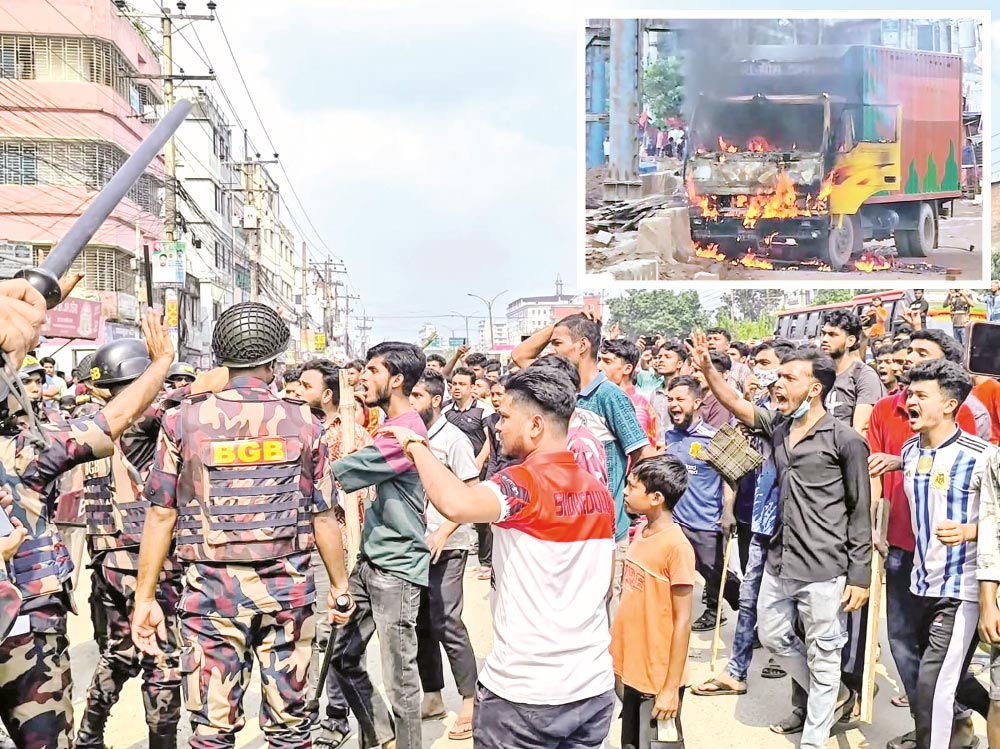 The garment workers' wage movement escalated into widespread unrest across the country's major industrial belts on Monday, forcing more than 500 factories in Gazipur, Savar and Ashulia to declare general holidays amid road blockades, clashes, vandalism and arson.
Workers demanding a minimum monthly wage of Tk30,000 took to the streets in several industrial areas, disrupting production and traffic on major highways. Police responded with tear gas and sound grenades, while the government deployed Border Guard Bangladesh (BGB) personnel and executive magistrates to contain the situation.
Amid growing concerns over political interference and sabotage, police and government officials alleged that vested interests, including activists linked to the banned Awami League, were exploiting workers' grievances to destabilise the industrial sector. Labour leaders, however, warned against attempts to divert a legitimate wage movement and called for an urgent resolution of workers' demands.
* BGMEA, BKMEA blame for delaying formation of wage board
* MP Nazrul Islam Azad urges RMG workers not to fall prey to incitement
* Police allege ‘local-foreign conspiracy’ behind RMG unrest
* Home Minister Salahuddin warns of stern action against instigators
* BGIWF calls for pay rise from Jan, urges restraint
* Govt must take firm stance on RMG industry unrest: Jamaat Ameer
The unrest also prompted the government to warn of strict action against violence while assuring workers that a newly formed Minimum Wage Board would review their pay.
In Gazipur, protests spread across Konabari, Safipur, Mouchak, Pollibidyut, Chandra and Kaliakair from Monday morning. Workers blocked the Dhaka-Mymensingh Highway at Signboard, Chhaydana, Maleker Bari, Bhogra Bypass, Nagarpada and Dakshin Salna around 7:30am. Blockades were also reported at several points on the Dhaka-Tangail Highway.
Violence escalated at Nawjor in the afternoon when three police vehicles were vandalised and one was set on fire. Journalists were also attacked and a camera damaged. A BGB member was injured in clashes in Safipur, Chandra and Kaliakair.
Police fired tear gas and sound grenades to disperse protesters. The authorities deployed 10 platoons of BGB and 21 executive magistrates to strengthen security in the industrial areas.
Gazipur Industrial Police Superintendent Amzad Hossain said around 200 factories declared general holidays due to the unrest. Police filed three cases over vandalism and arson, naming around 4,000 people as accused. At least 30 people were arrested.
In Savar and Ashulia, protests spread across Baroipara, Nishchintapur, Zirabo, Kathgara, Ghoshbagh and Narsinghpur. Clashes between workers and police involved stone-throwing and chasing and counter-chasing, leaving a police member injured. Police fired tear gas to restore order.
At around 12:15pm, a covered van was set on fire in front of Nadi Filling Station in Narsinghpur.
Superintendent of Police Mohammad Mominul Islam Bhuiyan of Industrial Police-1 said around 300 factories in Savar and Ashulia had declared general holidays. Additional police personnel were deployed, and two workers were detained in connection with the incident.
In Narayanganj, garment workers blocked the Dhaka-Narayanganj Link Road at Katherpul, demanding a minimum monthly wage of Tk30,000. Workers from Metro Knitting, Palmal Garments, Abir Fashion and Azad-Rifat Dyeing joined the demonstration, bringing traffic to a standstill.
The workers said soaring prices of food, housing, transport and other essentials had made it increasingly difficult to support their families on existing wages. They demanded an announcement of the revised wage rather than merely the formation of a wage board.
Narayanganj Correspondent adds: BNP lawmaker Nazrul Islam Azad intervened on Monday to end a three-and-a-half-hour blockade of the Dhaka-Narayanganj Link Road by garment workers demanding a minimum monthly wage of Tk30,000.
Workers from factories in Shibu Market, Katherpul and surrounding areas occupied both sides of the road and the overpass around noon, bringing traffic to a standstill. The protest reportedly followed a clash at a garment factory in Bhuigarh over workers leaving the facility.
The blockade left hundreds of vehicles stranded along an eight-kilometre stretch, causing immense hardship for commuters and pedestrians.
"We cannot survive on our existing wages amid soaring commodity prices. We shop at the same markets as government officials. If their salaries can be increased, why can't ours? We will not leave the streets until our minimum wage is raised to Tk30,000," worker Hasanur Rahman told reporters.
Another worker, Nur Alam, echoed the demand, stating, "We cannot make ends meet with our current wages. Our minimum wage must be Tk30,000."
The situation eased around 4:00pm after Azad, MP for Narayanganj-2 and BNP's Dhaka divisional co-organising secretary, joined district administration and police officials in persuading the workers to withdraw the blockade.
Addressing the protesters, lawmaker Azad urged them not to fall prey to provocation, adding, "This government came to power with the support of the working people. We stand by you."
Deputy Commissioner Md Raihan Kabir assured the agitators that their demands would be conveyed to the government and a reasonable solution sought through consultation with stakeholders.
Superintendent of Police Md Habibur Rahman urged the workers to remain patient, noting that the government had already formed a Wage Board.
Traffic movement gradually returned to normal after the blockade was withdrawn.
Meanwhile, the Dhaka Metropolitan Police's Detective Branch (DB) said 11 activists of the Awami League, Jubo League and Chhatra League were among those detained.
The DB alleged that a section of local activists of the banned Awami League had planned to exploit the workers' movement to create violence, claiming the detainees were not local garment workers.
DMP Joint Commissioner (Crime and Operations, North) Md Mahidul Islam said those attempting to disrupt law and order, threaten public safety or damage state property would be treated as criminals and brought to justice.
A Dhaka court sent 26 people to jail in three separate cases over attacks on police, vandalism, crude bomb explosions and arson during garment workers' protests in Mirpur on Sunday.
Thirteen were sent to jail in a case filed with Pallabi Police Station under the Anti-Terrorism Act, while seven were remanded to jail in another Pallabi case under the Explosives Act and different sections of the Penal Code.
The remaining six were sent to jail in a case filed with Mirpur Model Police Station under the Anti-Terrorism Act.
Police allege conspiracy
Senior police officials have alleged that vested interests, backed by local and foreign conspiracies, were instigating the unrest in Savar and Ashulia to destabilise the industrial belt.
Dhaka Range Deputy Inspector General (DIG) Md Mostafizur Rahman and Dhaka District Superintendent of Police Shamima Parveen made the allegations after inspecting the situation on Monday.
The DIG said police had intelligence about groups seeking to create instability despite the formation of a wage board. Their identities and motives were being verified, he said, warning that anyone involved in violence would face legal action regardless of political affiliation.
SP Shamima said police were analysing CCTV footage, journalists' videos and intelligence reports to identify people wearing helmets and masks during the protests. Several people had already been arrested, while outsiders had allegedly infiltrated workers' groups and engaged in vandalism.
She claimed advance intelligence and police operations had prevented major damage in Savar, Ashulia, the Export Processing Zone and Hemayetpur. Police were coordinating with industrial police, the Bangladesh Garment Manufacturers and Exporters Association (BGMEA) and factory owners to maintain security.
The SP said factories remaining closed had declared holidays on their own rather than due to security concerns. She urged workers to return to their jobs and avoid being misled by instigators.
The police officials said the formation of the wage board demonstrated the government's commitment to addressing workers' demands, but alleged that other groups had ulterior motives behind the continuing violence.
Home minister warns of strict action
Home Minister Salahuddin Ahmed warned that the government would take strict legal action against individuals and groups attempting to exploit workers' movements to create unrest in the garment sector.
He alleged that some factory owners, former lawmakers and ministers linked to the Awami League government, and individuals operating under labour organisations were using workers' grievances for political purposes.
Speaking to journalists at the Secretariat after meetings with BGMEA and Bangladesh Knitwear Manufacturers and Exporters Association (BKMEA) leaders on Monday, the minister said the government had collected video footage, audio recordings and other evidence of the incidents.
He claimed some industrialists with political links to the Awami League were behind the unrest and that groups supporting the ousted government were exploiting workers through highway blockades, arson and violence.
The minister also alleged that some factory owners had deliberately shut their establishments to aggravate the situation. BGMEA and BKMEA leaders had agreed to provide lists of factories suspected of being closed with ulterior motives, he said.
The government had initially sought to resolve the disputes through dialogue, although intelligence agencies had warned of possible unrest earlier. The Home Ministry had alerted the Labour Ministry about the possibility of such developments on October 18, he added.
Salahuddin said the government had now instructed law enforcement agencies to take firm action against those inciting violence or disrupting public order.
On workers' wage demands, he said the government had formed a wage board after receiving nominations from both employers and workers. The board was expected to begin its work shortly and recommend a revised minimum wage through consultations with stakeholders.
The existing minimum monthly wage is Tk12,500, while workers are demanding Tk30,000, citing rising living costs.
The minister said Prime Minister Tarique Rahman had instructed the authorities to consider workers' welfare, living standards and the actual condition of the garment industry while determining the new wage structure.
He said the government hoped to announce the revised wage within the stipulated timeframe, possibly by December, and urged factory owners to settle disputes through dialogue and keep their establishments operational.
To prevent further unrest, the Home Ministry, police and garment owners' associations had designated focal points for continuous communication. Police Headquarters would also establish a control room to monitor industrial areas round the clock through the Surakkha app.
Salahuddin said around 145 factories in Kaliakair and Gazipur had reopened on Monday after remaining closed for a day on Sunday. Some others remained shut because of financial difficulties and declining export orders, and the government would assist those seeking support to resume operations.
He also dismissed concerns about possible unrest in December, saying the government would not allow anyone to destabilise the country in any month.
Workers' representatives promise January wage implementation
Meanwhile, worker representatives on the six-member Minimum Wage Board pledged to ensure that the revised wage structure takes effect from January 2027, regardless of the amount eventually fixed.
At a press conference at the Labour Building in Dhaka, worker representative Babul Akhter said they wanted garment workers to receive the revised wages with their January salaries.
"There is no reason for us to delay; we are mentally prepared," he said.
He said the new wage structure should reflect inflation, the actual cost of living, families' basic needs and the overall condition of the garment industry.
Babul Akhter, general secretary of the Bangladesh Garment and Industrial Workers Federation (BGIWF), and permanent worker representative Anwar Hossain said they would consult all labour federations, factory-level trade unions and workers before preparing a common proposal for the board.
They said the process would be consensus-driven and would seek to improve workers' living standards rather than merely announce a new wage figure.
The representatives urged workers to remain patient, maintain peace and return to work, assuring them that their demands would be placed before the board.
They also demanded the immediate release of workers and labour leaders detained over the protests and withdrawal of cases against those involved in peaceful demonstrations. They urged employers not to dismiss, harass or blacklist workers for participating in the movement.
The representatives blamed the lack of effective trade unions in many factories for leaving workers' grievances unresolved. They said stronger workplace-level dialogue was essential to prevent disputes from escalating and allowing third parties to exploit them.
The government formed the six-member Minimum Wage Board on Sunday following protests over higher wages. Senior District and Sessions Judge Sheikh Ashfaqur Rahman was appointed chairman. Its members are employer representatives ABM Shamsuddin and Asif Ayub, worker representatives Babul Akhter and Anwar Hossain, and independent member Professor Mosleh Uddin Ahmed of the University of Dhaka.
Labour leaders warn against diversion of movement
Labour leaders have expressed concern that outsiders and politically motivated groups are exploiting the wage movement, potentially diverting it from workers' legitimate demands.
Nazma Akter, president of the Sammilito Garment Sramik Federation, told the Daily Observer that street vendors and other outsiders had joined demonstrations in some areas. She also raised concerns about fake videos, reportedly generated using artificial intelligence, showing protests that never occurred.
Referring to the unrest in Gazipur, she said some people with only six months to one year of factory experience appeared to be leading demonstrations. She also alleged that outsiders had entered factories, assaulted workers and forced them to join protests.
Nazma blamed delays by BGMEA and BKMEA in submitting nominees for the wage board for slowing down the wage-review process.
Under the 2026 amendment to the Bangladesh Labour Act, 2006, the interval for reviewing minimum wages has been reduced from five years to three years. The last RMG minimum wage was announced in November 2023.
However, she noted that the law requires a wage review every three years; it does not necessarily require the formation of a new wage board at every interval. The government may reconstitute the board when necessary.
Nazma said workers' demands for higher wages and other rights were legitimate, but protests should not lead to attacks on factories, vandalism or production stoppages.
She warned that production disruptions and delayed shipments could prompt international buyers to shift orders to competing countries, ultimately threatening workers' jobs and incomes.
Claiming that India had received 15�"20 per cent more orders than Bangladesh, she also pointed to industrial-zone development initiatives in Bihar and Odisha.
She urged workers to press their demands through the wage board and called for a clear timeframe for implementing the revised structure.
Mahdi Amin, the Prime Minister's Adviser on Education and Primary and Mass Education, also alleged that associates of the ousted regime were using incitement and sabotage to destabilise the garment industry.
In a Facebook post on Monday, he said the government had taken steps to determine wages on time, but a particular group was trying to create unrest.
Opposition leader calls for firm action
Jamaat-e-Islami Ameer and Leader of the Opposition Dr Shafiqur Rahman urged the government to take firm action to stop violence and vandalism in the garment industry.
In a post on his verified Facebook page on Monday, he said neither factory owners nor workers could establish their rights by destroying industrial establishments.
He expressed concern that vested interests and conspirators might be exploiting the situation to destabilise the sector.
Referring to reports that around 600 factories had been declared closed, he warned that attempts to undermine the industry ahead of the winter season could not be ruled out.
He urged factory owners, workers and other stakeholders to remain cautious and resolve disputes without damaging the country's vital export industry.
The widening unrest has exposed deep-seated wage grievances as well as allegations of political interference and sabotage.
While workers are demanding a substantial pay increase amid rising living costs, employers and the government face growing pressure to maintain production and protect export orders.
An early, credible wage decision, protection of workers' rights and an impartial investigation into allegations of violence and outside interference will be crucial to restoring industrial stability.

Loading...
Loading...
Also read



Editor : Iqbal Sobhan Chowdhury
Published by the Editor on behalf of the Observer Ltd. from Globe Printers, 24/A, New Eskaton Road, Ramna, Dhaka.
Editorial, News and Commercial Offices : Aziz Bhaban (2nd floor), 93, Motijheel C/A, Dhaka-1000.
Phone: PABX- 41053001-06; Advertisement: 41053012; 01793317829, 01550707291, 01550707296
E-mail: [email protected], [email protected]. [email protected], [email protected], [email protected], [email protected], Online-email: [email protected]


