



| HEADLINE |

|

How Prepared Is Bangladesh during the Extended LDC Graduation Period
Published : Tuesday, 3 November, 2026 at 12:00 AM
Talukder Monjur Elahi


 During the 81st session of the United Nations General Assembly on October 29, the preparatory period for Bangladesh’s graduation from the Least Developed Country (LDC) category was extended by three years, setting the new deadline at November 24, 2029. The decision took into account recent political transitions, disruptions to international energy and supply chains, and uncertainty in global trade. Although the extension offers additional time, Bangladesh must make significant progress in addressing its structural weaknesses. Priority should be given to domestic reforms, implementing a smooth transition strategy and strengthening coordination with UN agencies and bilateral, regional and multilateral development partners. The government must also regularly update the United Nations Committee for Development Policy (CDP) on progress. The main challenge is to strengthen economic capacity and prepare for the opportunities and risks that will follow graduation.
In the 1960s, the United Nations classified countries as developing or developed and designated the most disadvantaged developing nations as least developed, with a timeline for graduation from this category. Bangladesh joined the LDC list in 1975 through the UN Economic and Social Council (ECOSOC). The CDP, established by ECOSOC, reviews countries’ eligibility for graduation every three years. During the 2018 and 2021 reviews, Bangladesh met the criteria for three indicators: Gross National Income (GNI), the Human Assets Index (HAI) and the Economic Vulnerability Index (EVI). On November 24, 2021, the UN General Assembly scheduled Bangladesh’s graduation for November 24, 2026. The timeline was subsequently deferred by two years because of the COVID-19 pandemic, followed by the latest three-year extension. This is a significant diplomatic achievement, but the additional time must be used to address economic vulnerabilities and ensure a sustainable transition. The government should formulate a realistic, time-bound action plan and prepare for the challenges ahead.
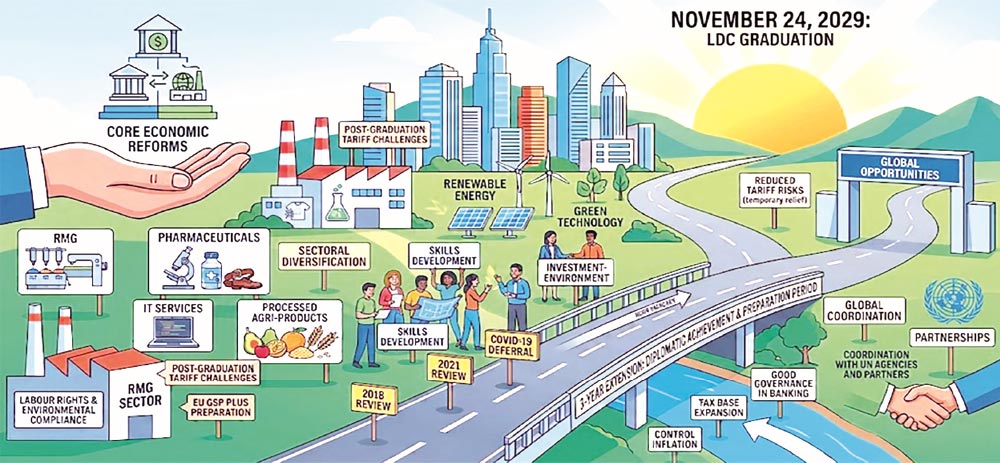 The extension provides temporary relief from the risk of an average 12.50 per cent tariff on Bangladeshi exports. As an LDC, Bangladesh currently enjoys duty-free market access in 38 countries and trade blocs, covering 73 per cent of total exports. Graduation, however, will bring both opportunities and challenges. The loss of preferential trade facilities, possible pressure on foreign exchange reserves, stagnant exports, reduced incentives and supply-chain disruptions could affect economic growth. Global instability, including the Russia-Ukraine war, tensions in the Middle East and worldwide inflation, has further complicated the outlook. Therefore, macroeconomic stability must remain the government’s foremost priority. Controlling inflation, increasing revenue collection, improving the balance of external payments and ensuring good governance in the banking sector are essential. The government must also expand the tax base, make taxation transparent and equitable, recover defaulted loans, strengthen discipline in loan disbursement and ensure accountability for financial irregularities. Without progress in these areas, the transition will become harder to manage.
By 2029, Bangladesh must build an economy capable of sustaining export competitiveness, employment and development even after LDC-specific benefits decline. The government should identify the institutions responsible for individual reforms, set implementation deadlines and establish clear mechanisms to evaluate progress. This is particularly important because the UN decision requires regular updates on the national smooth transition strategy. Following graduation, 74 per cent of Bangladesh’s exports will face changes in their access to global markets. The ready-made garment (RMG) sector, which accounts for a significant share of export earnings, will face particular pressure from changes in tariff preferences. The EU is expected to apply stringent trade regulations, including a two-tier transition mechanism and automatic safeguard clauses, to garment exports. The pharmaceutical sector also faces challenges. Bangladesh currently enjoys special exemptions under international intellectual property rights regulations as an LDC. Losing these benefits could raise the costs of producing patented medicines, transferring technology and conducting research, affecting product prices and international competitiveness. Changes in access to development assistance and concessional loans may also affect financing. Nevertheless, the extended period offers time to prepare for changes in intellectual property rights and conclude free trade agreements. Reforms in business, trade and the wider economy must proceed concurrently.
Export diversification is equally essential. Alongside garments, Bangladesh should expand pharmaceuticals, leather goods, processed agricultural products, light engineering and IT services. Exploring new markets and improving product quality will help exporters meet international demand. At the same time, the government must ensure compliance with labour rights and environmental standards, provide reliable energy and better transport infrastructure, and reduce the cost of doing business. Small and medium-sized enterprises need support in technology, skills development and financing to access new markets. Simplifying business registration and creating an investment-friendly environment will also encourage investment and lower production costs. Moreover, greater attention should go to renewable energy, green technology and climate preparedness.
Bangladesh must strengthen its ability to benefit from trade agreements after graduation, including by pursuing GSP Plus status in the EU market and seeking accession to the Regional Comprehensive Economic Partnership (RCEP). Advance discussions with major export markets should address possible tariff changes, rules of origin and post-graduation market access. Better productivity, product quality and industrial capacity will be essential to benefit from these arrangements.
Graduation to developing-country status will strengthen Bangladesh’s global standing and may make it more attractive to international investors. It can create new opportunities for industrialisation and infrastructure development while encouraging product diversification and higher quality. Proper skills development and training can also turn the country's young population into a valuable asset during this transition. Ultimately, the three-year extension will prove worthwhile only if the government uses it to implement timely, coordinated reforms and strengthen economic capacity. If Bangladesh can build a more resilient and competitive economy by 2029, it will be better prepared to overcome the challenges and seize the opportunities that follow LDC graduation.
The writer is a banker

Loading...
Loading...
Also read



Editor : Iqbal Sobhan Chowdhury
Published by the Editor on behalf of the Observer Ltd. from Globe Printers, 24/A, New Eskaton Road, Ramna, Dhaka.
Editorial, News and Commercial Offices : Aziz Bhaban (2nd floor), 93, Motijheel C/A, Dhaka-1000.
Phone: PABX- 41053001-06; Advertisement: 41053012; 01793317829, 01550707291, 01550707296
E-mail: [email protected], [email protected]. [email protected], [email protected], [email protected], [email protected], Online-email: [email protected]


