



| HEADLINE |

|

Mob killings expose law and order crisis


 At 4am on Tuesday, 32-year-old pickup driver Jony received a phone call from a friend asking him to meet in Kajla, in Dhaka’s Jatrabari area. The meeting ended in a beating that left him dead.
Their deaths, allegedly at the hands of people who suspected them of mugging, offer another glimpse into a disturbing pattern of violence spreading across Bangladesh: allegations are increasingly being settled through beatings and killings, often before police can establish what happened.
The circumstances of Tuesday’s attacks remain disputed. Nishat’s sister, Sharmin Akter, alleged that seven to eight people, including a locally influential man named Harun, were involved. She claimed the killings were driven by previous enmity and said their father was also assaulted when he arrived.
Police gave a different account. Sub-Inspector Hasan Kabir of Jatrabari Police Station said two suspects in a mugging incident had been caught and beaten by locals, while others escaped.
The killings came six days after Alam Sheikh was beaten to death on the premises of Shaheed Suhrawardy Hospital on October 21 after being suspected of kidnapping.
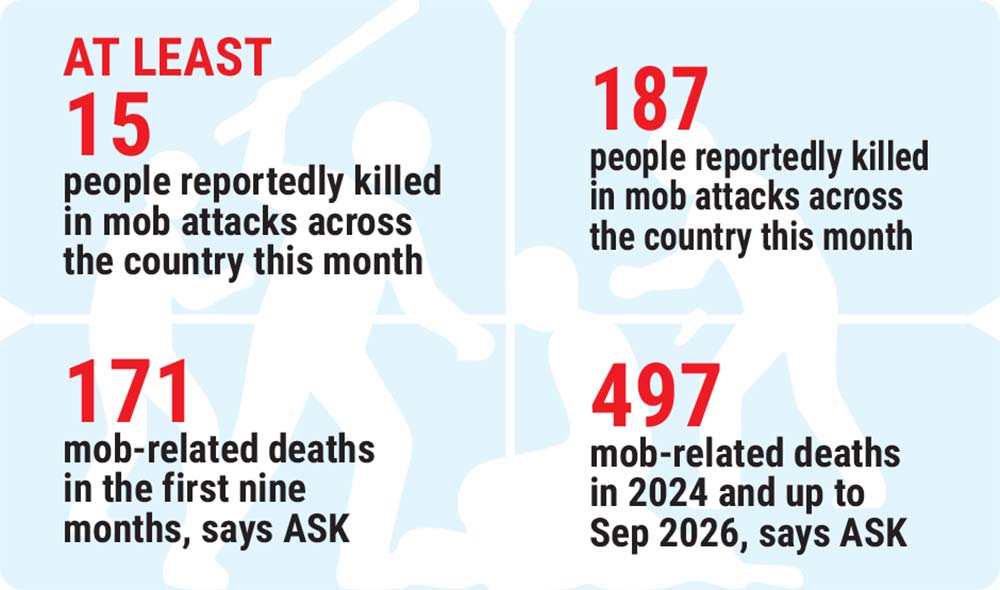
At least 15 people have reportedly died in mob attacks across the country this month. The incidents raise serious questions about why allegations of crime, personal disputes and political or social hostility so frequently end in public killings.
Rights activist Nur Khan Liton described the phenomenon as something more serious than mob beating.
“What is being called mob beating is actually mob violence, or outright terrorism,” he told The Daily Observer, blaming the persistence of such attacks on the failure of law enforcement agencies to act effectively.
The scale of the problem is difficult to establish, partly because official figures differ sharply from independent human rights records.
A Home Ministry report released on October 20, based on Police Headquarters data, recorded 40 deaths in 63 mob-beating incidents between January and September this year. During the same period in 2025, it recorded 63 deaths in 107 incidents.
But Ain o Salish Kendra (ASK) documented 171 deaths in the first nine months of this year. The Human Rights Support Society (HRSS) reported an even higher toll of 187 deaths and 401 injuries in 398 incidents.
ASK recorded 128 mob-related deaths in 2024 and 198 in 2025. Its additional 171 deaths through September this year bring the organisation's documented toll to 497 over the period.
On October 13, Wahiduzzaman Shamim, 38, was rescued by police after being beaten in Satkhira over allegations that he had hurt religious sentiments. But attackers allegedly took him away from hospital and assaulted him again. He died while being transported to another healthcare facility.
In Bhola, 25-year-old Md Hasib died in hospital after being beaten by a mob following an alleged knife attack on a local BNP leader. Police said the incident appeared to have stemmed from previous enmity.
University campuses have also witnessed deadly attacks, with investigations and arrests in several cases moving slowly.
At Dhaka University, Tofazzal Hossain was beaten to death on September 18, 2024, over suspicion of theft. An initial chargesheet named 21 people, followed by a supplementary chargesheet identifying 28. A court issued arrest warrants against 22 accused this year, but only six have been arrested.
On the same day, former Chhatra League leader Shamim Ahmed, known as Shamim Molla, was beaten to death at Jahangirnagar University. The Police Bureau of Investigation has yet to submit its investigation report.
For rights campaigners, these cases point to a cycle in which violence is followed by investigations that struggle to deliver accountability.
Nur Khan said people were increasingly being attacked over land disputes, personal enmities and political rivalries, while many accused secured bail after arrest.
Tawhidul Hoque, an associate professor at Dhaka University's Institute of Social Welfare and Research, said declining confidence in state institutions was encouraging people to take the law into their own hands.
“When people lose confidence that the state will protect them, the tendency to take justice into their own hands increases,” he said.
Home Minister Salahuddin Ahmed pledged firm action against mob violence on September 1, saying existing laws were sufficient to prosecute perpetrators.

Loading...
Loading...
Also read



Editor : Iqbal Sobhan Chowdhury
Published by the Editor on behalf of the Observer Ltd. from Globe Printers, 24/A, New Eskaton Road, Ramna, Dhaka.
Editorial, News and Commercial Offices : Aziz Bhaban (2nd floor), 93, Motijheel C/A, Dhaka-1000.
Phone: PABX- 41053001-06; Advertisement: 41053012; 01793317829, 01550707291, 01550707296
E-mail: [email protected], [email protected]. [email protected], [email protected], [email protected], [email protected], Online-email: [email protected]


