



| HEADLINE |

|

Legal Vacuum Behind AI Driven Consumer Exploitation
Published : Saturday, 31 October, 2026 at 12:00 AM
Foyjunnesa Sharmin


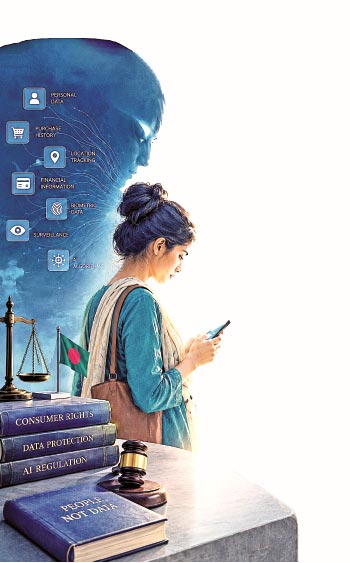 In the early era of digital adoption in Bangladesh, the revolution of usage of AI in daily life took place slowly. In case of e-commerce sector, consumers slowly built confidence in digital transactions, transitioning from physical marketplaces to virtual ones. Since then, AI has been offering unparalleled convenience and accessibility to people of all age. It has been influence our lives which opens the scope of abuse in data harvesting, corporate tracking and surveillance. The worst part is that the preventive AI laws and regulation is completely missing when it comes to abuse and consumers right.
On a positive note, Bangladesh has commenced addressing human rights under AI. In August, Bangladesh earned well-deserved international praise on the global stage. Leading a core group of nations at the United Nations Human Rights Council in Geneva, Bangladesh achieved a milestone by presenting a resolution on Artificial Intelligence. This landmarks resolution now needs to be expended to protect consumers’ right in order to balance consumers and tech companies interest of business.
Before digging deeper into the issue of consumers right, a brief explanation is needed that how AI is making a negative impact on consumers right. For instance, when a person log onto an e-commerce platform or digital service, that individual is almost always greeted by a familiar pop-up. To proceed, you must click a button that says, “I agree to the Terms and Conditions.” It feels like a choice, but it isn’t.
For the average consumer, it is a forced choice. Let’s say, if you refuse to let these host technologies harvest, track, and store your personal data, you are completely locked out of the digital economy. According to BTRC, there were over 130 million internet users in Bangladesh as of January 2024, with approximately 40 million active online shoppers. In a country gradually moving away from cash and physical stores, consumers find themselves trapped: either surrender your digital privacy or be left behind in the pre-digital past.
This helplessness was brought into sharp focus by a startling incident. Fearing the cyber-security vulnerability, the Bangladesh Bank followed closely by commercial institutions like Janata Bank and Bengal Commercial Bank took its entire public website completely offline for days. Moreover, the recent temporarily suspended online National Identity Card (NID) services and closed the main server as a precaution against cyber-attack risks related to critical PHP software vulnerabilities, is indicating the position of government to address and handle this issue.
When an e-commerce platform or financial node faces a cyber-attack, there is no transparency. Customers are not guaranteed that their personal information, transaction history, phone numbers, or national ID details are safe. Instead, the ultimate security response is a digital blackout, hidden behind a generic “scheduled maintenance” screen.
This leaves the citizen in a state of constant digital vulnerability. If a massive data breach occurs during a hack, the consumer is usually the last to know, leaving them exposed to predatory identity theft, financial fraud, and targeted scams.
The root of this crisis lies in our existing legal framework. The Consumers’ Rights Protection Act, 2009 was enacted to protect people from counterfeit goods and expired food in physical markets not to prevent algorithmic manipulation, forced data consent, or corporate cyber-security negligence.
If tech giants and financial institutions are going to force consumers to hand over their personal data as a condition of entry, they must be legally bound to protect it. Hence, digital economy requires expended cyber defenses and mandatory data-breaching laws like the EU enacted “EU AI Act (Regulation (EU) 2024/1689)” to penalize violations.
Until the existing laws amended to include liabilities of abuse of AI, the aim to cope up with digital world will remain an illusion for citizens.

Loading...
Loading...
Also read






Editor : Iqbal Sobhan Chowdhury
Published by the Editor on behalf of the Observer Ltd. from Globe Printers, 24/A, New Eskaton Road, Ramna, Dhaka.
Editorial, News and Commercial Offices : Aziz Bhaban (2nd floor), 93, Motijheel C/A, Dhaka-1000.
Phone: PABX- 41053001-06; Advertisement: 41053012; 01793317829, 01550707291, 01550707296
E-mail: [email protected], [email protected]. [email protected], [email protected], [email protected], [email protected], Online-email: [email protected]


