



| HEADLINE |

|

Antarctica’s Blood Falls!
Published : Monday, 26 October, 2026 at 2:24 PM
Observer Online Report


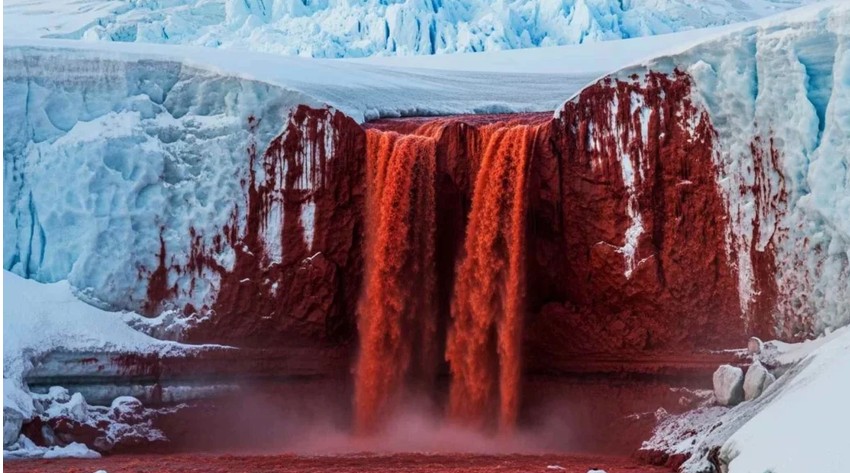
A striking crimson stream spilling across the white Antarctic landscape looks like something out of a horror film. But the eerie spectacle known as Blood Falls is no sign of blood or catastrophe. Instead, it is a remarkable natural phenomenon driven by chemistry, geology and microbial life beneath the ice.
Located at the edge of Taylor Glacier in Antarctica’s McMurdo Dry Valleys, Blood Falls stands out against the surrounding frozen terrain. Its deep red streaks flowing down the glacier have fascinated scientists for more than a century.
The unusual feature was first documented in 1911 by British geologist Thomas Griffith Taylor, after whom Taylor Glacier was named. The dramatic contrast between the red water and the surrounding white ice soon drew scientific attention, prompting researchers to investigate the source of its unusual colour.
Scientists have since traced the phenomenon to iron-rich, highly saline water trapped beneath the glacier. As the brine emerges through cracks in the ice and comes into contact with the air, its dissolved iron oxidises, producing reddish compounds similar to the rust that forms on exposed metal.
Despite its blood-like appearance, the water’s distinctive colour is therefore the result of a chemical reaction, not biological material. Research also suggests that the brine is linked to ancient seawater that became trapped beneath the ice over a long period.
But Blood Falls holds another scientific surprise beyond its dramatic colour. Beneath the glacier lies an environment characterised by extreme cold, darkness, high salinity and limited oxygen—conditions that make survival difficult for most forms of life.
Yet scientists have found evidence of microbial communities in this hidden ecosystem. Some of these microorganisms can obtain energy through chemical reactions involving iron and sulphur compounds, allowing them to survive without sunlight.
The discovery offers valuable insights into how life can persist in some of Earth's harshest environments. It has also attracted interest from scientists investigating whether similar microbial life could exist in other icy worlds, including environments on Mars where liquid water or chemically active brines may once have been present.
The flow at Blood Falls is not necessarily constant. Its behaviour is influenced by the movement of salty water beneath the glacier, the structure of the ice and the processes that allow the brine to reach the surface. Scientists continue to study these mechanisms to better understand how the unusual system operates.
What appears at first glance to be a chilling scene of blood pouring across a frozen landscape is, in reality, a window into a hidden world of chemical reactions and microscopic life. Blood Falls is a striking reminder that even beneath Antarctica's seemingly lifeless ice, nature can sustain processes that challenge our understanding of where and how life survives.

Loading...
Loading...
Also read









Editor : Iqbal Sobhan Chowdhury
Published by the Editor on behalf of the Observer Ltd. from Globe Printers, 24/A, New Eskaton Road, Ramna, Dhaka.
Editorial, News and Commercial Offices : Aziz Bhaban (2nd floor), 93, Motijheel C/A, Dhaka-1000.
Phone: PABX- 41053001-06; Advertisement: 41053012; 01793317829, 01550707291, E-mail: [email protected], [email protected] Online: email: [email protected] 41053014; 01550707297 Advertisement: 01550707296


