



| HEADLINE |

|

Police fall short of finding missing disabled people


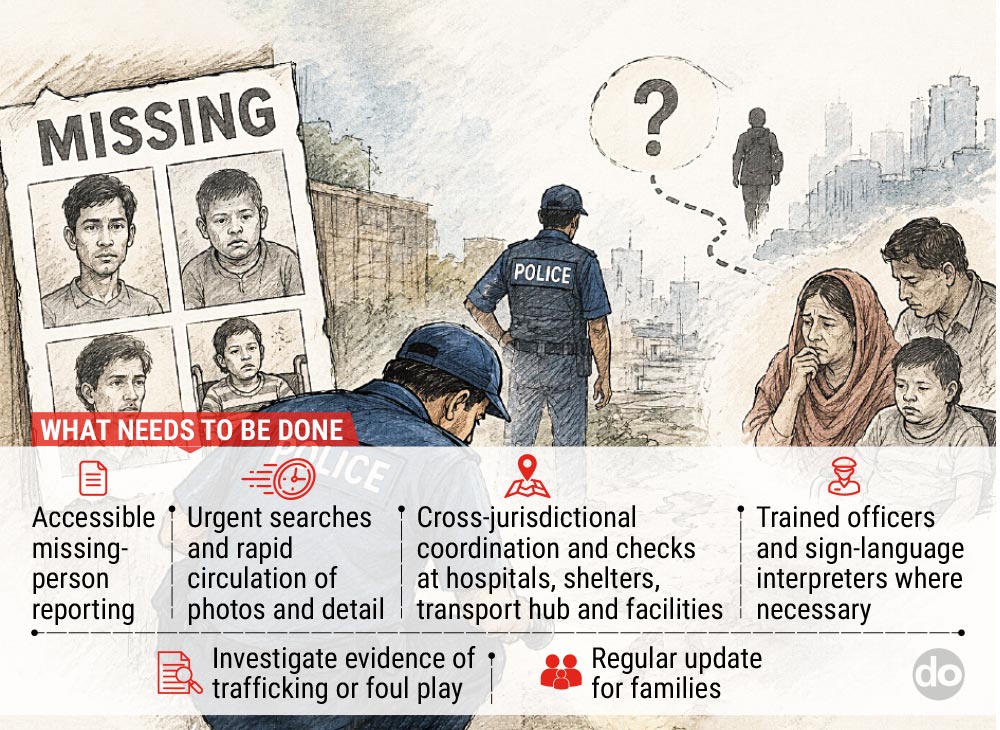 When Rajan Chandra Das, 42, went missing from Narinda Rishipara in Dhaka on September 14, his family began searching for him. Rajan has an intellectual disability and cannot speak. Unable to find him, the family lodged a General Diary (GD) at Gendaria Police Station on September 26. Nearly a month later, there was still no trace of him.
Sub-Inspector Ali Ashraf Jewel, the investigating officer, acknowledged the difficulties facing the search. “We could not obtain any footage from the location where he went missing. Furthermore, he does not use a mobile phone, and he is unable to speak.”
Police shared Rajan’s photograph and details on online platforms in the hope that someone would recognise him or provide information about his whereabouts. The officer also noted that his family could not offer leads about which direction he might have taken or other relevant information.
Rajan’s case highlights a wider concern: when missing persons cannot communicate or identify themselves, searches face added obstacles.
These barriers should heighten urgency, not diminish it. Reports of disappearances, suspicious deaths and suspected exploitation raise questions about whether families, communities and law enforcement adequately recognise the risks faced by persons with disabilities.
They may struggle to seek help, resist attacks or identify perpetrators, making them vulnerable to exploitation. Their absence may be dismissed as wandering away, delaying crucial action.
Recent cases are troubling. Saip Hasan, 13, went missing in Chapainawabganj on September 21, 2026, and was found dead in a ditch the next day. Fayez, 25, who had an intellectual disability, was found dead in water in Bhola on October 4, two days after disappearing. In Jashore, Emon Hossain, 24, who had speech and intellectual disabilities, was found dead in a ditch two days after going missing.
In 2019, Abu Bakkar, 7, was found beneath water hyacinths in a Faridpur canal; his cousin, Shawon Hossain Dindar, was identified as the killer. Physically disabled rickshaw driver Sohel Mia, 40, was found strangled in Narayanganj in 2016, and his vehicle was stolen. In 2024, Mofijul Islam strangled his physically disabled nephew, Rafiqul Islam, 38, in Comilla’s Burichong and staged a robbery.
In Sylhet’s Beanibazar, Emon Ahmad, 20, who had an intellectual disability, was found bound and dead in 2025, three days after disappearing. Ashraful Islam, 22, was identified as the alleged perpetrator and accused of killing him to steal an iPhone sent by his elder brother abroad.
These cases demonstrate that persons with disabilities have suffered murder, robbery and other serious crimes. However, not every disappearance indicates abduction or trafficking. Each case requires an evidence-based investigation into the circumstances, last known contacts and possible signs of coercion or criminal activity.
The risks extend to human trafficking. People who struggle to protect themselves or alert others may be lured away or moved between locations. Those who are homeless, destitute or lack family support face additional risks because their disappearance may go unreported or searches may be delayed.
In 2023, Ratul Islam Fahim, 14, a boy with an intellectual disability from Comilla, was found inside a cargo container at Port Klang, Malaysia, raising questions about how he travelled so far and whether others were involved. Enamul Haque Kayes, a disabled person, was among 76 people rescued by the Navy off Saint Martin’s Island while being trafficked, renewing concerns about trafficking networks along the Teknaf coast.
Possible links to illegal organ trafficking also warrant scrutiny. However, the available details do not establish organ harvesting as a motive in these disappearances or deaths. Authorities must investigate credible leads while distinguishing allegations from proven facts.
Families across Bangladesh continue searching for missing relatives with disabilities. They include Mehedi Hasan, 30, who has mental health issues and disappeared from Dhaka’s Khilkhet area on August 31, 2026; Didar, 26, from Cox’s Bazar; Abu Torab Babu, 48, who was deaf and mute and went missing in Feni on August 21; and Mosammat Ajena Khatun, 17, who has a mental disability and disappeared from Dhaka’s Bangladesh National Eye Hospital on September 12.

Loading...
Loading...
Also read



Editor : Iqbal Sobhan Chowdhury
Published by the Editor on behalf of the Observer Ltd. from Globe Printers, 24/A, New Eskaton Road, Ramna, Dhaka.
Editorial, News and Commercial Offices : Aziz Bhaban (2nd floor), 93, Motijheel C/A, Dhaka-1000.
Phone: PABX- 41053001-06; Advertisement: 41053012; 01793317829, 01550707291, E-mail: [email protected], [email protected] Online: email: [email protected] 41053014; 01550707297 Advertisement: 01550707296


