



| HEADLINE |

|

PM’s Japan Visit
Dhaka eyes $14b investment, faster EPA execution
Published : Saturday, 24 October, 2026 at 12:00 AM
Mizanur Rahman


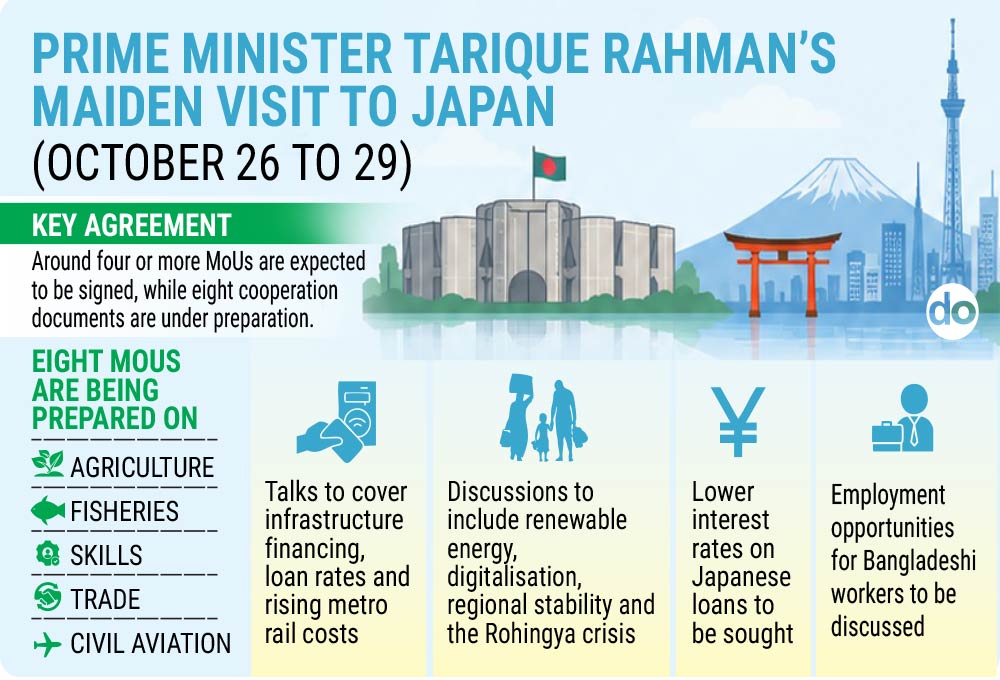 Bangladesh is seeking to turn Prime Minister Tarique Rahman’s upcoming visit to Japan into an opportunity to attract fresh investment, expand exports and deepen economic cooperation, with faster implementation of the bilateral Economic Partnership Agreement (EPA) emerging as a key priority.
Business leaders and economists say the visit could help Bangladesh secure greater access to the Japanese market, attract investment in high-value industries and strengthen technology transfer. However, they stress that concrete implementation measures, rather than new commitments alone, will determine the economic benefits.
Tarique Rahman is scheduled to visit Japan for four days from October 26.
He is expected to hold bilateral talks with Japanese Prime Minister Sanae Takaichi on October 27 and address the Japan-Bangladesh Economic Forum.
Bangladesh is preparing a proposed $14 billion investment and economic cooperation package covering 12 priority sectors for 2026-31. The discussions are also expected to cover infrastructure financing, lower interest rates on Japanese loans and expanded cooperation in skilled manpower development.
The challenge for Dhaka is to translate the proposals into actual investment, industrial expansion, employment and export growth.
World Bank Dhaka office’s former chief economist Dr Zahid Hussain said Bangladesh should prioritise the implementation of the EPA during the visit.
“The two sides need to review the progress made, identify the outstanding issues and determine where the implementation process is getting stuck,” he said, stressing the need for clear directions from the governments of both countries to resolve outstanding complications.
He said Bangladesh should also seek clarity on tariff arrangements, market access and potential trade barriers, particularly as the country prepares to graduate from the least developed country (LDC) category.
According to Zahid, meeting Japanese requirements for product quality, certification, food safety and health standards will be essential to expanding exports, especially agricultural and processed agricultural products.
The proposed cooperation package covers transport and urban connectivity, industrial and commercial hubs, energy, climate resilience, manufacturing, semiconductors, automobiles, agriculture, tourism and the blue economy.
The proposed allocations include $3.45 billion for transport and urban connectivity, $3.14 billion for integrated industrial, port and commercial hubs, and $2.22 billion for energy and climate resilience.
Another $1.57 billion is earmarked for manufacturing, semiconductors and automobiles, while $1.22 billion is proposed for agriculture, the blue economy and tourism.
These figures represent proposed allocations under the cooperation package, not confirmed investment commitments.
Foreign Secretary Asad Alam Siam said the visit would cover infrastructure cooperation, technical assistance and financing. Bangladesh would also seek lower interest rates on loans, particularly amid rising costs of major projects such as MRT Line-1 and Line-5.
The two countries are discussing around eight memorandums of understanding, of which three or four may be signed during the visit, according to the foreign secretary. The final list of agreements has yet to be confirmed.
Despite longstanding economic ties, attracting Japanese direct investment remains a challenge for Bangladesh.
Bangladesh Bank data show that Japanese foreign direct investment stood at $78.77 million in 2021 before falling to $38.51 million in 2022. Following a partial recovery, net investment turned negative at $3.32 million in 2025.
Zahid said Bangladesh needed to demonstrate tangible improvements in its investment climate instead of relying on assurances.
He also identified automobile manufacturing and semiconductors as potential areas for Japanese investment, which could create opportunities for technology transfer and higher-value industrial production.
Rabiul Alam, secretary-general of the Japan-Bangladesh Chamber of Commerce and Industry, said bureaucratic complications, lengthy approval procedures and limitations in port and logistics infrastructure continued to hinder investment.
He stressed the need to make one-stop services more effective, simplify administrative procedures and speed up import-export operations to make Bangladesh more attractive to investors.
Anwar-ul Alam Chowdhury Parvez, president of the Bangladesh Chamber of Industries, said export diversification, increased foreign investment and technology transfer were essential for sustainable economic development.
He also called for greater emphasis on higher-value products beyond traditional garment exports.
Bilateral trade between Bangladesh and Japan reached $3.42 billion in the fiscal year 2025-26, according to Bangladesh Bank data cited in the supplied material.
Bangladesh exported goods worth $1.36 billion to Japan and imported $2.06 billion, resulting in a trade deficit of $700 million.
Garments accounted for $1.13 billion of Bangladesh’s exports to Japan, highlighting the country's continued dependence on the apparel sector.
Bangladesh Garment Manufacturers and Exporters Association (BGMEA) President Mahmud Hasan Khan said Bangladesh wanted to increase garment exports to Japan while attracting more Japanese investment in energy and logistics.
Investment in these areas could help reduce production costs, improve delivery times and strengthen the competitiveness of Bangladesh’s apparel industry, he said.
Japanese Ambassador to Bangladesh Saida Shinichi has also expressed optimism about prospective Japanese investment and emphasised the importance of using the EPA to strengthen bilateral trade and business ties.
Experts say stronger compliance with Japanese quality standards, improved logistics and a more predictable regulatory environment will be necessary to realise this potential.
The visit is also expected to address skilled manpower development, technology cooperation and employment opportunities for Bangladeshi workers in Japan.
For Bangladesh, the economic significance of the visit will ultimately depend on progress in implementing the EPA, attracting productive investment and removing barriers to business operations.
Clear implementation timelines, improved market access and investment in technology-intensive industries could help Bangladesh diversify its export base and strengthen its economic partnership with Japan as it prepares for the challenges of LDC graduation.

Loading...
Loading...
Also read



Editor : Iqbal Sobhan Chowdhury
Published by the Editor on behalf of the Observer Ltd. from Globe Printers, 24/A, New Eskaton Road, Ramna, Dhaka.
Editorial, News and Commercial Offices : Aziz Bhaban (2nd floor), 93, Motijheel C/A, Dhaka-1000.
Phone: PABX- 41053001-06; Advertisement: 41053012; 01793317829, 01550707291, E-mail: [email protected], [email protected] Online: email: [email protected] 41053014; 01550707297 Advertisement: 01550707296


