



| HEADLINE |

|

Jungle, Animals, Birds and Joy
Published : Friday, 23 October, 2026 at 12:00 AM
Selina Mohsin


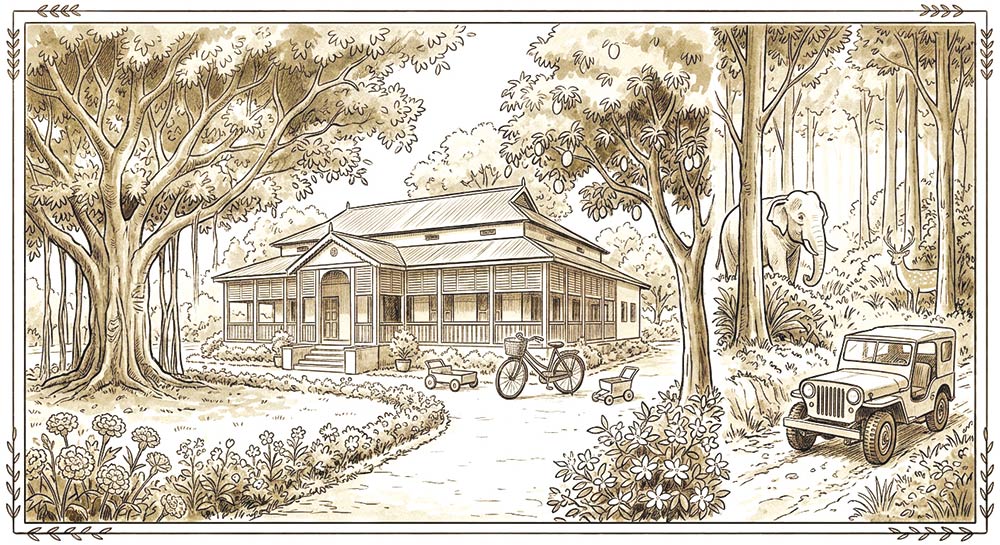 My father whom we called Baba was Md Mohsin PSP. He was a former Indian Police Service (IPS) officer. He was posted in 1954 as Superintendent of Police of the largest district of East Pakistan. It was Mymensingh. We travelled to Mymensingh by train passing miles of sal trees. We arrived in our home at night and the District Magistrate sent us some food as a gesture of friendship.
Early in the morning, I got up. It was winter and chilly. A fine mist, covering the front lawn slowly rose upwards like a rising grey blue smoke revealing a captivating garden- the most beautiful I had ever seen. A large green lawn was bordered on three sides by beds of carefully selected flowers that ran wild with colour. At one corner was a towering cherry blossom tree bent with the weight of its blossom, pale pink and alluring. Dew drops under the soft rays of the winter sun glistened on the large green emerald lawn which appeared to be floating on water. Imagination or hallucination perhaps, I thought as I gazed transfixed at the multi-coloured flowers bordering the expanse of the green lawn. Gradually the sun shone brighter, voices were heard and the brief spell was broken. It was no longer an enchanted garden, but a beautiful one. Yet, the brief memory of enchantment remained in my mind.
The house was large. It was two storied and like most colonial houses the rooms had no windows but doors on both sides of each room for cross ventilation. The ceilings were high and there was a drawing room, a long -dining rooms, plus many other rooms in the ground floor. The pantry beside the dining room was the domain of the bearer who cleaned plates, polished silver and ruled our breakfast lunch and dinner.

Soon my parents enrolled us in school. There I made friends with Mary. She frequently came to play with me and when the friends of my brothers’ came we played a game called ‘Catch a Thief’. At other times Mary and I sat on the branches of a guava tree eating green guava and chatting.
One spring holiday, Baba said that we should all go and spend a few days in the Madhupur Forest. It was not far away and we would spend four days in the spring in the jungle. Swiss tents were installed and we each had a room and a bathroom. This entailed a large number of servants, police constables as well as sweepers who travelled in several pick-ups and we went by two jeeps. At night the camp area was surrounded with wood fire to ward off wild animals.
Our father gave a detailed description of Modhupur forest. In early 1950s, the forest was massive with relatively uninterrupted jungle of mainly sal trees also called gazari which covered around 70% to 80% of the forest stretching over 45,000 acres. But, there were around 73 distinct tree species. Some trees like gutum, gadia, mahua, amloki, hartoki, amra, koroi and many others were present. The topography of the forest was characterized by slightly elevated reddish clay plateau and low lying valleys used for rice cultivation by the tribal people. The sal trees shed their leaves in the winter and exploded into lush green during the spring. The forest floor was rich with hundreds of medicinal plants and climbers.
There was still abundant wildlife in the forest. But Royal Bengal Tigers were few as they were indiscriminately shot by British Officers. There were leopards, tigers, elephants, wild boars, monkeys, deer, snakes and a huge population of deer, peacocks and numerous wild birds. The human footprint in the midst of the deeper parts of the forest in the 1950s was small so these areas were harmonious and unique. The people who lived in the forest were Garo and Koch who had lived there for centuries and practiced shifting cultivation (jhum).
My father said that the forest was owned by zamindars but soon the area would be under the Forest Department as ‘East Bengal State Acquisition and Tenancy Act’ which was already ending the zamindari system. The central government did not apply the same rule in West Pakistan. This was unfortunate so we should enjoy the forest before it was destroyed.
We were there in the spring. My father brought several guns as wildlife was abundant. The forest had a few Royal Bengal Tigers, leopards, barking deer, wild boars, elephants, monkeys, porcupines and a vibrant population of peacocks and wild birds. It was a place of breathtaking natural beauty.
At night we heard the howls of jackals, wild boars and sometimes roar of tigers. Baba went shooting every morning with a few police people who knew the way. He shot a deer and jungle fowl and pea fowl. Our cooks made ‘kebabs of deer meat and the birds were roasted or cooked as curry for all to eat. Next day as gifts, my father got two mynah birds for us two sisters. The following day Baba brought orioles for my brothers.
We roamed in the forest with police escort and saw many types of birds, fantastic shaped trees, clean water trickling down from higher land with silvery fish and various types of snakes. The jungle was never quiet. We heard the chattering of monkeys, barking of leopards, rustling of leaves, twittering of birds, howling of jackals and varied sounds of insects and continuous croaking of frogs. We also heard hissing of snakes and rustling of leaves in the wind. We had to be careful and wore gum boots and our guide carried a gun. On the fourth day we packed and returned home. Soon, Baba got two spotted deer and a large place was fenced off in the garden to keep the two deer. They walked all the time and only stopped to eat. They ate mainly amloki.
Baba said orioles have to be free so the gardener kept them under the large banyan tree where they ate ripe banyan figs and we gave them some mangoes that fell from the mango trees in the summers or ripe bananas. Sometimes they flew away and after a few days returned under the banyan tree.
Baba promised to surprise us and soon two colourful peacocks came to our house. We were mesmerized. They did not need closed space but moved around picking rice and other things the gardener gave them. When it was cloudy with a sign of rain the peacocks would spread their feathers and dance. It was a wonderful sight. The whole ground was the habitat of the peacocks and they moved at ease but liked the front lawn best.
Then the same year a large bamboo basket arrived with dozens of tiny parakeets. Their feathers were brilliant leaf green with coral red beaks with males having bright blue patch on the throats. A place was made for the parakeets with large nets and a wooden bottom. A number of dead branches were placed in the net for the birds to hang upside down. The gardener looked after them. They were so vibrant that we never got tired by looking at them.
Our young lives were full with varied animals birds and deer and guests. My parents were hospitable and held luncheon and dinners and asked the children of other families in the evening to come and play and have soft drinks and sandwiches. We had great fun playing with the children of our age. It was a time of joy and laughter. I cannot remember such happy time as I had in Mymensingh.
The Writer is a former Ambassador

Loading...
Loading...
Also read



Editor : Iqbal Sobhan Chowdhury
Published by the Editor on behalf of the Observer Ltd. from Globe Printers, 24/A, New Eskaton Road, Ramna, Dhaka.
Editorial, News and Commercial Offices : Aziz Bhaban (2nd floor), 93, Motijheel C/A, Dhaka-1000.
Phone: PABX- 41053001-06; Advertisement: 41053012; 01793317829, 01550707291, E-mail: [email protected], [email protected] Online: email: [email protected] 41053014; 01550707297 Advertisement: 01550707296


