



| HEADLINE |

|

Our education system seriously lacks accountability, transparency
Published : Wednesday, 21 October, 2026 at 12:00 AM
Tanvir Raihan


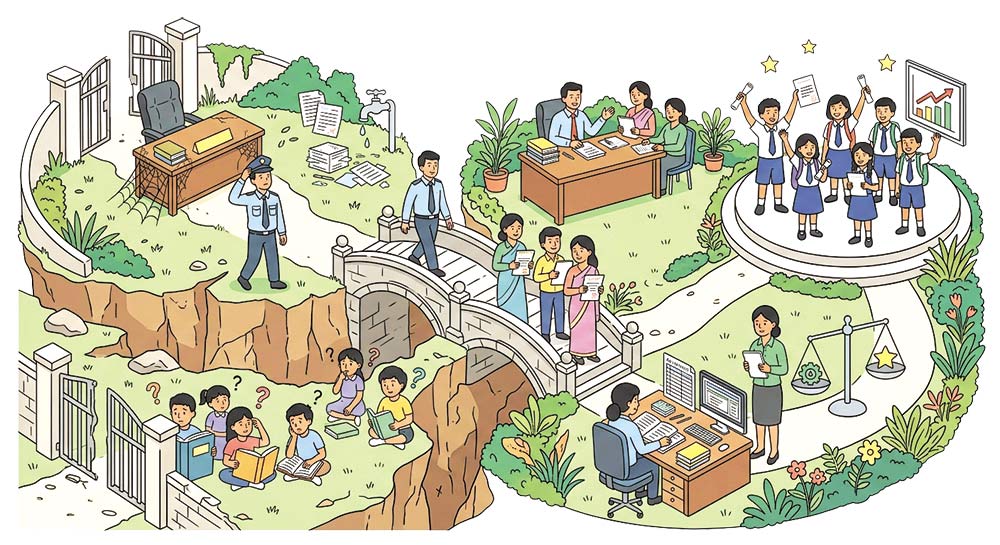 Vacant leadership posts, audit objections over textbook spending and concerns over learning outcomes raise questions about governance across the country’s education sector Bangladesh's education crisis extends beyond shortages of teachers, classrooms and learning materials. Vacant leadership positions, weak supervision, questions over recruitment practices and concerns about financial transparency are raising broader questions about accountability across the country's education system, from primary schools to universities.
Despite substantial public spending on education, concerns persist over students' basic learning skills. Hundreds of leadership positions remain vacant in government secondary schools, while audit findings have raised questions about financial management in the procurement and printing of free textbooks. Higher education institutions are also facing concerns over vacant senior administrative posts and the transparency of financial reporting.
Taken together, these issues suggest that increasing education spending alone will not be enough. Effective leadership, regular monitoring, transparent financial management and measurable improvements in student learning are also essential.
Primary education lays the foundation for a child's academic development. Headteachers play a central role in managing schools, supervising lessons, supporting teachers, monitoring student progress and maintaining communication with parents. Prolonged vacancies in these positions can weaken school management and limit effective oversight.
According to information from the Ministry of Primary and Mass Education, 36,235 headteacher posts were vacant in government primary schools across the country.
Education Minister ANM Ehsanul Haque Milon said at the time that the vacancies would be addressed through promotions. He also indicated that recruitment would be undertaken to fill assistant teacher positions left vacant following those promotions.
Vacant headteacher posts can place additional pressure on other teachers and disrupt routine administration and supervision. However, the number of vacancies alone does not establish the extent of disruption at individual schools. School-level information on teacher attendance, classroom hours, management arrangements and student progress is needed to assess the actual impact.
Education experts argue that filling vacant posts should go hand in hand with improving school leadership, providing professional support to teachers and regularly assessing students' learning progress.
Assessments of primary education have raised concerns about students' proficiency in Bangla and mathematics. Comparisons between assessments conducted in different years, however, require caution. Changes in testing methods, question formats, sample groups and assessment frameworks must be taken into account before concluding that learning outcomes have improved or deteriorated.
Professor Dr Md Abdus Salam of the Institute of Education and Research at the University of Dhaka has highlighted the importance of classroom teaching, teacher preparation, assessment systems and students' actual learning abilities in evaluating educational quality.
Leadership and supervision gaps are also evident in government secondary schools.
DSHE Director General Professor Dr Khan Moinuddin Al Mahmud Sohel has discussed administrative constraints and the need for effective supervision in the education system. Updated information from the directorate on recruitment progress, the school-level effects of the vacancies and a timeline for filling the posts would help establish the current situation more clearly.
Financial accountability has become a major concern in the procurement and distribution of free textbooks.
News reports published on July 27, 2026, citing an audit report from the Directorate of Education Audit, said audit findings concerning the National Curriculum and Textbook Board's (NCTB) activities in the 2024-25 fiscal year involved approximately Tk 27.11 billion in alleged financial irregularities, irregular expenditure and losses to the public exchequer.
The reported audit objections covered several areas, including textbook printing, binding and supply, compliance with tender conditions, excess printing and payments of allowances and honoraria to officials and employees.
Such findings raise important questions about the transparency and management of public funds. However, the full amount identified in audit objections should not automatically be described as proven corruption. Audit objections, irregular expenditure, assessed financial losses and criminal wrongdoing are distinct categories and must be reported separately.
Publishing details of audit-objection settlements, accountability measures and the recovery of public money would help strengthen oversight of NCTB's procurement and financial management. Responses from NCTB and the printing companies concerned are also necessary to ensure balanced reporting.
Weak transparency in school management committees, revenue collection, development projects and fee administration can undermine parents' confidence in educational institutions. Allegations of financial irregularities should be examined through impartial investigations supported by documentary evidence.
Regular disclosure of institutional income and expenditure, procurement decisions, construction costs, fees collected from students and management committee decisions could strengthen accountability. Effective complaint-handling mechanisms are equally important to ensure that allegations are investigated fairly and that all parties have an opportunity to respond.
Vacant senior administrative positions have also raised concerns in the higher education sector.
Reports citing information from the University Grants Commission (UGC) have highlighted vacancies in key positions at private universities, including vice-chancellors, pro-vice-chancellors and treasurers, across a sector comprising 117 institutions.
These positions are central to academic planning, faculty recruitment, financial management, research and institutional accountability. Prolonged vacancies can delay decisions, blur lines of responsibility and undermine administrative continuity.
Faculty recruitment is another area where transparency and compliance with established rules are essential. Allegations of irregular recruitment should be examined against appointment rules, job advertisements, selection committee records and responses from the institutions concerned. It would be
inappropriate to treat all appointments at an institution as irregular based solely on allegations, but such claims should not be left unexamined either.
Professor Dr M Niaz Asadullah, an economics professor at the University of Dhaka, has highlighted education quality, skills and human resource development in a broader policy context. Policymakers need to consider such research alongside implementation data and measurable outcomes when assessing the performance of the education sector.
No single measure can resolve the management weaknesses, teacher shortages and learning gaps affecting educational institutions in both rural and urban areas. Reform requires a coordinated approach that links education spending with stronger school leadership, teacher development, transparent financial management and measurable improvements in student learning.
Hossain Zillur Rahman, chairman of the Power and Participation Research Centre (PPRC), along with other education and development experts, has emphasised the importance of identifying practical problems, strengthening institutional capacity and ensuring accountability in policymaking.
Parliamentary oversight also has a role to play. Lawmakers and parliamentary committees responsible for education can help scrutinise spending, review implementation progress and press authorities to explain delays and unresolved audit findings.
Ultimately, the future of Bangladesh's education system will depend not only on new projects, school buildings or textbook distribution, but also on how much students learn, how effectively teachers are supported and how transparently public money is spent. Without measurable progress in these areas and regular public reporting of results, promises to improve educational quality may remain unfulfilled.

Loading...
Loading...
Also read



Editor : Iqbal Sobhan Chowdhury
Published by the Editor on behalf of the Observer Ltd. from Globe Printers, 24/A, New Eskaton Road, Ramna, Dhaka.
Editorial, News and Commercial Offices : Aziz Bhaban (2nd floor), 93, Motijheel C/A, Dhaka-1000.
Phone: PABX- 41053001-06; Advertisement: 41053012; 01793317829, 01550707291, E-mail: [email protected], [email protected] Online: email: [email protected] 41053014; 01550707297 Advertisement: 01550707296


