



| HEADLINE |

|

Powering Bangladesh with rooftop solar
Published : Sunday, 18 October, 2026 at 12:00 AM


The Infrastructure Development Company Limited (IDCOL), a government-owned development finance institution whose solar home system programme brought electricity to more than 18 million people beyond the grid, now wants to put solar panels on the rooftops of grid-connected homes and shops through its Domestic Rooftop Solar (DRS) programme. S. M. Monirul Islam, Managing Director (Acting) of IDCOL, in an exclusive interview with Farhana Naznin of The Daily Observer, explains what the programme offers families, how the government’s new renewable energy fund fits in, and why it matters for the economy. Excerpts of the interview are as follows:
Daily Observer: What does the DRS programme offer a family?
Monirul Islam: This is a solar system on your own roof and its cost is paid for mostly in monthly installments that cut your electricity bill and keep the lights on during load-shedding.
Take a 3 kWp hybrid system with battery backup. At the indicative price of about Tk 2.37 lakh, a family pays about Tk 47,500 upfront and then about Tk 3,670 a month for five years. The system should generate around 280 units a month. For a family that uses around 600 units a month, that cuts the bill by about Tk 4,000 at today’s tariffs, which is more than the installment, because solar replaces the most expensive units at the top of the tariff slabs.
The battery keeps lights, fans and other essentials running when the grid goes down, often replacing an IPS that itself depends on the grid to recharge. If the home produces more than it uses, the surplus earns Tk 10.50 a unit for three years, provided the system is installed by 28 February 2027.
DO: Why do you push for rooftop solar system now?
Monirul Islam: As imported fuel grew scarce and costly, power shortages reached nearly 4,000 MW at their August peak. Rooftops are the fastest way to respond. They need no land, which we cannot spare. They also produce the most power in the hottest hours of the day, just when fans and air conditioners push demand up.
DO: How does it work, and how will families know they are getting a good system?
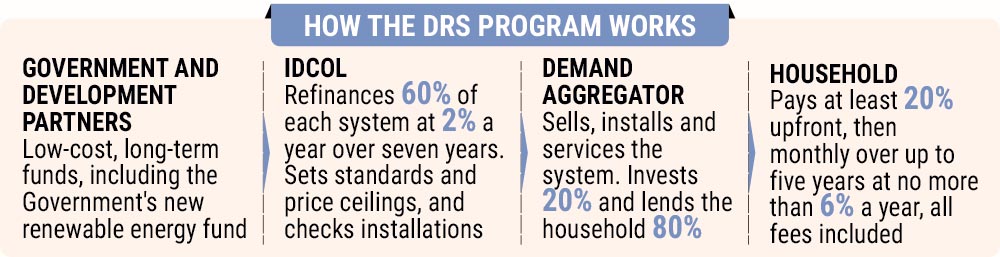
Monirul Islam: We enlist companies and NGOs as Demand Aggregators, or DAs. A DA visits the home, checks the roof and the family’s electricity use, and recommends a package, with or without battery backup. It then installs the system and arranges the net metering connection with the local utility, which the programme requires within 15 days of installation.
Families can pay in cash or on credit. On credit, they pay at least 20 percent upfront and the rest over up to five years through mobile financial services, at no more than 6 percent a year with every fee included.
 DO: Who can join and when?
Monirul Islam: Any grid-connected household with a suitable roof can join, and so can shops, small businesses and other small grid-connected customers, with systems of up to 80 kWp. They apply through an enlisted DA. Families can find the list of enlisted DAs on our website, www.idcol.org, or get information from our call center at 16653. We expect to sign our first agreement with a DA later this month, and the first installations should follow in early November.
DO: How will IDCOL use its Tk 500 crore from the government’s new fund?
Monirul Islam: Under the Finance Division’s circular of 14 September, the government lends Tk 500 crore each to IDCOL, BIFFL and PKSF. All of our Tk 500 crore goes into DRS, and BIFFL will channel its Tk 500 crore through the programme as well. We lend to DAs at 2 percent a year over seven years, which lets them lend to households within the 6 percent ceiling. Because households pay 20 percent of each system’s cost and DAs invest another 20 percent, every Tk 100 we lend brings in about Tk 67 of private money. Together, the two allocations can finance roughly 200 MWp, or about 70,000 homes with 3 kWp hybrid systems.
DO: What does this mean for the economy and the environment?
Monirul Islam: By IDCOL’s estimate, every 1,000 MWp of household rooftop solar saves about USD 203 million a year in fuel imports and about Tk 460 crore a year in electricity subsidy. We import the panels once; otherwise, we import fuel every day.
The same 1,000 MWp avoids about 713,000 tons of carbon dioxide a year, supporting Bangladesh’s climate commitments without taking an acre of farmland.
DO: What would you say to an undecided family?
Monirul Islam: Do not wait for next summer’s load-shedding. Systems installed by 28 February can earn the Tk 10.50 rate, and the sooner a system goes up, the sooner the savings start. Talk to an enlisted DA and ask for the package that fits your needs. Your roof has been idle long enough. Put it to work, for your family and for the country.

Loading...
Loading...
Also read



Editor : Iqbal Sobhan Chowdhury
Published by the Editor on behalf of the Observer Ltd. from Globe Printers, 24/A, New Eskaton Road, Ramna, Dhaka.
Editorial, News and Commercial Offices : Aziz Bhaban (2nd floor), 93, Motijheel C/A, Dhaka-1000.
Phone: PABX- 41053001-06; Advertisement: 41053012; 01793317829, 01550707291, E-mail: [email protected], [email protected] Online: email: [email protected] 41053014; 01550707297 Advertisement: 01550707296
Published by the Editor on behalf of the Observer Ltd. from Globe Printers, 24/A, New Eskaton Road, Ramna, Dhaka.
Editorial, News and Commercial Offices : Aziz Bhaban (2nd floor), 93, Motijheel C/A, Dhaka-1000.
Phone: PABX- 41053001-06; Advertisement: 41053012; 01793317829, 01550707291, E-mail: [email protected], [email protected] Online: email: [email protected] 41053014; 01550707297 Advertisement: 01550707296


