



| HEADLINE |

|

Dear dads, stand by your daughters during period
Published : Saturday, 17 October, 2026 at 12:00 AM
Musfika Laiju


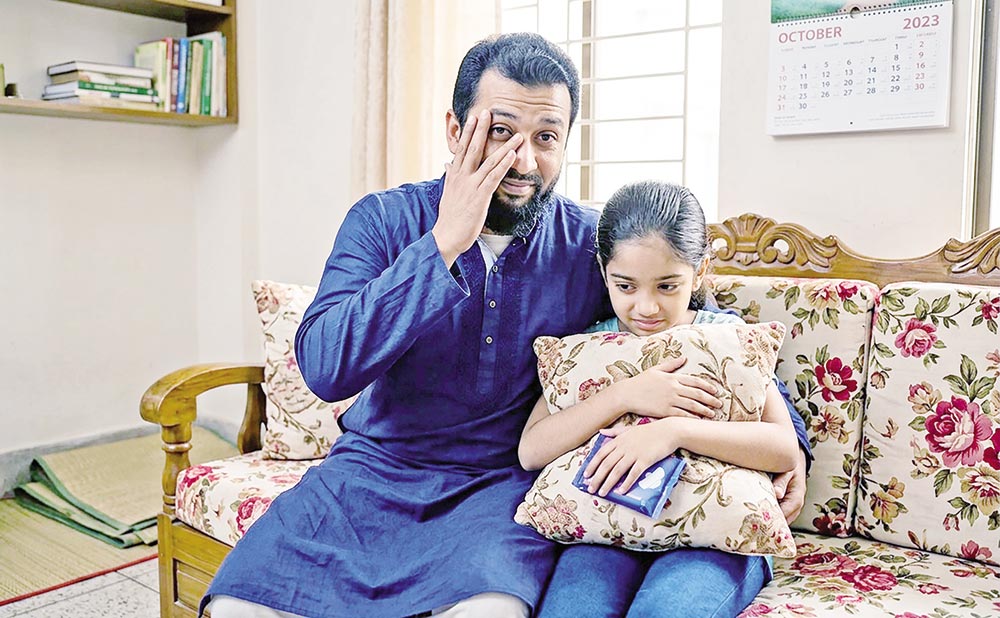 A Human Rights Activist There is something strangely selective about the way we understand fatherhood.
There comes a moment in every girl’s life when childhood begins to change. Her body changes, her emotions change, and suddenly she experiences something she may never have been prepared for: her first period.
For many teenage girls, menstruation is not simply a biological event. It can bring embarrassment, anxiety, pain and confusion. While mothers, teachers and female relatives are often expected to support girls through this transition, one person’s role is frequently overlooked: the father.
Why should a father feel comfortable discussing his daughter’s education, food, safety, clothing and future but become silent when the conversation turns to menstruation? A daughter does not stop being her father’s responsibility when she gets her period. In fact, adolescence is precisely when she may need his understanding and support more than ever.
Menstruation is biological. The responsibility for supporting someone through it should not be gender-specific.
Yet, in many households, the mother buys sanitary pads, explains menstruation, deals with stained clothes, listens to complaints about cramps and takes her daughter to the doctor. The father may simply provide money, if she manages to ask.
This arrangement may look ordinary, but ordinary does not necessarily mean fair. Gender inequality often survives through everyday practices that nobody questions.

The issue is not simply whether a father buys a packet of pads. It is whether we recognise a daughter’s bodily needs as a legitimate part of family responsibility.
A father walking into a pharmacy to buy sanitary pads for his daughter should be no more remarkable than buying medicine when she has a fever. Both are healthcare. Both are acts of care. Neither requires shame.
In Bangladesh, menstruation remains surrounded by silence, embarrassment and social taboos. UNICEF has highlighted gaps in menstrual health awareness, including the fact that many girls lack adequate knowledge before their first period.
A teenage girl may discover blood on her clothes and fear that something is wrong. She may need sanitary pads but feel too embarrassed to ask her father for money. She may experience painful cramps but remain silent because she does not know whether discussing menstrual pain is acceptable.
Sometimes, the father is physically present but emotionally absent from this part of his daughter’s life. This does not necessarily mean he does not care. Many fathers have simply never been taught that menstrual health is also part of fatherhood.
A father may say, “Ask your mother.” Of course, mothers and other caregivers have important roles. But why should the responsibility automatically fall on women? If we genuinely believe in gender equality and equal parenting, we must question the gendered division of care within our own homes.
A father who buys food for the family can also buy sanitary pads. A father who takes his daughter to school can take her to a doctor when she experiences severe menstrual pain. He can ensure that she has privacy, clean water and the products she needs. He can also teach his son to respect girls and never make fun of them for menstruating.
These are not extraordinary acts. They are ordinary acts of parenting.
Imagine a father telling his daughter before her first period, “You may experience bleeding every month. It is normal. If you feel frightened or have questions, you can talk to me.”
Imagine him keeping sanitary pads at home without hiding them and asking, “Do you have everything you need?”
Such a father would not be less of a man. He would simply have a broader understanding of fatherhood.
Something as simple as buying sanitary pads can become a complicated family ritual. A daughter tells her mother, the mother asks the father for money, and someone else eventually buys the pads. Everyone behaves as though they are handling something embarrassing.
But imagine the difference if a father simply said, “You need pads? Of course. Tell me what you need.”
No embarrassment. No interrogation. No jokes. Just care.
That small response could teach a daughter something much bigger: my father respects my body, and I can talk to him when I need help.
We often define fatherhood through financial responsibility: paying school fees, providing food, arranging medical treatment and planning for children’s futures. But children need more than financial support.
They need emotional safety.
A father does not need to become a menstrual health expert. He simply needs to understand that menstruation is a normal biological process and that his daughter may require practical, emotional and medical support. He can learn, just as fathers learn to help their children with mathematics, technology, sports and career choices.
Care includes uncomfortable conversations. A girl should never have to wonder whether her father will be embarrassed by her biology. She should know that her body is not a source of shame and her needs are not an inconvenience.
Menstrual health is not merely about sanitary products. It is connected to education, dignity, health, confidence and participation. Stigma and inadequate facilities can prevent girls from managing menstruation safely and comfortably.
Fathers can make a difference by learning about menstruation, listening without judgement, providing sanitary products, respecting privacy, taking menstrual pain seriously and ensuring that periods do not unnecessarily interrupt education or everyday activities. They should also talk to their daughters before the first period arrives.
Perhaps it is time to redefine what we mean when we say a father has responsibilities towards his daughter. His responsibility is not only to protect her from the outside world but also to make home a place where she does not have to hide part of herself.
It is not only to prepare her for examinations, employment or marriage. It is also to help her understand and respect her own body. His responsibility is not only to provide money but also to provide dignity.
So, dear fathers, the next time your daughter quietly asks, “Baba, can you buy me some pads?”, please do not look away or tell her to ask her mother.
Simply say, “Of course. What do you need?”
For a girl growing up in a society where menstruation is still surrounded by silence, those words can carry a powerful message: your body is not shameful, your needs matter, and I am here for you.
That is not just menstrual support. That is fatherhood.

Loading...
Loading...
Also read



Editor : Iqbal Sobhan Chowdhury
Published by the Editor on behalf of the Observer Ltd. from Globe Printers, 24/A, New Eskaton Road, Ramna, Dhaka.
Editorial, News and Commercial Offices : Aziz Bhaban (2nd floor), 93, Motijheel C/A, Dhaka-1000.
Phone: PABX- 41053001-06; Advertisement: 41053012; 01793317829, 01550707291, E-mail: [email protected], [email protected] Online: email: [email protected] 41053014; 01550707297 Advertisement: 01550707296
Published by the Editor on behalf of the Observer Ltd. from Globe Printers, 24/A, New Eskaton Road, Ramna, Dhaka.
Editorial, News and Commercial Offices : Aziz Bhaban (2nd floor), 93, Motijheel C/A, Dhaka-1000.
Phone: PABX- 41053001-06; Advertisement: 41053012; 01793317829, 01550707291, E-mail: [email protected], [email protected] Online: email: [email protected] 41053014; 01550707297 Advertisement: 01550707296


