



| HEADLINE |

|

Maha Shashthi: story behind Durga’s awakening
Published : Friday, 16 October, 2026 at 7:20 PM
Sakia Kawser Siddique


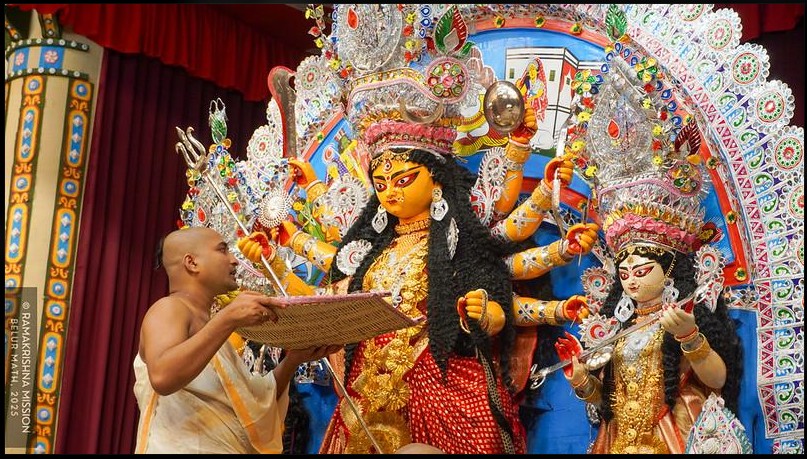
Maha Shashthi marks the formal beginning of Sharadiya Durga Puja in Bangladesh on Friday, October 16, with Bodhan, the ceremonial awakening and invocation of Goddess Durga, at the heart of the day’s observances. The ritual is associated with the Bengali tradition of Akal Bodhan and the story of Lord Rama’s autumnal worship of the goddess before his battle with Ravana.
What happens on Maha Shashthi?
Maha Shashthi is the sixth lunar day of the bright fortnight associated with the autumnal festival. In Bengal, it marks the transition from preparations for Durga Puja to the principal days of worship.
The day’s rituals include Kalparambha, which marks the formal commencement of the worship, and Bodhan, the awakening of the goddess. This is followed by Amantran, the invitation to the deity, and Adhibas, a consecration ceremony.
In the ritual tradition described by Belur Math, Bodhan is performed at dusk, with worship centred on a bel tree or a branch of the tree. A water-filled vessel is installed as part of the ceremony, and prayers are offered to invoke the goddess. The specific procedures and timing may differ between temples and community pujas.
In Bangladesh, this year’s formal observances began on Friday. At Dhakeshwari National Temple in Dhaka, Kalparambha and Bihita Puja were held in the morning, while devotees observed Bodhan to mark the beginning of the festivities, according to Bangladesh Sangbad Sangstha.
The legend of Akal Bodhan
The story most closely associated with Bodhan in Bengali tradition concerns Rama’s worship of Durga before his battle against Ravana.
According to the Bengali Krittivasi Ramayana, attributed to Krittivas Ojha, Rama was advised to worship the goddess to secure her blessings before confronting the king of Lanka. Because the worship took place in autumn rather than the season traditionally associated with the goddess’s worship, the episode became known as Akal Bodhan, meaning an untimely or out-of-season invocation.
In the familiar account, Rama offers 108 blue lotuses to the goddess. When he discovers that one flower is missing, he prepares to offer one of his eyes, which are compared to lotus petals. Durga, moved by his devotion, intervenes and grants her blessing.
The story has an important textual distinction. The account of Rama’s Akal Bodhan is associated with the Bengali Krittivasi Ramayana; it does not appear in the same form in Valmiki’s Ramayana. It should therefore be understood as part of Bengal’s particular religious and literary tradition, rather than a narrative shared identically by every version of the epic.

What history tells us about Bodhan
The historical development of Durga Puja rituals can be traced in part through medieval Bengali religious manuals, although the origins of individual ceremonies cannot always be established with certainty.
In a peer-reviewed study published in the Journal of the Royal Asiatic Society in 2012, scholar Bihani Sarkar examined the ritual system described in Durgapuja-tattva, a manual associated with the Bengali scholar Raghunandana Bhattacharya, who lived from 1520 to 1575. The study uses this text and related ritual literature to reconstruct how Durga Puja may have been performed in Bengal during the medieval period.
Such manuals provide important evidence of the ceremonies and religious practices followed by Bengali worshippers. However, they do not establish a definitive date for the origin of Bodhan itself. The historical record before the medieval period remains limited, making it important to distinguish documented ritual traditions from later explanations of their origins.
The legend of Rama’s autumnal worship helps explain how the festival is understood within Bengali religious culture, while ritual manuals offer evidence of how worship was prescribed and performed. These are related but distinct kinds of evidence.
A tradition observed across Bengal
Bodhan is observed in both Bangladesh and West Bengal, although the arrangements and details of worship can vary between temples, family ceremonies and community mandaps. The use of a bel branch, the installation of a ritual vessel and the sequence of invocation and consecration are described in established Bengali Durga Puja traditions, but not every community necessarily follows an identical procedure.
In Bangladesh, Maha Shashthi brings devotees to temples and community mandaps for prayers and ceremonies marking the arrival of the goddess. The main worship continues through Saptami, Ashtami and Navami, followed by Bijoya Dashami, when devotees bid farewell to Durga and the idols are immersed.
For devotees, Bodhan is both a prescribed religious ceremony and a symbolic act of welcome. Its continuing significance rests on the belief that the goddess is invoked to receive worship and bless her devotees. The story of Akal Bodhan gives the autumn festival a distinctive place in Bengali religious tradition, while the ritual itself marks the beginning of the days of worship.
Sources: Krittivasi Ramayana; Bihani Sarkar, “The Rite of Durgā in Medieval Bengal”, Journal of the Royal Asiatic Society (2012); Belur Math’s Durga Puja ritual guidelines; (BSS)
sks

Loading...
Loading...
Also read









Editor : Iqbal Sobhan Chowdhury
Published by the Editor on behalf of the Observer Ltd. from Globe Printers, 24/A, New Eskaton Road, Ramna, Dhaka.
Editorial, News and Commercial Offices : Aziz Bhaban (2nd floor), 93, Motijheel C/A, Dhaka-1000.
Phone: PABX- 41053001-06; Advertisement: 41053012; 01793317829, 01550707291, E-mail: [email protected], [email protected] Online: email: [email protected] 41053014; 01550707297 Advertisement: 01550707296
Published by the Editor on behalf of the Observer Ltd. from Globe Printers, 24/A, New Eskaton Road, Ramna, Dhaka.
Editorial, News and Commercial Offices : Aziz Bhaban (2nd floor), 93, Motijheel C/A, Dhaka-1000.
Phone: PABX- 41053001-06; Advertisement: 41053012; 01793317829, 01550707291, E-mail: [email protected], [email protected] Online: email: [email protected] 41053014; 01550707297 Advertisement: 01550707296


