



| HEADLINE |

|

3D-printed plant-based 'Salmon' enters US market
Published : Thursday, 15 October, 2026 at 6:06 PM
Observer Special Report


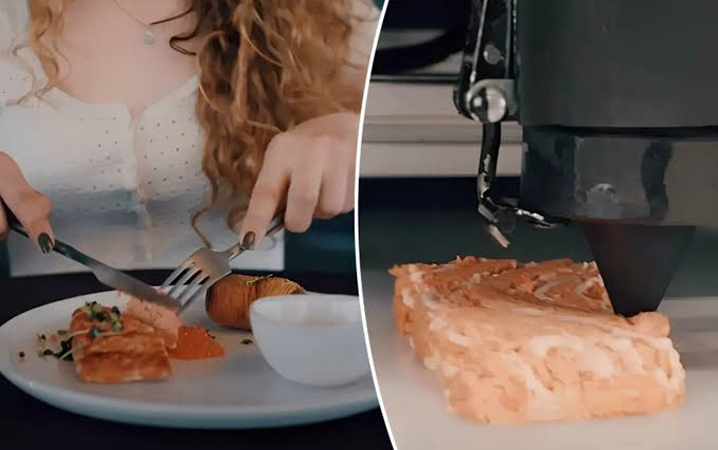
Image: HypeFresh
An Israeli food-technology company has commenced retail sales of 3D-printed, plant-based meat and seafood alternatives in the United States, featuring salmon patties made entirely from plant proteins.
Steakholder Foods, listed on the Nasdaq under the ticker symbol STKH, launched its "Perfecta" brand in selected Northeastern stores in early September 2026, announcing the commercial rollout on September 3, according to Hypefresh. The firm described the launch as its first commercial placement on US retail shelves.
Product Range and Composition
The initial product lineup comprises five items: plant-based marbled steak, filet mignon, chicken breast, salmon patties, and white fish patties.
The salmon patty is a plant-protein product structured through 3D-printing technology. It contains no conventional salmon or lab-grown cultivated fish cells. Reports indicate that the ingredients consist of plant proteins, including soy, combined with oils, starches, flavorings, and beetroot-based coloring.
The product carries allergen warnings for soy and gluten and contains a lower protein content compared to conventional salmon.
Distribution and Market Reach
In July, the Ness Ziona-based company, located near Tel Aviv, announced that its initial shipment had arrived in the United States. It appointed KeHE Distributors, one of the largest natural and specialty food distributors in the US, to handle distribution across dozens of Northeastern retailers.
The company has not disclosed specific participating retailers, store locations, or pricing structures. Consequently, the products are expected to appear primarily in natural and specialty grocery stores rather than major national retail chains. According to MyPatriotSupply, citing Allrecipes, at least two products have been listed on Instacart, though stock availability could not be independently confirmed.
Expansion Plans and Financial Support
Chief Executive Officer Arik Kaufman stated that the Northeastern launch is "just the beginning," noting that the company intends to expand its retail presence and distribution network as consumer demand increases.
Weeks following its US market entry, Steakholder Foods raised USD 3.5 million through private placements, with an additional USD 7 million potentially available through warrants, to expand the distribution of the Perfecta product range.
Market Dynamics and Public Reaction
Plant-based meat and seafood currently account for less than one per cent of total US meat sales, with purchases declining by 10 per cent in 2025. Steakholder Foods is targeting flexitarian consumers—individuals who consume meat but are open to plant-based alternatives.
A 2025 report by the Good Food Institute revealed that whole cuts constituted just one per cent of US plant-based meat retail sales, a market gap the Perfecta range aims to address.
Reports confirm that the product packaging does not explicitly state that the items are 3D-printed. Social media responses have ranged from curiosity to concerns regarding safety and labeling transparency, according to Hypefresh.
Viral online posts discussing "printed salmon" in US supermarkets frequently omitted the fact that the product is plant-based. Hypefresh noted that the items comply with standard US Food and Drug Administration (FDA) regulations for plant-based foods.
MyPatriotSupply emphasized that transparency remains critical to consumers as food manufacturing processes become more technologically complex. Claims regarding taste and product quality have been issued by the manufacturer, while independent side-by-side comparative testing against real salmon remains limited.
Industry Background
Steakholder Foods is among several Israeli enterprises developing 3D-printed seafood alternatives. In 2022, another startup, Plantish, unveiled a plant-based salmon fillet prototype, according to The Times of Israel. Plantish operates independently of Steakholder Foods and is not involved in the current US retail rollout.
Citing data from the Good Food Institute, The Times of Israel reported that approximately 90 companies worldwide are currently developing plant-based seafood alternatives.
-SA

Loading...
Loading...
Also read








Editor : Iqbal Sobhan Chowdhury
Published by the Editor on behalf of the Observer Ltd. from Globe Printers, 24/A, New Eskaton Road, Ramna, Dhaka.
Editorial, News and Commercial Offices : Aziz Bhaban (2nd floor), 93, Motijheel C/A, Dhaka-1000.
Phone: PABX- 41053001-06; Advertisement: 41053012; 01793317829, 01550707291, E-mail: [email protected], [email protected] Online: email: [email protected] 41053014; 01550707297 Advertisement: 01550707296
Published by the Editor on behalf of the Observer Ltd. from Globe Printers, 24/A, New Eskaton Road, Ramna, Dhaka.
Editorial, News and Commercial Offices : Aziz Bhaban (2nd floor), 93, Motijheel C/A, Dhaka-1000.
Phone: PABX- 41053001-06; Advertisement: 41053012; 01793317829, 01550707291, E-mail: [email protected], [email protected] Online: email: [email protected] 41053014; 01550707297 Advertisement: 01550707296


