



| HEADLINE |

|

Global sea-level rise accelerating alarmingly



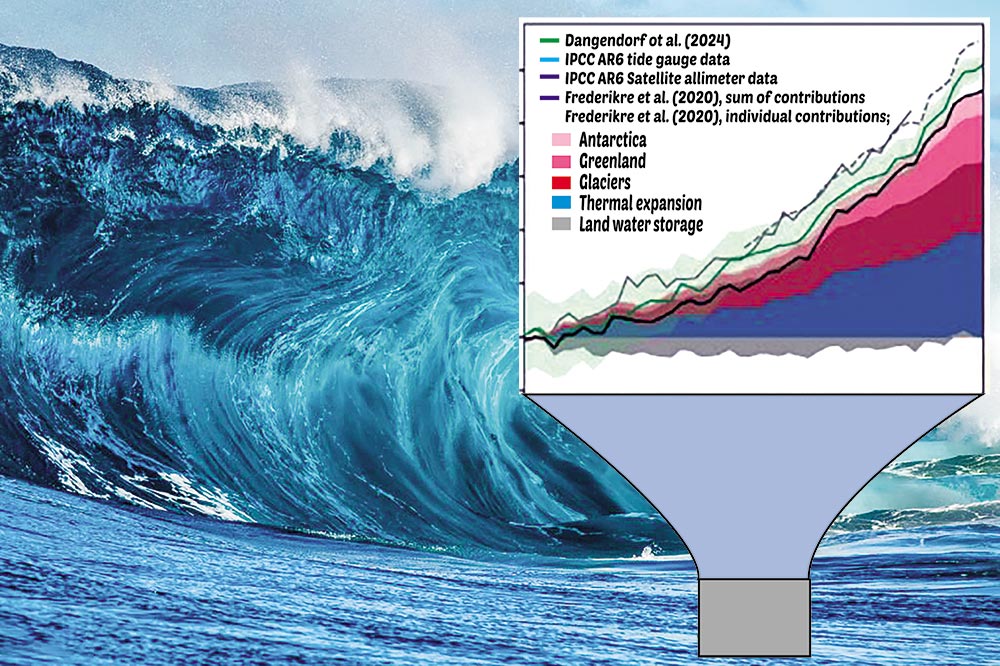 Bangladesh could face mounting risks to its coast, freshwater resources and energy security as new climate research warns that some impacts of global warming are already irreversible and that the choices made today will determine the scale of future damage.
The warning comes from the 10 New Insights in Climate Science 2026/2027, a synthesis of the latest climate research by Future Earth, The Earth League and the World Climate Research Programme (WCRP). The report, prepared by more than 70 researchers with contributions from over 200 experts worldwide, identifies 10 major developments in climate science and examines their implications for policymaking. For Bangladesh, one of the world's most climate-vulnerable delta countries, the findings are particularly significant as the country faces rising sea levels, growing freshwater stress and an increasingly fragmented global energy transition.
Global sea-level rise is accelerating, with the rate having doubled over the past three decades, according to the report. Some sea-level rise is already unavoidable because of past greenhouse gas emissions. However, the amount of additional rise in the coming decades will depend heavily on how quickly the world cuts emissions. For countries such as Bangladesh, the consequences go far beyond the loss of land. Rising seas can threaten economic and social infrastructure, livelihoods, human health and security, the report says. It calls for adaptation planning based on regional risk assessments and greater support for addressing loss and damage from slow-onset climate impacts. The findings are particularly relevant for Bangladesh's densely populated coastal belt, where salinity intrusion, erosion, tidal flooding and sea-level rise are already putting pressure on communities and livelihoods.
 The report also highlights accelerating continental drying and freshwater loss as a major emerging climate risk. Climate change, combined with human consumption of freshwater, is causing significant losses of water from land, threatening water availability, ecosystems and food production. Several South Asian areas have been identified as hotspots, including the Ganges basin, where unsustainable irrigation is already widespread and could intensify further. The report warns that water stress can create cascading impacts across agriculture, energy, ecosystems and socioeconomic and political stability. For Bangladesh, which is located downstream of major transboundary river systems, changes in freshwater availability could have consequences not only for agriculture and ecosystems but also for food security and livelihoods. The report calls for stronger monitoring of water availability, more efficient water use and greater attention to climate-driven freshwater depletion in adaptation and loss-and-damage planning.
The report warns that the longer and further global temperatures exceed the 1.5°C warming threshold, the greater the risk of irreversible climate impacts. A prolonged overshoot would also narrow the options for adaptation and increase reliance on carbon dioxide removal. Even if global temperatures are eventually brought down, some changes in slow-responding systems-including oceans, glaciers, ice sheets and permafrost-would not simply reverse, the researchers say. Johan Rockström, director of the Potsdam Institute for Climate Impact Research, co-chair of The Earth League and a member of the report's editorial board, said the evidence was unequivocal that crossing 1.5°C would increase the risks of cascading and potentially irreversible climate impacts. "Every additional tenth of a degree" would make those risks more severe, he said. The warning comes as global temperatures continue to rise. The report says the global mean near-surface temperature in 2025 was approximately 1.43°C above pre-industrial levels, while the years from 2015 to 2025 were the 11 warmest years on record.
The economic consequences of continued carbon emissions may also have been significantly underestimated, according to the report. Updated approaches suggest that the economic damages associated with carbon emissions could be up to four times higher than previously estimated. The finding strengthens the economic case for cutting emissions rapidly and raises questions about the long-term costs of continued dependence on fossil fuels. For developing countries facing high energy costs and exposure to global fuel-price volatility, the researchers' findings add another dimension to the debate over energy security and the transition to cleaner sources.
The global transition to clean energy is also facing growing geopolitical risks, the report warns. Geopolitical instability could accelerate the clean-energy transition in some countries while pushing others towards greater reliance on fossil fuels. Countries with limited access to capital and clean technologies could fall further behind, creating an increasingly unequal global energy transition. The report calls for greater investment and transition finance to help countries avoid new forms of geopolitical dependence and long-term fossil-fuel lock-in. It also stresses the need for secure and fair supply chains and sufficient policy space for countries to pursue their own energy-transition pathways. For Bangladesh, this issue has particular relevance as the country seeks to improve energy security while managing dependence on imported fuels. The report's findings suggest that energy transition policies will increasingly need to consider not only emissions but also energy security, access to technology, financing and exposure to international supply chains.
The researchers say the narrowing window for effective climate action makes finance increasingly important. The report calls for progress from the existing $300 billion annual climate finance goal towards at least $1.3 trillion a year by 2035, with priority given to predictable public, grant-based and concessional finance.
For Bangladesh, the message is clear: the choices made today-on emissions, adaptation, water management and energy transition-will determine the scale of future damage. The report underscores that climate action is no longer just an environmental imperative but a matter of economic survival, energy security and national resilience. As one of the world's most climate-vulnerable nations, Bangladesh stands at a crossroads where global decisions on emissions and finance will directly shape its ability to protect its coast, feed its people and power its future.

Loading...
Loading...
Also read



Editor : Iqbal Sobhan Chowdhury
Published by the Editor on behalf of the Observer Ltd. from Globe Printers, 24/A, New Eskaton Road, Ramna, Dhaka.
Editorial, News and Commercial Offices : Aziz Bhaban (2nd floor), 93, Motijheel C/A, Dhaka-1000.
Phone: PABX- 41053001-06; Advertisement: 41053012; 01793317829, 01550707291, E-mail: [email protected], [email protected] Online: email: [email protected] 41053014; 01550707297 Advertisement: 01550707296
Published by the Editor on behalf of the Observer Ltd. from Globe Printers, 24/A, New Eskaton Road, Ramna, Dhaka.
Editorial, News and Commercial Offices : Aziz Bhaban (2nd floor), 93, Motijheel C/A, Dhaka-1000.
Phone: PABX- 41053001-06; Advertisement: 41053012; 01793317829, 01550707291, E-mail: [email protected], [email protected] Online: email: [email protected] 41053014; 01550707297 Advertisement: 01550707296


