



| HEADLINE |

|

Radda: From rubbles to services
Published : Monday, 12 October, 2026 at 12:00 AM
Arifur Rahman Rabbi


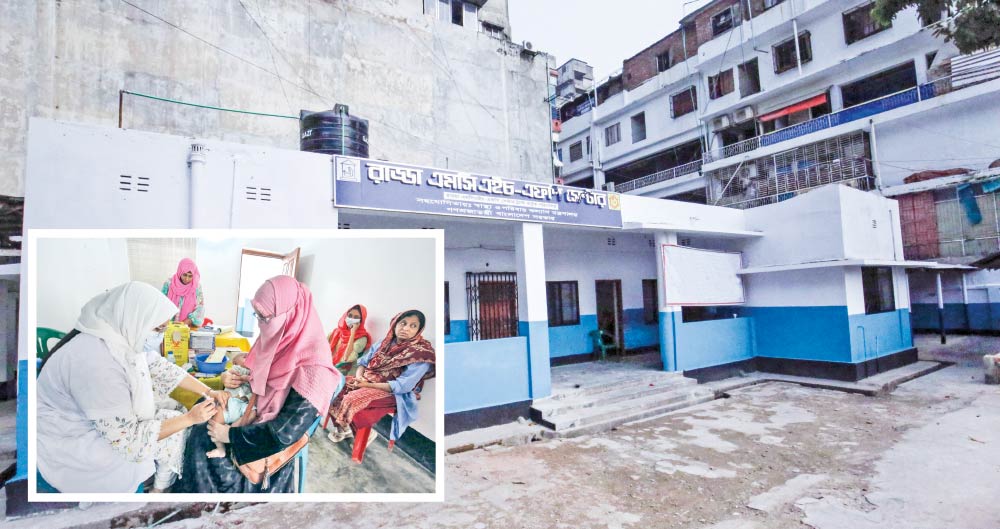 For Nasrin Akter, the Radda Centre in Mirpur-1, Dhaka, is more than a healthcare facility. It is a trusted refuge for families who cannot afford costly medical care.
The middle-aged woman recently brought her grandchild to the centre for vaccination, relieved to find its doors open again after the facility was ransacked and partially demolished in September.
“I am getting medical advice and vaccinations for my grandchild free of charge. They have asked me to return in a month for another dose,” the grandmother told this correspondent.
Nasrin knows the value of the centre from personal experience. Her husband and son work as rickshaw pullers, and the family lives near Shah Ali Mazar. When her daughter gave birth, she received treatment at the centre. Now, she has returned with the next generation of her family, hoping to secure the healthcare they need without straining their limited means.
“For poor people like us, this Radda Health Centre is a friend and a source of support. Many people like me receive medical care here free of charge or at a low cost,” she said.
The destruction of the facility, she added, had struck at a vital source of support for disadvantaged families. She called for those responsible to be identified and brought to justice.
The centre, which has served low-income communities in Mirpur for more than five decades, is now struggling to rebuild not only its damaged premises but also its capacity to provide essential healthcare.
At midnight on September 24, more than 200 masked people armed with locally made weapons stormed the Radda MCH-FP Centre. They held security guards hostage, looted medicines, vaccines, medical equipment and other supplies, and used heavy machinery to demolish parts of the facility, including walls and other structures.
The attack disrupted services at a centre that has long been a source of affordable maternal and child healthcare for local families.
Staff resumed limited vaccination services the following day, determined to continue serving patients despite the damage. After restoration work, State Minister for Youth and Sports Aminul Haque formally handed the centre back to its authorities on October 10.
During a visit on Sunday, the signs of recovery were visible. The two single-storey buildings-one for healthcare services and the other for administration-had been painted sky blue and white. New doors, windows and electric fans had been installed, the damaged boundary walls rebuilt and a new signboard put up. Workers had also repaired a tin-roofed structure and the staff dining room, while a new water connection and taps had been installed.
Police personnel guarded the main entrance as medical consultations and vaccinations resumed in two rooms. Yet, beneath the fresh paint and repaired walls, the centre's struggle to return to normal was evident.
Rezia Begum arrived with her one-month-old son for vaccination. Concerned that part of the baby's leg felt hard, she sought advice and explained that the child had previously been admitted to a hospital. The baby was subsequently vaccinated.
For mothers like Rezia and grandparents like Nasrin, the reopening means renewed access to essential healthcare close to home. More than 100 people are now visiting the centre daily, although attendance remains far below its pre-attack level.
Established in 1974 to serve disadvantaged and low-income residents of Mirpur, the Radda MCH-FP Centre has provided childhood vaccinations, paediatric care, reproductive health services and family planning support for decades. For many families, its affordable services have helped bridge the gap between their healthcare needs and their ability to pay.
Noor Mohammed Khan, deputy clinical in-charge of the centre, said an average of 300 to 400 people visited daily before the attack.
“We provide government and private-sector vaccinations, along with maternal and child healthcare services. Pregnant women used to receive routine check-ups here, and ultrasound facilities were also available. However, deliveries were not conducted at the centre. Patients requiring delivery services were referred to hospitals,” he said.
Although services have resumed following the repairs, three rooms at the rear of the facility remain unrestored. Daily attendance has fallen to between 100 and 150 people, Khan said, expressing hope that patient numbers would recover once the centre was fully operational.
For now, however, the centre faces a shortage of the furniture and medical equipment needed to restore its services fully.
Nasrin Akter, executive director of the centre, told The Daily Observer that the rebuilding work had repaired the premises, but the facility still lacked essential resources.
“Although police have recovered some items, we still need to assess whether they are usable. Additional equipment and other arrangements are required to resume healthcare services fully,” she said.
The shortages have left the centre's authorities with difficult choices. They must continue providing care with limited space and resources, even as they work to restore the services that once drew hundreds of patients each day.
“We have to adapt to the circumstances and continue our work with the space available to us. At present, we do not have the financial capacity to undertake another reconstruction or construction project. If we receive assistance from the government or other sources in the future, we will consider our options,” Nasrin said.
Beyond the immediate challenges of rebuilding, the centre also faces questions over the land on which it has operated since 1974.
Nasrin said the centre began operating under an agreement signed that year, but its authorities were unaware that the land had subsequently been allocated under another name.
Asked about the next steps, she said the matter would have to be settled through legal proceedings and declined to comment further.
At the handover ceremony on October 10, State Minister Aminul Haque said those involved in disorder and wrongdoing could not claim political affiliation as a shield. He also expressed hope that the remaining suspects and the alleged masterminds behind the attack would soon be brought to justice.
For the moment, the centre's return offers a measure of relief to families who depend on its services. But its recovery remains incomplete. Repaired walls and reopened rooms have brought healthcare back within reach, while shortages of equipment, furniture and space continue to limit what the facility can provide.
For Nasrin and countless other low-income families, the hope is simple: that the centre will once again be able to offer the affordable care they have relied on for generations.

Loading...
Loading...
Also read



Editor : Iqbal Sobhan Chowdhury
Published by the Editor on behalf of the Observer Ltd. from Globe Printers, 24/A, New Eskaton Road, Ramna, Dhaka.
Editorial, News and Commercial Offices : Aziz Bhaban (2nd floor), 93, Motijheel C/A, Dhaka-1000.
Phone: PABX- 41053001-06; Advertisement: 41053012; 01793317829, 01550707291, E-mail: [email protected], [email protected] Online: email: [email protected] 41053014; 01550707297 Advertisement: 01550707296
Published by the Editor on behalf of the Observer Ltd. from Globe Printers, 24/A, New Eskaton Road, Ramna, Dhaka.
Editorial, News and Commercial Offices : Aziz Bhaban (2nd floor), 93, Motijheel C/A, Dhaka-1000.
Phone: PABX- 41053001-06; Advertisement: 41053012; 01793317829, 01550707291, E-mail: [email protected], [email protected] Online: email: [email protected] 41053014; 01550707297 Advertisement: 01550707296


