



| HEADLINE |

|

YouTube inspires Sirajganj farmer to grow Thai watermelon
Published : Sunday, 11 October, 2026 at 11:39 AM
Observer Online Report


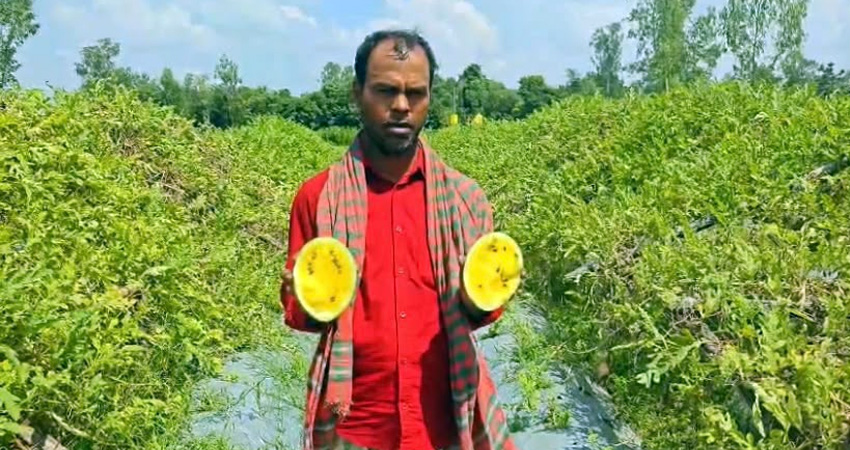
A farmer in Sirajganj is expecting a profit of around Tk 1.8 lakh from cultivating Thailand's high-yielding hybrid Kania watermelon on 20 decimals (Shotangsho) of land after learning about the variety through YouTube videos.
Hasibur Rahman, a farmer from Mugbelai village under Bhadra Ghat Union in Kamarkhand upazila, has drawn attention in his area by experimentally growing the new variety. He has spent around Tk 40,000 on cultivation and hopes to make a good profit if the yield and market prices remain favourable.
Striped green watermelons hang from rows of vines in his field. The fruit has a yellow interior and is known for its sweet taste. Local farmers have been visiting the field to see the variety and learn about its cultivation.
Hasibur said he began watching agricultural videos on YouTube out of an interest in growing new varieties alongside conventional watermelons. Through the videos, he learned about Thailand's Kania variety.
He later collected seeds and initially cultivated three varieties of watermelon. As the Kania plants showed better growth and yield, he became increasingly interested in the variety.
Encouraged by the results, he expanded its cultivation to 20 decimals of land. He also used online videos to learn about plant care, fertiliser application and pest and disease management.
“This year's yield has been good. I have spent around Tk 40,000. I hope to make a good profit if everything goes well,” Hasibur said.

Kamarkhand Upazila Agriculture Officer Md Farid Hossain said Hasibur had cultivated the hybrid Kania watermelon, which is suitable for year-round production.
He said the fruit has a striped green exterior and yellow flesh, and is tasty when ripe. The crop is now in the final stage of harvesting.
The agriculture officer described Hasibur as an enterprising farmer and said the agriculture department had previously arranged a demonstration of the variety in his field.
Hasibur's initiative has raised interest among local farmers in using technology and online resources to explore new crops. However, further experience is needed to assess production costs, market prices, pest and disease management, and long-term yield potential.
Hasibur hopes to expand cultivation next season if market demand and prices remain favourable. He believes agricultural advice and support could encourage other farmers to try new crop varieties.
-EM/SA

Loading...
Loading...
Also read








Editor : Iqbal Sobhan Chowdhury
Published by the Editor on behalf of the Observer Ltd. from Globe Printers, 24/A, New Eskaton Road, Ramna, Dhaka.
Editorial, News and Commercial Offices : Aziz Bhaban (2nd floor), 93, Motijheel C/A, Dhaka-1000.
Phone: PABX- 41053001-06; Advertisement: 41053012; 01793317829, 01550707291, E-mail: [email protected], [email protected] Online: email: [email protected] 41053014; 01550707297 Advertisement: 01550707296
Published by the Editor on behalf of the Observer Ltd. from Globe Printers, 24/A, New Eskaton Road, Ramna, Dhaka.
Editorial, News and Commercial Offices : Aziz Bhaban (2nd floor), 93, Motijheel C/A, Dhaka-1000.
Phone: PABX- 41053001-06; Advertisement: 41053012; 01793317829, 01550707291, E-mail: [email protected], [email protected] Online: email: [email protected] 41053014; 01550707297 Advertisement: 01550707296


