



| HEADLINE |

|

Who will save Dhaka’s roads? (Part I)



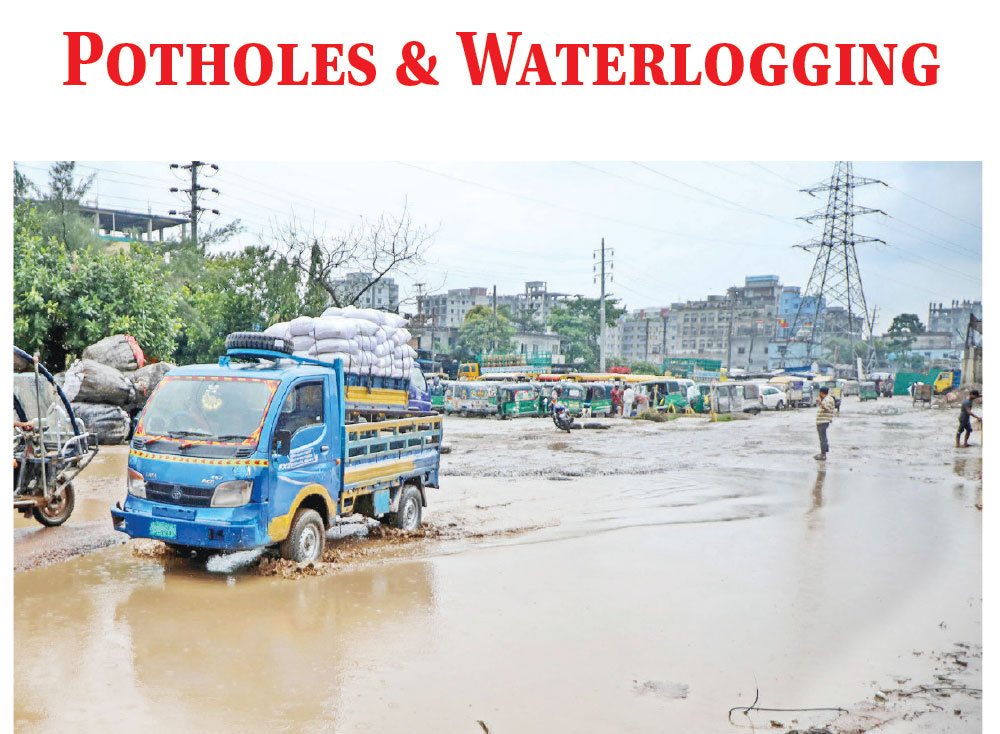 A tour of roads across the Dhaka South City Corporation (DSCC) area after the September 20 downpour found stretches where commuters were forced to negotiate deep potholes, broken surfaces, muddy lanes and waterlogged carriageways. In several places, roads cut for development work months ago remain unfinished, while others have deteriorated after years of inadequate repair.
The damage is widespread, stretching from the old city neighbourhoods of Bakshibazar, Lalbagh, Chawkbazar and Bangshal to Gendaria, Jatrabari, Jurain, Kadamtali, Basabo, Madartek, Nandipara, Malibagh, Khilgaon and other parts of the DSCC area.
The problem is not simply the result of heavy rain. Delayed repairs, unfinished excavation, drainage problems, limited funds and poor workmanship have combined to leave many roads in a deteriorating condition.
DSCC maintains about 1,656 kilometres of roads, of which around 120 kilometres need repair or construction. Last year, it improved 50 kilometres of roads, 37 kilometres of drains and 2 kilometres of footpaths. A special programme added around 17 kilometres of roads and 10 kilometres of drains.
This year, the corporation has allocated about Tk266 crore for roads, drains and footpaths and another Tk117 crore for the special programme. Engineers say the funds are limited and priority is being given to the worst-damaged roads.
Atish Dipankar Road is among the busiest. The Sayedabad-bound stretch from Mugda Hospital to Shaheed Sipahi Mostafa Kamal Stadium was cut around six months ago but has yet to be carpeted. Its broken surface has turned into a series of uneven lumps, making movement difficult.
In Sabujbagh, work on around 2.5 kilometres of the Basabo-Madartek-Nandipara road is under way. Drainage work has been completed and road repair is due to begin. The project was scheduled for completion on August 16, but only about half the work has been completed. Engineers say the contractor has been given until December to finish it.
The first 250 metres, still without drains, are badly damaged. Bricks placed in large holes have been washed away by rain, while prolonged construction has caused traffic congestion.
Nearby Basabo Buddhist Temple Road is also riddled with potholes. Engineers acknowledge the need for repairs but cite a lack of funds, saying a project is being prepared.
The same picture appears across the old city. Gendaria New Road, stretching about 1.75 kilometres from Dayaganj Mor towards Jurain Railgate, has deep holes at several points. At least four are one to one-and-a-half feet deep, with bamboo poles placed in the carriageway to warn motorists. Another 11 damaged spots have been identified.
After rain, the holes disappear under water, while waterlogging can persist for days. On nearby Mir Hazirbagh Road, drain water flows across the uneven surface, forming foul-smelling pools in the potholes.
Damage is also visible on roads across Bakshibazar, Lalbagh, Chawkbazar, Begum Bazar, Bangshal, Swamibagh, Kaltabazar, Armanitola, Sutrapur, Jatrabari, Jurain and Kadamtali. Sections of Pilkhana Road towards New Market are in poor condition, while narrow Agamasi Lane becomes muddy and difficult for pedestrians after rain.
Roads around Hatirpool, Paribagh, Sonargaon Road, Green Road, Dhanmondi and Moghbazar also show signs of deterioration. From Tikatuli towards the Hanif flyover near Rajdhani Super Market, vehicles struggle along a heavily rutted surface.
The roads around Sayedabad bus terminal, through which hundreds of buses travel daily, are particularly concerning. Large potholes have developed through prolonged neglect, and passengers have reportedly been injured after falling into holes obscured by rainwater.
Dayaganj resident Ripon Das said roads connecting Dayaganj with Jatrabari and Jurain have remained in poor condition for three or four years, causing frequent accidents.
Tikatuli resident Akbar Ali questioned the timing of road excavation, saying work is often carried out during the rainy season despite the usual restriction.
According to city corporation sources, excavation and development work is normally restricted between April 1 and August 31 to minimise disruption during the monsoon, although routine repairs continue throughout the year. This year, however, repairs stopped completely for several months.
Urban planners point to heavy vehicles and poor workmanship as additional reasons for recurring road damage. They also argue that an annual road map setting out where and when excavation will take place could reduce prolonged disruption and repeated damage.

Loading...
Loading...
Also read



Editor : Iqbal Sobhan Chowdhury
Published by the Editor on behalf of the Observer Ltd. from Globe Printers, 24/A, New Eskaton Road, Ramna, Dhaka.
Editorial, News and Commercial Offices : Aziz Bhaban (2nd floor), 93, Motijheel C/A, Dhaka-1000.
Phone: PABX- 41053001-06; Advertisement: 41053012; 01793317829, 01550707291, E-mail: [email protected], [email protected] Online: email: [email protected] 41053014; 01550707297 Advertisement: 01550707296
Published by the Editor on behalf of the Observer Ltd. from Globe Printers, 24/A, New Eskaton Road, Ramna, Dhaka.
Editorial, News and Commercial Offices : Aziz Bhaban (2nd floor), 93, Motijheel C/A, Dhaka-1000.
Phone: PABX- 41053001-06; Advertisement: 41053012; 01793317829, 01550707291, E-mail: [email protected], [email protected] Online: email: [email protected] 41053014; 01550707297 Advertisement: 01550707296


