



| HEADLINE |

|

Social Media Trolling
The Mob in the Online Landscape



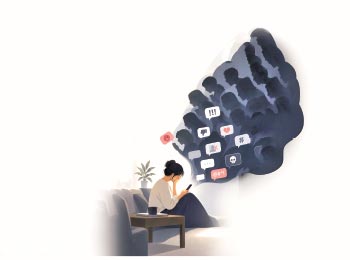 A person can now be surrounded without anyone entering the room. She sits alone at home, yet within minutes hundreds of hostile voices reach the same screen, the same inbox, the same private life. A photograph is doctored, a rumour is pinned to her name, one vulgar remark breeds a thousand more, and what began as a post ends as a public trial.
We call it trolling, as though the word itself were a licence for mischief. It is time we stopped.
Criticism is the lifeblood of democracy. Article 39 of the Constitution guarantees freedom of thought, conscience and speech, while the UN Human Rights Council has affirmed that rights enjoyed offline must also be protected online. Citizens may mock a minister, attack a policy and express an unpopular opinion. Calling a politician incompetent is not the same as threatening to kill him. Satire is not blackmail, and criticism is not doxxing.
The line is crossed when abuse becomes targeted, repeated or coordinated: threats of rape or death, exposure of home addresses, impersonation, sexual humiliation, fabricated allegations and extortion. Then trolling ceases to be mere bad behaviour and enters the territory of security, privacy and equal participation in public life.
A crowd with a keyboard
Trolling rarely begins with technology. The internet merely gives old human impulses a faster and wider road.
Fanaticism can turn disagreement into hostility. Extremism can reduce society to friends and enemies. Misogyny and patriarchy can make a woman’s voice, appearance or public presence a provocation. Jealousy can turn another person’s success into an offence. Offline rivalries, political enmities and personal grudges can cross the screen and suddenly acquire thousands of spectators.
Then come cyber gangs and coordinated networks. A doctored photograph becomes a digital teaser; the teaser attracts sexual comments; the comments draw more viewers; the crowd grows; and the victim finds herself facing not one abuser but a moving wall of hostility.
In some online subcultures, sexual frustration is also expressed through sexualised insults, humiliation and threats. It would be wrong to suggest that sexual frustration itself produces trolling. But when it meets misogyny, anonymity and group encouragement, it can become another ingredient in online sexual aggression.
Bangladesh's numbers show how serious the problem is. The 2024 Violence Against Women Survey, conducted by the Bangladesh Bureau of Statistics with UNFPA, found that 8.3 per cent of women surveyed had experienced technology-facilitated violence, rising to 10.3 per cent in urban areas. Police Cyber Support for Women had received complaints from 60,808 women by May 2024, with doxxing accounting for 41 per cent of reported cases.
Most victims remain silent. Nearly 75 per cent reportedly refrain from complaining because of stigma and fear of humiliation, while an ActionAid study found that almost two thirds of those who complained saw no action.
Behind those figures are ordinary lives. Schoolteacher Beauty Rani Pal posted a short video of herself walking around her school grounds. Misleading captions turned it into a scandal and strangers demanded her punishment, although no wrongdoing was found. Activist Maisha Mahjabeen Priooty received repeated rape and assault threats and began hiding her face in public, fearing that digital hatred might follow her into the street.
For women in politics, the hostility is often more explicitly sexual. An analysis of 139 posts targeting 15 women who rose to prominence during the July Uprising found that nearly two thirds contained sexual insults or attacks on character, while at least 11 carried explicit threats of violence.
Their opponents changed. The misogyny did not.
When the screen becomes a weapon
There is a dangerous progression from insult to persecution. An old enemy releases a humiliating image. A rival adds a rumour. A cyber group amplifies it. Strangers begin searching for the victim's family, workplace or address. What began as a personal quarrel becomes a collective punishment.
Suicide rarely has a single cause, and responsible reporting must acknowledge that. Yet online cruelty can form part of a chain of events with devastating consequences.
In Bauphal, a 16-year-old girl died in March 2025 after months of stalking, culminating in a photograph posted with mocking remarks. Law student Fairuz Sadaf Abontika took her own life in 2024 after alleging harassment both online and offline.
Beyond Bangladesh, Amanda Todd was tormented by an extortionist using multiple identities; Japanese wrestler Hana Kimura was subjected to relentless online abuse; and an inquest into the death of British teenager Molly Russell concluded that what she viewed online contributed to her death in more than a minimal way.
A 2026 meta-analysis of 125 studies involving more than 260,000 participants linked cyberbullying victimisation with depression, anxiety, self-harm and suicidality.
But there are quieter deaths too.
A woman stops posting photographs. A journalist abandons a subject. A student deactivates an account. Someone retreats from public life because an anonymous crowd has made visibility frightening.
The person survives. A part of her public life does not. UN Women's Tipping Point report found that seven in ten women human rights defenders, activists and journalists had faced online violence linked to their work. Forty-two per cent connected online attacks with offline harm, while nearly one in four reported AI-assisted abuse such as deepfakes. UNESCO found that 45 per cent of women journalists surveyed had self-censored.
Trolls do not win arguments. They empty the room.
The Rohingya crisis showed how dangerous that room can become. Amnesty International concluded that Facebook's algorithms substantially contributed to the atrocities against the Rohingya in 2017, which drove more than 700,000 people into Bangladesh. Hatred at that scale becomes persecution with a delivery system.
Draw the line, but draw it carefully
Calling trolling a rights violation must never become an excuse for censorship. A democracy cannot criminalise every offensive opinion. Precision is essential. The law should target the pattern and purpose of harassment, not merely its unpleasantness.
Bangladesh has taken steps through laws dealing with sextortion, blackmail, revenge pornography and the disclosure of private information. But statutes alone cannot outrun a problem powered by anonymity, speed and numbers.
Police must stop asking victims what they did to deserve abuse. Documented harassment preceding a death deserves serious investigation. Platforms must recognise coordinated campaigns rather than treating each abusive post as an isolated incident. Newsrooms, universities and institutions need protection protocols.
And the rest of us have a simpler duty: do not join the mob. The internet did not abolish human rights. It multiplied the number of people capable of violating them.
A screen is not a border beyond which dignity ceases to apply.

Loading...
Loading...
Also read



Editor : Iqbal Sobhan Chowdhury
Published by the Editor on behalf of the Observer Ltd. from Globe Printers, 24/A, New Eskaton Road, Ramna, Dhaka.
Editorial, News and Commercial Offices : Aziz Bhaban (2nd floor), 93, Motijheel C/A, Dhaka-1000.
Phone: PABX- 41053001-06; Advertisement: 41053012; 01793317829, 01550707291, E-mail: [email protected], [email protected] Online: email: [email protected] 41053014; 01550707297 Advertisement: 01550707296
Published by the Editor on behalf of the Observer Ltd. from Globe Printers, 24/A, New Eskaton Road, Ramna, Dhaka.
Editorial, News and Commercial Offices : Aziz Bhaban (2nd floor), 93, Motijheel C/A, Dhaka-1000.
Phone: PABX- 41053001-06; Advertisement: 41053012; 01793317829, 01550707291, E-mail: [email protected], [email protected] Online: email: [email protected] 41053014; 01550707297 Advertisement: 01550707296


