



| HEADLINE |

|

Rooppur Unit-1 gets nod for first criticality


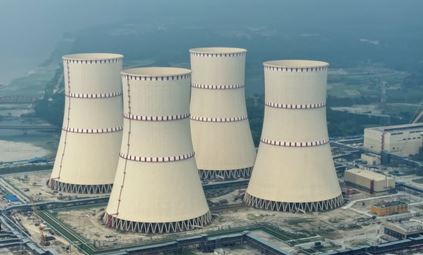
Collected Photo
Bangladesh Atomic Energy Regulatory Authority (BAERA) on Thursday (October 8) granted permission for Rooppur Nuclear Power Plant’s Unit-1 to achieve first criticality, allowing the reactor to begin a controlled nuclear reaction after delays and numerous obstacles.
When grid supply begins, Bangladesh will become the world’s 33rd country producing nuclear power. This will open a new chapter in the country’s energy security, scientific progress and technological advancement.
Project officials said the approval had been held up by complications involving the automatic pressure relief safety valves (PORV/POSV) in Unit-1. A team of experts from Russia resolved the problem using various techniques, and the system passed a series of tests.
As a result, trial supply of electricity to the national grid is now possible by late December.
Sources said first criticality had been a major challenge for Rooppur. With BAERA’s permission, the reactor will now begin a stable, self-sustaining nuclear chain reaction. This will formally mark the reactor’s transition from a static state to an active operational nuclear facility.
During the physical start-up phase, the reactor will be operated at less than 1 percent of its full rated thermal power to reach initial criticality. This is when the first self-sustaining nuclear chain reaction begins.
Key reactor parameters, systems, safety features and control equipment will be closely monitored and verified. The entire physical start-up process, including first criticality, may take about 30 to 40 days. If test results are satisfactory, reactor power will be increased in phases.
After physical start-up, the project will enter the power start-up phase. This will involve gradually raising reactor power, synchronising the turbine and eventually connecting the generator to the national grid.
For this, the operating organisation must obtain a trial operational licence from BAERA.
The power start-up phase poses significant technical and organisational challenges. It requires immediate and highly coordinated communication among the plant’s internal operations — the reactor, turbine and safety systems.
At the same time, strict and regulated technical and regulatory coordination must be ensured with various entities outside the plant.
Project officials said that once power generation begins, output will initially be raised to 3 percent and then gradually to 20-30 percent. After that, electricity can be supplied to the national grid.
Once generation starts, trial production may continue for seven to eight months.
-AH

Loading...
Loading...
Also read








Editor : Iqbal Sobhan Chowdhury
Published by the Editor on behalf of the Observer Ltd. from Globe Printers, 24/A, New Eskaton Road, Ramna, Dhaka.
Editorial, News and Commercial Offices : Aziz Bhaban (2nd floor), 93, Motijheel C/A, Dhaka-1000.
Phone: PABX- 41053001-06; Advertisement: 41053012; 01793317829, 01550707291, E-mail: [email protected], [email protected] Online: email: [email protected] 41053014; 01550707297 Advertisement: 01550707296
Published by the Editor on behalf of the Observer Ltd. from Globe Printers, 24/A, New Eskaton Road, Ramna, Dhaka.
Editorial, News and Commercial Offices : Aziz Bhaban (2nd floor), 93, Motijheel C/A, Dhaka-1000.
Phone: PABX- 41053001-06; Advertisement: 41053012; 01793317829, 01550707291, E-mail: [email protected], [email protected] Online: email: [email protected] 41053014; 01550707297 Advertisement: 01550707296


