



| HEADLINE |

|

BD feels the heat as US apparel market shrinks
Published : Thursday, 8 October, 2026 at 12:00 AM
Mizanur Rahman


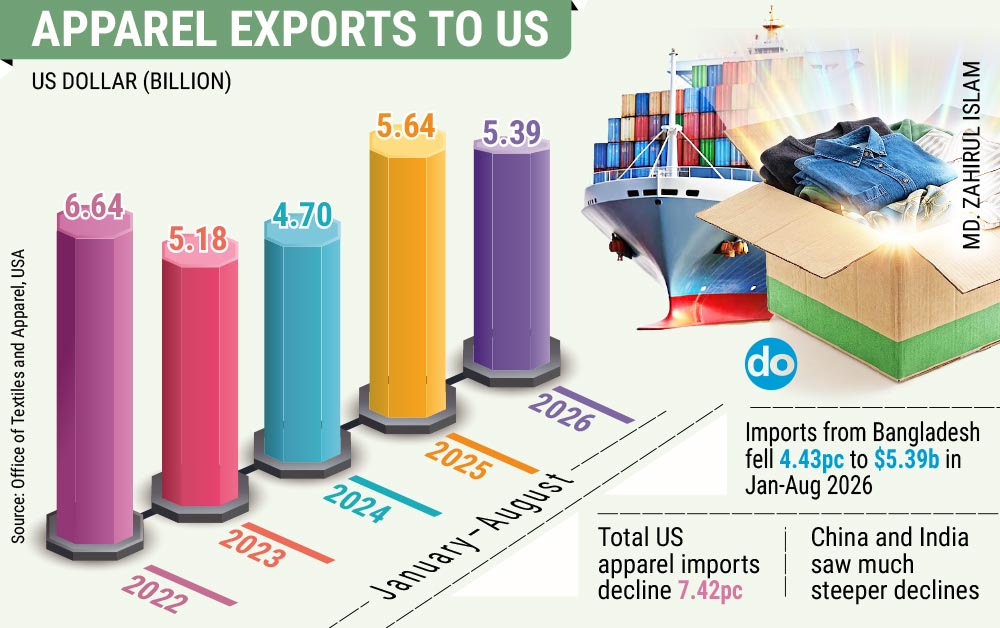 The US apparel market is shrinking, and Bangladesh is feeling the pressure �" but not as sharply as many of its major Asian competitors.
The imports from Bangladesh fell 4.43 per cent year-on-year to $5.39 billion in the January-August period of 2026. Yet the country's shipments staged a strong rebound in August, rising 11.15 per cent from the same month a year earlier, according to data from the US Office of Textiles and Apparel (OTEXA).
The contrasting figures point to a market undergoing a broader adjustment rather than a setback confined to Bangladesh. Total US apparel imports declined 7.42 per cent to $49.08 billion in the first eight months, while import volume fell 8.98 per cent in square metre equivalent (SME).
What makes Bangladesh's performance notable is its relative resilience. Imports from China, the largest supplier, plunged 29.39 per cent, while India recorded a 26.44 per cent decline. Pakistan's shipments fell 3.83 per cent and Vietnam's 0.76 per cent. In contrast, imports from Indonesia increased 2.58 per
cent and Cambodia 6.91 per cent.
But beneath Bangladesh's comparatively modest decline lies a more worrying trend: prices are under pressure.
Bangladesh's import volume fell 2.75 per cent in SME terms, while its average unit price declined 1.73 per cent. This came even as the overall US apparel market recorded a 1.71 per cent increase in average unit prices.
The divergence highlights the growing pressure on Bangladeshi exporters to offer more competitive prices while dealing with rising production costs.
China's import volume fell 21.61 per cent, accompanied by a sharp 9.93 per cent drop in unit price. India's volume declined 24.91 per cent and its unit price 2.04 per cent. Pakistan's volume fell only 0.27 per cent, but its unit price dropped 3.57 per cent.
Meanwhile, Indonesia and Cambodia increased both import value and volume, although their unit prices fell 5.49 per cent and 0.25 per cent respectively.
Mohiuddin Rubel, founder and CEO of Bangladesh Apparel Voice (BAV), said the August rebound was encouraging, but the cumulative figures showed that the industry remained under pressure.
“The August growth is certainly a positive sign, but the cumulative figures show that Bangladesh is still facing pressure in the US market. The decline in both volume and unit price means exporters have to compete more aggressively,” Rubel said.
He said Bangladesh's relatively smaller decline compared with some major competitors demonstrated the resilience of the apparel industry, but exporters would need to focus increasingly on product diversification, efficiency and higher-value garments.
For the Bangladesh Garment Manufacturers and Exporters Association (BGMEA), the figures also underscore the need to address the industry's domestic cost pressures.
BGMEA President Mahmud Hasan Khan said exporters were facing rising production costs and increasing competition in international markets.
Ensuring competitive energy prices, improving port and customs efficiency and reducing the overall cost of doing business would be crucial to maintaining Bangladesh's position in the US market, he said.
“Bangladesh has to improve its competitiveness continuously. We cannot depend only on low-cost production. We need to move towards higher-value products and strengthen productivity,” he said.
A senior BGMEA leader said the decline in imports from several major sourcing countries suggested that the US market was undergoing a broader adjustment rather than Bangladesh simply losing market share.
“Bangladesh has remained comparatively resilient. But the fall in unit prices is a concern because manufacturers are already facing higher costs. If prices remain under pressure, exporters' margins will be squeezed further,” he said.
The shifting sourcing pattern also points to a changing competitive landscape. While China suffered the steepest decline among major suppliers, Cambodia and Indonesia expanded their presence in the US market, increasing both import value and volume.
For Bangladesh, industry insiders say the next phase of competition will depend less on cheap labour and more on the ability to offer a wider range of products at competitive prices.
They stressed the need for greater investment in man-made fibre products, technical textiles, design and product development, alongside productivity gains and technological upgrading.
Such changes are becoming increasingly important as US buyers seek lower prices without compromising quality, compliance or delivery times.
Bangladesh remains one of the world's largest apparel exporters, with the US among its most important individual markets. The strong August rebound offers some encouragement, but the eight-month figures show that the industry cannot rely on volume growth alone.
The challenge for Bangladeshi exporters is becoming clearer: hold on to market share in a weaker US market while moving up the value chain before falling prices and rising costs squeeze margins further.

Loading...
Loading...
Also read



Editor : Iqbal Sobhan Chowdhury
Published by the Editor on behalf of the Observer Ltd. from Globe Printers, 24/A, New Eskaton Road, Ramna, Dhaka.
Editorial, News and Commercial Offices : Aziz Bhaban (2nd floor), 93, Motijheel C/A, Dhaka-1000.
Phone: PABX- 41053001-06; Advertisement: 41053012; 01793317829, 01550707291, E-mail: [email protected], [email protected] Online: email: [email protected] 41053014; 01550707297 Advertisement: 01550707296
Published by the Editor on behalf of the Observer Ltd. from Globe Printers, 24/A, New Eskaton Road, Ramna, Dhaka.
Editorial, News and Commercial Offices : Aziz Bhaban (2nd floor), 93, Motijheel C/A, Dhaka-1000.
Phone: PABX- 41053001-06; Advertisement: 41053012; 01793317829, 01550707291, E-mail: [email protected], [email protected] Online: email: [email protected] 41053014; 01550707297 Advertisement: 01550707296


