



| HEADLINE |

|

Battling on all fronts: How govt is tackling the energy crisis
Published : Tuesday, 6 October, 2026 at 1:59 PM
Shahman Abir


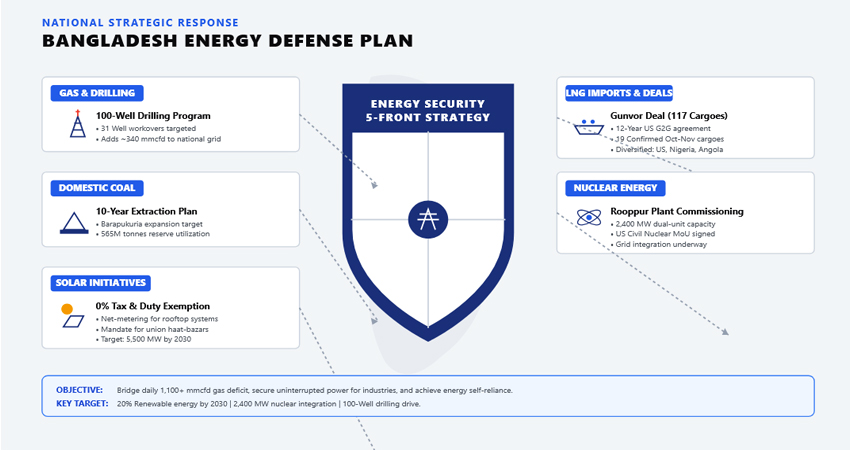
The government is actively combating the gas and Liquefied Natural Gas (LNG) crisis through intensified local drilling, long-term LNG supply agreements, domestic coal utilization, solar energy expansion, and nuclear power integration.
A daily gas deficit exceeding 1,100 million cubic feet per day (mmcfd)—exacerbated by falling domestic reserves and ongoing geopolitical conflicts in the Middle East—has placed pressure on national energy security. However, comprehensive measures are underway across multiple fronts to stabilize supply for domestic industries and power generation.
Prime Minister Tarique Rahman assured the business community on September 14 that the gas shortfall would be mitigated. Over the past several weeks, concrete administrative and strategic actions have been taken to fulfill that commitment.
The current energy stringency originated in late July 2026 following an emergency fire incident at the Floating Storage and Regasification Unit (FSRU) operated by Excelerate Energy. The crisis was further compounded by global energy market disruptions arising from the US-Iran conflict.
In response, the administration initiated immediate policy interventions to secure relief across key economic sectors.
Local Wells: Strategic Drilling Push
Domestic gas fields remain the primary source of national supply. On September 15, domestic production contributed approximately 1,620 mmcfd, while the two floating LNG terminals supplied 990 mmcfd, bringing total daily distribution to 2,610 mmcfd.
Petrobangla is expediting the drilling and workover of active and idle wells. Earlier in January, the agency announced that work on 11 targeted wells would add roughly 143 mmcfd to the national grid. Under a broader long-term framework, plans are in place to drill 100 new wells and complete workovers on 31 existing ones.

To date, the drilling drive has integrated 126 mmcfd into the national pipeline network, achieving 35.6 per cent of its initial 353 mmcfd target. Officials attributed the shortfall to sub-surface geological complexities, water encroachment, and transmission bottlenecking.
Efforts are ongoing, with eight wells currently undergoing active drilling or workover procedures, holding a combined potential yield of 90 mmcfd. An additional 26 priority wells are slated for intervention, which could add an estimated 340 mmcfd upon completion.
Gunvor Agreement and Confirmed Cargoes
Dhaka has secured long-term LNG imports from the United States to stabilize supply. On August 12, the Cabinet Committee on Government Purchase approved a government-to-government agreement with Gunvor USA LLC in a meeting chaired by Finance Minister Amir Khosru Mahmud Chowdhury.
The contract encompasses 117 LNG cargoes between 2026 and 2038. 14 cargoes are scheduled for delivery between 2026 and 2028, indexed to the JKM plus $0.0875 per MMBtu benchmark.

The remaining 103 cargoes will be delivered between 2029 and 2038 at a rate of 10 cargoes annually, tied to the US Henry Hub index. Gunvor is set to deliver five cargoes within the current year, with the initial vessel, "LNG Geneva," having already arrived.
Near-term requirements have also been managed. Petrobangla has confirmed 19 LNG cargoes for October and November. Petrobangla Chairman Md Abdul Mannan confirmed that nine cargoes for November are fully scheduled, while 10 cargoes are slated for October arrival.
Of the October shipments, three were sourced from the spot market, two via long-term contracts, and five under short-term procurement arrangements. For November, six cargoes will arrive under long-term agreements and three via short-term contracts. Sourced from the United States, Nigeria, and Angola, these combined shipments represent approximately 60.8 million MMBtu of natural gas.
Coal Utilization Strategy
To reduce reliance on costly foreign fuel, the government led by Prime Minister Tarique Rahman has initiated a long-term strategy to utilize domestic coal reserves. Bangladesh currently imports nearly 17 million tonnes of coal annually, incurring an import expenditure ranging between Tk 15,000 crore and Tk 20,000 crore.
In contrast, domestic deposits across five major fields hold an estimated 7,912 million tonnes of coal—a volume capable of sustaining national power demands for over three centuries, even at an elevated consumption rate of 20 million tonnes per year.
Data from the Energy Division indicates that extracting 20 per cent of these domestic reserves (1,564 million tonnes) would yield energy equivalent to 40 TCF of natural gas. Imported LNG currently meets 25 to 30 per cent of national gas demand, costing between Tk 50,000 crore and Tk 60,000 crore annually, with government subsidies reaching Tk 20,000 crore.
The ten-year coal extraction framework targets the recovery of 565 million tonnes from domestic fields. Strategic components of the initiative include:
• Barapukuria Expansion: Execution phase scheduled between 2026 and 2030.
• Extraction Goals: A target to extract 160 million tonnes from Barapukuria between 2031 and 2035.
• Infrastructure Links: Evaluation of direct railway networks connecting coal fields to major power generation hubs.
• Power Generation: Feasibility studies regarding additional coal-fired power units at the Matarbari complex.
• Regulatory Policy: Formulation of a comprehensive National Coal Policy targeted for completion by June 2028.
Barapukuria remains the nation's sole active coal mine, holding 390 million tonnes in reserves. Operated by Barapukuria Coal Mining Company Limited, the site produces up to 950,000 tonnes annually, with cumulative extraction exceeding 16.469 million tonnes as of FY2025-26.
Industry experts, including Professor M Tamim of Independent University and former BERC member Maqbul-E-Elahi Chowdhury, have emphasized the necessity of independent risk assessments, advanced extraction technology, environmental safeguards, efficient water management, and rehabilitation structures to support domestic mining operations.
Solar Energy Framework and Market Mandates
The government is executing major policy shifts toward renewable energy. The FY2026-27 national budget eliminated import duties, regulatory duties, supplementary duties, and advance taxes on essential solar infrastructure components, including solar panels, inverters, and lithium-ion battery storage systems.
Furthermore, corporate income tax for the solar power sector has been reduced to zero per cent through 2035, while end-consumers receive a 5 per cent tax rebate on solar electricity payments. Subsequent notifications from the National Board of Revenue (NBR) exempted VAT and advance income tax, reducing the overall tax burden on imported solar equipment from 17 per cent to 1 per cent.

Private sector incentives have also been expanded. Energy Minister Iqbal Hasan Mahmud Tuku confirmed that the government is evaluating a five-year tax holiday alongside land allotment incentives for private utility-scale solar projects.
Under the net-metering framework, commercial and residential rooftop solar installations equipped with battery storage will receive Tk 10.50 per unit for surplus energy fed back into the national grid. To qualify for this tariff, systems must be operational between February 28, 2027, and February 28, 2030.
At the rural level, the Local Government Division issued a directive on September 24 mandating the installation of solar power systems across all rural markets and union-level commercial hubs (haat-bazars) by January 31, 2027. These systems must incorporate a minimum of two hours of battery backup, with excess generation fed directly into the national grid. The government aims to generate 20 per cent of national electricity—equivalent to 5,500 MW—from renewable sources by 2030.
Rooppur Nuclear Power Plant Integration
Construction at the Rooppur Nuclear Power Plant in Pabna, the nation's largest infrastructure project, is entering its operational phase. Built with technical assistance from Russia, the facility features two units with a combined generation capacity of 2,400 MW, expected to contribute roughly 10 per cent of Bangladesh's total installed electricity capacity.

On-site activities are being supervised by Russian specialists from Rosatom, with both parties agreeing on September 14 to accelerate final installation workflows. Technical guidance is also being coordinated with the International Atomic Energy Agency (IAEA).
Russian Ambassador Alexander Khozin stated on September 16 that initial trial power feeding of 300 MW to the grid could occur in the fourth quarter, with full commercial integration planned following required safety tests by December, followed by a seven-to-eight-month trial generation phase.
Upon operational synchronization, Bangladesh will become the 33rd nation globally to operate nuclear power generation facilities.
US Civil Nuclear Cooperation Agreement
Dhaka has expanded its international nuclear cooperation framework through a strategic agreement with Washington. On September 25, Bangladesh and the United States signed a bilateral Memorandum of Understanding (MoU) on strategic civil nuclear cooperation. The document was signed by Prime Minister’s Adviser Rehan Asif Asad and US Under Secretary Jacob Helberg.
The non-binding MoU establishes a framework for technical consultation among government departments, regulatory bodies, and industry experts, paving the way for a potential formal "123 Agreement" under US law. Both nations reaffirmed commitments to high standards of nuclear safety, security, operational safeguards, and non-proliferation under existing IAEA oversight. This agreement follows an earlier broader energy cooperation MoU signed with the US in May.
Impact of Middle East Conflict on LNG Imports
Global energy supply chains remain under severe strain due to the conflict in the Middle East, which began on February 28. Tanker transit through the Strait of Hormuz declined sharply following the escalation, prompting QatarEnergy to suspend operations on March 2 and declare force majeure.
Qatar serves as Bangladesh's primary long-term LNG supplier, delivering 40 cargoes annually under a 15-year bilateral contract. QatarEnergy has notified Bangladeshi authorities that cargo cancellations will extend through November.
The reduction in spot market availability pushed Asian spot LNG prices toward $30 per MMBtu, with shipping volumes through the Strait of Hormuz remaining substantially below pre-war baselines.
Government Coordination Strategy
The government has taken diverse approach to battle the energy crisis in which the whole world has fallen. Recently, US President Donald Trump asked European countries to release their diesel reserves to keep the oil barrels under $100 mark.
In such turbulent situation, steps taken by the BNP government is starting to ease Bangladesh’s domestic energy deficit.

Loading...
Loading...
Also read








Editor : Iqbal Sobhan Chowdhury
Published by the Editor on behalf of the Observer Ltd. from Globe Printers, 24/A, New Eskaton Road, Ramna, Dhaka.
Editorial, News and Commercial Offices : Aziz Bhaban (2nd floor), 93, Motijheel C/A, Dhaka-1000.
Phone: PABX- 41053001-06; Advertisement: 41053012; 01793317829, 01550707291, E-mail: [email protected], [email protected] Online: email: [email protected] 41053014; 01550707297 Advertisement: 01550707296
Published by the Editor on behalf of the Observer Ltd. from Globe Printers, 24/A, New Eskaton Road, Ramna, Dhaka.
Editorial, News and Commercial Offices : Aziz Bhaban (2nd floor), 93, Motijheel C/A, Dhaka-1000.
Phone: PABX- 41053001-06; Advertisement: 41053012; 01793317829, 01550707291, E-mail: [email protected], [email protected] Online: email: [email protected] 41053014; 01550707297 Advertisement: 01550707296


