



| HEADLINE |

|
Potential to earn thousands of crs annually from Carbon Credits
From agriculture to energy: BD builds framework to monetize carbon reduction
Published : Wednesday, 30 September, 2026 at 4:11 PM
Toriqul Islam Sumon


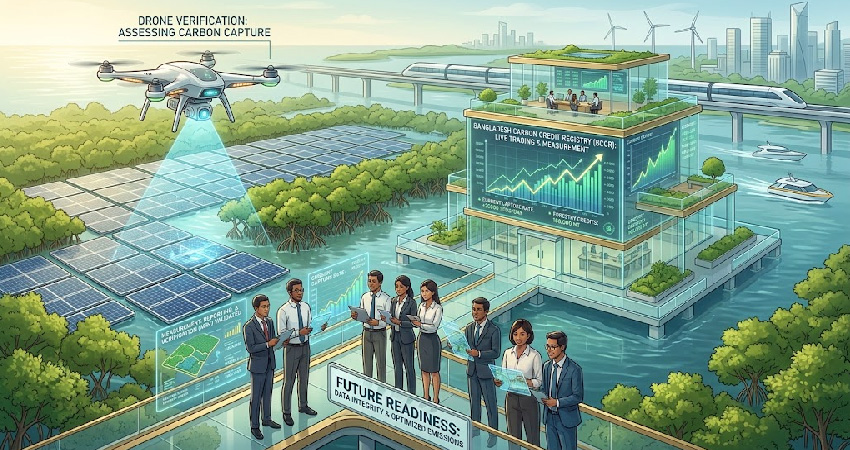
AI Illustration
Bangladesh is one of the countries most severely affected by climate change, despite contributing less than one percent to global greenhouse gas emissions. In this context, carbon credits have emerged not only as a tool to tackle climate risks but also as a potential new source of revenue. Local and foreign companies are showing growing interest in Bangladesh’s carbon market, with investment proposals pouring into the forestry, agriculture, and energy sectors. Prime Minister Tarique Rahman has already directed the authorities concerned to take necessary initiatives in this regard.
The government believes that with proper policies, modern technology, and international recognition, Bangladesh can earn thousands of crores of taka in foreign currency every year by selling carbon credits. Preparations have begun to enter the international carbon market. A carbon credit is a system where an individual, organization, or country receives recognition for reducing a specific amount of carbon dioxide or other greenhouse gas emissions. Generally, one carbon credit is awarded for reducing or absorbing the equivalent of one ton of carbon dioxide. These credits can later be sold in the international market, where companies from developed nations purchase them to meet their emission reduction targets.
Experts say opportunities to generate carbon credits exist across various sectors in Bangladesh, including forestry, agriculture, renewable energy, waste management, brick kiln modernization, solar power, biogas, and clean cooking stoves. Increasing investments in these sectors would help protect the climate while opening up new avenues for earning foreign currency. Although Bangladesh has not been very active in the international carbon market so far, the government is working on a national carbon market framework.
It has been learned that Bangladesh will participate in the international carbon market under Article 6 of the Paris Agreement. A national registry will be set up to store information on all carbon credit projects in the country. This will eliminate the risk of selling the same carbon credit multiple times and enhance the confidence of international buyers. Merely conserving forests will not suffice; to earn carbon credits, it must be proven that a project has genuinely reduced emissions or absorbed additional carbon. To achieve this, systems for measurement, reporting, and verification (MRV) in line with international standards must be established, which remains the most expensive and time-consuming part of the process.
According to Forest Department sources, several local and foreign organizations have submitted proposals for Memorandums of Understanding (MoUs) and expressed investment interest in afforestation on newly accreted land along the country’s coasts. These organizations include EcoSocial Solutions, Value Nature Venture, Bangladesh Bondhu Foundation, Arannayk Foundation, Mati Organic Limited, and the Institute of Water Modelling (IWM). Additionally, ATEC of Australia, EWC of South Korea, and Mitsui and Sumitomo of Japan are conducting feasibility studies for projects.
Coastal afforestation is expected to add 116,000 hectares of new land to Bangladesh’s existing landmass within five years, creating carbon trading opportunities for interested companies through plantation efforts on these newly accreted coastal lands.
An official from the Forest Department, speaking on condition of anonymity, stated that several companies have expressed interest in investing in carbon trading through afforestation. These investments will follow two models: direct investment and public-private partnerships (PPP).
Last June, the government established a authority named the Designated National Authority (DNA) under the Ministry of Environment, Forest and Climate Change to formulate policies regarding carbon trading and approve such projects. Bangladesh’s contribution to global carbon emissions stands at 0.48 percent.
Carbon trading is a market-based mechanism designed to reduce greenhouse gas emissions, including carbon dioxide. Under this system, governments or international bodies set caps on the maximum emissions allowed for a country, institution, or company. Entities exceeding their limits must purchase carbon credits from the market.
Sources revealed that the state-owned Infrastructure Development Company Limited (IDCOL) was the first to conduct carbon trading in the country. In 2006, IDCOL earned BDT 170 crore from carbon credits generated through solar home systems and improved cooking stoves. However, no further carbon trading took place for a long period as the framework governing it (the Kyoto Protocol) expired in 2020. The adoption of Article 6 of the Paris Agreement in 2024 revived the prospects of carbon trading. Currently, there are two types of carbon markets: compliance carbon markets and voluntary carbon markets. In a compliance carbon market, countries that fail to meet their emission reduction commitments offset their shortfalls by purchasing credits from other countries.
In a voluntary carbon market, companies purchase credits equivalent to their pollution levels to build an eco-friendly corporate image.
Environmental and climate experts note that international climate finance is falling short of expectations, making carbon credits a major new financing opportunity for Bangladesh. However, hastily approving projects carries the risk of damaging credibility in the international market. Therefore, maximum emphasis must be placed on transparency, accurate data, and strict supervision. The government's recent plans prioritize renewable energy, industry, transport, forestry, agriculture, and waste management sectors while working with international partners to build capacity for managing the carbon market.
Mirza Shawkat Ali, Director of Climate Change and International Conventions at the Department of Environment, said, "We are working on the carbon trading framework. In the plans we submitted, carbon trading has been given serious consideration. We plan to meet 40 to 50 percent of our NDC targets through carbon trading." He added that Japanese company Mitsui is implementing an Alternate Wetting and Drying (AWD) project on 250,000 hectares of cropland to reduce excess water use. This method increases production by 10 percent with less water while reducing methane emissions.
Sumitomo aims to reduce methane emissions by fixing gas pipeline leaks. Meanwhile, Australia’s ATEC and South Korea’s EWC are implementing projects to promote clean cooking stoves over conventional gas stoves.
Agriculture, Fisheries, and Livestock Could Be Major Strengths
Experts view agriculture, fisheries, and livestock as the sectors with the greatest potential to boost revenue from carbon credits, as nearly half of Bangladesh's population remains involved in agriculture. The country possesses vast agricultural lands, wetlands, coastal areas, haors, forests, and rich fisheries resources. With proper planning, these sectors could significantly reduce carbon emissions and create extensive opportunities for carbon sequestration.
According to agricultural experts, substantial carbon reductions can be achieved by lowering methane emissions from rice cultivation, using balanced fertilizers, applying organic fertilizers, practicing conservation agriculture, refraining from burning crop residues, and adopting solar-powered irrigation. If verified internationally, these activities can yield carbon credits.
The Ministry of Agriculture is already implementing programs for smart agriculture, soil health improvement, organic fertilizer usage, agricultural mechanization, and the expansion of climate-resilient crops. While these projects are not directly aimed at carbon credits, opportunities exist to link them with the international carbon market in the future.
Under the Ministry of Fisheries and Livestock, efforts are underway regarding sustainable fishing, wetland conservation, biofloc technology, and eco-friendly farm management. Furthermore, coastal mangrove forests, seagrass, and wetlands absorb massive amounts of carbon; conserving them could generate credits in the international carbon market. However, no standalone national project dedicated to earning carbon credits has been launched in these sectors yet. Experts emphasize the urgent need to formulate dedicated policies.
The livestock sector also presents new opportunities. Methane emissions can be curtailed by producing biogas from livestock waste, manufacturing organic fertilizer from dung, utilizing solar energy on farms, and improving feed management. Registering these initiatives as carbon credit projects would allow farmers to earn supplementary income. Experts point out that Bangladesh has millions of smallholder farmers; while an individual farmer’s land may not generate many credits, aggregating thousands of farmers into large-scale projects can make international market participation feasible through cooperative or cluster-based initiatives.
Several studies on carbon credits have already been conducted in Bangladesh.
The Centre for Policy Dialogue (CPD) has emphasized that before entering the international market, Bangladesh must ensure a strong legal framework, an accurate database, and transparent management; otherwise, the country will fail to reap the expected benefits. Their research stressed the importance of developing skilled manpower and establishing reliable carbon measurement systems. The International Union for Conservation of Nature (IUCN) and several development partners are also researching carbon market prospects centered on Bangladesh’s forests, wetlands, and coastal ecosystems. In their view, nature conservation and economic development can be achieved simultaneously.
Sources from the Ministry of Commerce indicated that Bangladesh highlighted its preparations to participate in the international carbon market at COP30 in Belém, Brazil. As Bangladesh transitions from Least Developed Country (LDC) status, many of its preferential trade benefits will gradually diminish, requiring export-oriented industries to become more competitive globally. Furthermore, markets in Europe and elsewhere are placing greater emphasis on environmental standards, carbon footprints, and green production. Under these circumstances, carbon credits and low-carbon manufacturing systems could offer fresh opportunities for Bangladeshi industries. Eco-friendly enterprises will gain greater acceptance among foreign buyers, making it easier to retain export markets. Business leaders agree that expanding renewable energy use and boosting energy efficiency in industries like ready-made garments, leather, ceramics, and agro-processing is now a necessity.
Dr. Saimum Parvez, Special Assistant to the BNP Chairperson’s Foreign Affairs Advisory Committee, stated that the current government plans to plant 250 million trees over five years. "We have seen that if this project is successfully implemented, we could receive nearly 1 billion USD annually solely by selling carbon credits generated through tree planting. This will benefit the environment by lowering temperatures, increasing rainfall, and improving soil quality, while creating significant economic opportunities." He noted that mangrove trees absorb the highest amount of carbon from the environment, which is why mangrove afforestation in coastal areas is receiving priority. Thousands of hectares of newly emerged, unpopulated chars in the Meghna basin, Hatiya, and other coastal stretches stretching from the Sundarbans to Cox’s Bazar will be targeted for afforestation.
Dr. M. Abu Eusuf, Professor at Dhaka University and Executive Director of Research and Policy Integration for Development (RAPID), stated that renewable energy adoption not only reduces costs but can also generate extra revenue through carbon credit sales. Although a full-fledged carbon trading system has not yet developed in Bangladesh, creating the right framework will make selling credits in the international market possible. Bangladesh’s industrial sector currently stands at a crossroads where balancing economic development with environmental protection is imperative. Having committed to emission reductions under the Paris Agreement, carbon credit trading offers a key mechanism to help industrial enterprises offset their carbon footprint.
Globally, the climate-driven carbon market is expanding rapidly. Building on trends from 2023–24, revenue from the global carbon pricing market reached USD 107 billion in 2025, up nearly 2 percent from the previous year. The total capacity of this market currently stands at approximately USD 250 billion and is projected to reach USD 1 trillion by 2050, driven primarily by private sector investments.
-SA
Loading...
Loading...
Also read







Editor : Iqbal Sobhan Chowdhury
Published by the Editor on behalf of the Observer Ltd. from Globe Printers, 24/A, New Eskaton Road, Ramna, Dhaka.
Editorial, News and Commercial Offices : Aziz Bhaban (2nd floor), 93, Motijheel C/A, Dhaka-1000.
Phone: PABX- 41053001-06; Advertisement: 41053012; 01793317829, 01550707291, E-mail: [email protected], [email protected] Online: email: [email protected] 41053014; 01550707297 Advertisement: 01550707296
Published by the Editor on behalf of the Observer Ltd. from Globe Printers, 24/A, New Eskaton Road, Ramna, Dhaka.
Editorial, News and Commercial Offices : Aziz Bhaban (2nd floor), 93, Motijheel C/A, Dhaka-1000.
Phone: PABX- 41053001-06; Advertisement: 41053012; 01793317829, 01550707291, E-mail: [email protected], [email protected] Online: email: [email protected] 41053014; 01550707297 Advertisement: 01550707296


