



| HEADLINE |

|
UNDP links five campuses with recyclers to curb plastic pollution
Published : Tuesday, 29 September, 2026 at 3:38 PM
Staff Correspondent


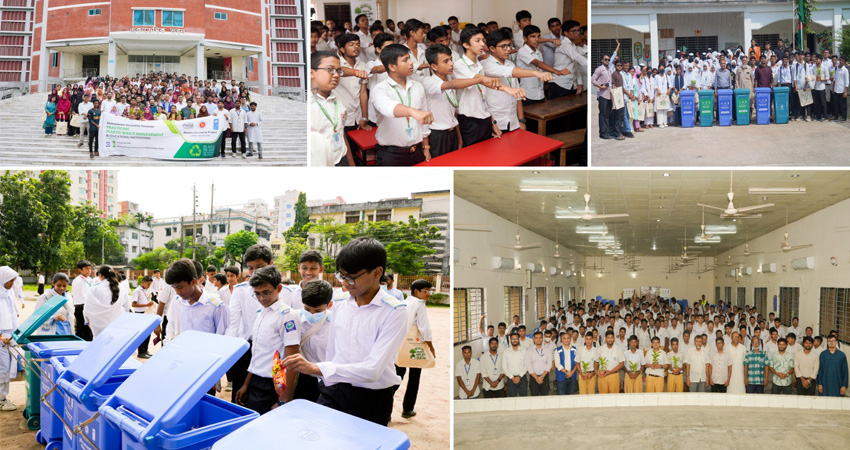
A month-long campaign by the United Nations Development Programme (UNDP) has connected five educational institutions in Tangail, Chittagong and Cox’s Bazar with local recyclers to promote waste segregation and prevent plastic waste from entering landfills, canals and drains.
More than 730 students, teachers and staff participated in the campaign, which introduced waste segregation practices and established links between the campuses and local recycling actors.
The campaign was organised under the Plastics Circularity Project, funded by The Coca-Cola Foundation and implemented by UNDP Bangladesh in partnership with the government and local development partner Young Power in Social Action (YPSA), according to an official statement.
The campaign began at Bindu Basini Government Boys’ High School in Tangail on Aug 31 and at Mawlana Bhashani Science and Technology University on Sept 1, drawing more than 300 participants across the two days.
It then moved to Kadam Mobarak City Corporation High School and CDA Public School and College in Chittagong on Sept 7 and 8, where more than 295 people participated. The campaign concluded at Cox’s Bazar Commerce College on Sept 28 with more than 135 participants.
Each institution received 120-litre colour-coded segregation bins labelled in Bengali for biodegradable and non-biodegradable waste. The institutions were also connected with named local recyclers who will collect segregated plastic on agreed schedules.
The campaign sought to go beyond conventional awareness activities by introducing participants to the full plastic recovery chain, from collection and segregation at source to storage, transportation and reprocessing. Participants were also shown how neighbourhood scrap and bhangari dealers contribute to moving recovered plastic into the recycling economy.
The sessions focused on the 4R framework — Reduce, Reuse, Recover and Recycle — with particular emphasis on recovery as the link between waste segregation and the recycling chain.
An 80-minute programme was conducted at each institution, featuring an interactive presentation, a hands-on waste segregation game, a “Rapid Fire” quiz and a collective environmental pledge. Quiz winners received potted plants in clay or ceramic pots instead of plastic trophies.
The formal handover of the segregation bins was conducted in the presence of local recycling partners, with the first collection arrangements agreed with the participating institutions.
The campaign also asked teachers and school administrations to maintain separate bins in classrooms and key locations, hand over plastic waste separately to collectors instead of mixing it with other waste, and organise a clean-up campaign once a week.
“Plastic has become a real source of alarm for us — we are eating plastic without knowing it. A school is not only a place for learning mathematics and English; the things we need to be aware of have to be learned here too. Today it is not only the students who are learning — we, the teachers, are learning as well,” said Tinku Kumar Bhowmik, head teacher of Kadam Mobarak City Corporation High School.
At Cox’s Bazar Commerce College, Principal Md Josim Uddin said building a plastic-free Bangladesh had to begin at educational institutions, including his college.
At Mawlana Bhashani Science and Technology University, Professor Dr Mahmuda Binte Latif, chairman of the Department of Environmental Science and Resource Management, said the university would properly manage the bins and encourage other departments to participate in the initiative.
At Bindu Basini Government Boys’ High School, Headmaster Tafazzal Hossain said the school would organise programmes of this kind every month, involving students from different classes.
The project has been designed to combine awareness with practical infrastructure, with each participating campus receiving segregation bins and being linked to a recycling partner. The organisers said the approach was intended to create a functioning recovery system rather than leave the campaign as a one-off awareness event.
Plastic collection volumes from the five institutions will now be tracked to measure the amount of waste recovered through the campaign.
The Plastics Circularity Project continues its work on plastic waste collection, segregation and recycling in Chittagong, Cox’s Bazar and Tangail.
-SA
Loading...
Loading...
Also read



Editor : Iqbal Sobhan Chowdhury
Published by the Editor on behalf of the Observer Ltd. from Globe Printers, 24/A, New Eskaton Road, Ramna, Dhaka.
Editorial, News and Commercial Offices : Aziz Bhaban (2nd floor), 93, Motijheel C/A, Dhaka-1000.
Phone: PABX- 41053001-06; Advertisement: 41053012; 01793317829, 01550707291, E-mail: [email protected], [email protected] Online: email: [email protected] 41053014; 01550707297 Advertisement: 01550707296
Published by the Editor on behalf of the Observer Ltd. from Globe Printers, 24/A, New Eskaton Road, Ramna, Dhaka.
Editorial, News and Commercial Offices : Aziz Bhaban (2nd floor), 93, Motijheel C/A, Dhaka-1000.
Phone: PABX- 41053001-06; Advertisement: 41053012; 01793317829, 01550707291, E-mail: [email protected], [email protected] Online: email: [email protected] 41053014; 01550707297 Advertisement: 01550707296


