



| HEADLINE |

|
Stardom in Bangladesh Film Industry



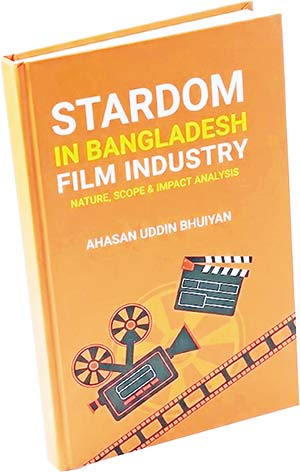 We often recognise a film star by the face on the screen, the name on the poster or the crowd gathered outside a cinema hall. But stardom begins long before that and continues far beyond it. It is built through films, media, business, publicity and, above all, the relationship between stars and their audiences. Ahasan Uddin Bhuiyan’s Stardom in Bangladesh Film Industry: Nature, Scope & Impact Analysis takes a close look at this often overlooked side of Dhallywood. As I moved through the book, I found myself returning to the films, stars and fan culture I have grown up with, but seeing them from a different angle.
The book has six chapters, and the structure works well because the discussion develops step by step. It moves from the idea of stardom and public relations to fan behaviour, film business and digital media.
These topics could easily have felt separate, but Ahasan keeps bringing them back to one central idea: a star is not created by the actor alone. The industry, media and audience all play a part. In that sense, the book is not only about film stars but also about the culture that creates, supports and remembers them.
The early chapters question the common idea that stardom is simply about popularity or screen presence. Ahasan presents the star as someone shaped by art, identity, politics and business. A successful performer can reflect what an audience admires, desires or feels connected to. This broader view helps explain why some actors remain part of popular culture long after their individual films have faded from public memory.
This discussion also points to a larger gap in research. Bangladesh has a long film history, but much of it remains scattered across newspapers, magazines, personal memories and informal archives. Ahasan points out that serious research on Bangladeshi stars and audiences is still limited. This is a concern worth taking seriously. At the same time, the book could have done more to fill that gap. More archival material, closer study of individual films and interviews with audiences would have added depth to several of its arguments.
Chapter Two, “Mechanisms of Construction”, is where the book becomes particularly interesting. Ahasan looks at stereotyping, the male gaze, cultural imitation, media exposure and scandal to explain how star images are built. A performer may have talent and screen presence, but a public image develops through many different forces. Producers, publicity teams, media organisations and audiences all help shape it. The chapter therefore takes us beyond the star and into the system that creates celebrity.
This idea becomes clearer in Ahasan’s discussion of the “Monopoly-Exposure Dialectic”, especially through his examination of Shakib Khan. He argues that industry influence and regular media exposure can strengthen each other, making visibility a source of power. Shakib Khan is a useful example, although the discussion would have been stronger with comparisons with stars from earlier generations. Such comparisons could have shown whether this relationship is mainly a feature of today’s Dhallywood or part of a longer history.
From there, the book moves into the changing media landscape. Rickshaw paintings, radio, television, cinema halls and social media have all given stars different ways to reach the public. These forms of media have not only spread star images but also changed the relationship between stars and audiences. Digital platforms have made that relationship faster and more direct. Fans can now follow stars closely, discuss their work and even help shape their public image.
This leads naturally to the discussion of fan behaviour and box-office success. Ahasan also draws an important distinction: popularity does not always mean financial success. A star may have a huge following, yet a film can still fail at the box office. The book could have explored this issue further by looking more closely at production costs, distribution, cinema exhibition and changing viewing habits. These factors matter when we try to understand how a star’s popularity turns into financial value.
The book also has a strong theoretical base, drawing on scholars such as Richard Dyer and Stuart Hall. Their ideas help place Bangladeshi stardom within wider discussions of celebrity, identity and representation. At times, however, the theory feels slightly removed from the examples. The strongest parts are those where Ahasan connects these ideas directly with familiar stars, films and media practices. More evidence and closer discussion of individual films could have made some of the theoretical arguments stronger without making the book difficult to read.
What gives the book much of its appeal is its balanced view of popular cinema. Ahasan Uddin Bhuiyan neither romanticises Dhallywood nor treats it as mere entertainment. He looks at the industry with curiosity while recognising the role of money, media and audience demand. This becomes especially relevant in the final chapters, which examine Facebook, YouTube, streaming platforms and other digital spaces. These platforms have created new ways for people to become famous and have brought stars much closer to their audiences.
By the end of the book, it becomes clear that Bangladeshi stardom cannot be explained by a single formula. Instead, Ahasan opens several useful areas for further study - how stars are created, promoted, followed and remembered. The book covers a lot of ground, although some areas need deeper research and stronger evidence. Even so, Ahasan Uddin Bhuiyan has taken a subject deeply rooted in our popular culture and given it the serious attention it deserves. More importantly, the book changed the way I look at our film stars. They are not simply familiar faces on a screen; they are also cultural figures through whom we can understand how Bangladesh has watched, remembered and imagined itself through cinema.
Loading...
Loading...



Editor : Iqbal Sobhan Chowdhury
Published by the Editor on behalf of the Observer Ltd. from Globe Printers, 24/A, New Eskaton Road, Ramna, Dhaka.
Editorial, News and Commercial Offices : Aziz Bhaban (2nd floor), 93, Motijheel C/A, Dhaka-1000.
Phone: PABX- 41053001-06; Advertisement: 41053012; 01793317829, 01550707291, E-mail: [email protected], [email protected] Online: email: [email protected] 41053014; 01550707297 Advertisement: 01550707296
Published by the Editor on behalf of the Observer Ltd. from Globe Printers, 24/A, New Eskaton Road, Ramna, Dhaka.
Editorial, News and Commercial Offices : Aziz Bhaban (2nd floor), 93, Motijheel C/A, Dhaka-1000.
Phone: PABX- 41053001-06; Advertisement: 41053012; 01793317829, 01550707291, E-mail: [email protected], [email protected] Online: email: [email protected] 41053014; 01550707297 Advertisement: 01550707296


