



| HEADLINE |

|
Political tagging changes vocabulary, not purpose


 Political tagging and the politics of tagging have recently taken an alarming turn. What begins as disagreement can swiftly become public condemnation, bruising reputations, livelihoods and even personal safety. As accusations outrun facts, political debate is giving way to suspicion, stigma and collective judgement.
Bangladesh’s political discourse has increasingly shifted from debating ideas to branding people, but the practice predates the Awami League, dating back to the post independence years when dissenters were branded Chinese agents, Soviet or Indian stooges, Pakistan sympathisers or American agents. Five decades later, the vocabulary has changed, but the instinct remains. During the Awami League’s rule, “Razakar”, “Jamaat”, “Shibir” and “militant” became familiar labels for critics. Human rights defender Nur Khan Liton compares the practice to a cancer that has metastasised through the body politic. “In the previous government's time, we saw that anyone whose views were unwelcome would be branded Razakar, Jamaat, Shibir, or militant,” he remarks. “In the recent period, we are seeing the labels ‘collaborator of the autocrat’, ‘autocrat’ and ‘Indian stooge’ applied indiscriminately. The chief purpose remains the same, to corner the individual in society.”
The lexicon has since widened to “anti liberation elements”, “Shahbagi”, “Hefajati”, “RAW agent”, “fascist”, “collaborator of fascists”, “atheist”, “infidel”, “apostate”, “godless”, “Gupto” or secret operative, “fake freedom fighter”, “bot army”, “Pakistan’s stooge”, “India’s stooge”, “nishiddho songothoner kormi” or activist of a banned organisation, “leaguer”, “Chhatra League”, “Jubo League” and “doshor” or collaborator. Since August 2024, “pro Awami League”, “anti July” and “politically suspect” have also emerged, sometimes attached to students, teachers and others without formal inquiry or legal process.
What distinguishes tagging from ordinary political insult is its trajectory. An individual is branded without a chance to respond, and as the label spreads, accusation can harden into violence. Those defending the target may inherit the stigma. Social media has accelerated the cycle, with “bot armies” circulating tags around the clock while unverified clips and out of context footage give accusations the appearance of evidence. Sectarian violence has also at times been dismissed as “political tagging”, which, according to leaders of the Bangladesh Hindu Buddhist Christian Unity Council, can allow perpetrators to evade accountability.
The consequences have been fatal. BUET student Abrar Fahad was beaten to death by Chhatra League activists in October 2019 after being suspected of being “Shibir” for criticising Bangladesh India agreements on Facebook. In July 2024, retired judge H.M. Shamsuddin Chowdhury Manik called a television presenter the “child of a Razakar”. Following the fall of the Awami government, critics have instead been branded “agents of fascism”, “agents of India”, “atheists” or “hostile to Islam”. Political analyst and present Adviser to the Prime Minister for Cultural Affairs Dr Zahed Ur Rahman has publicly stated that such labels placed his personal safety at risk.
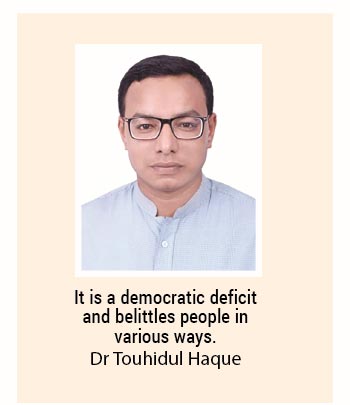
The logic behind such labelling is simple. A tag is cheaper than a trial. It needs neither evidence nor cross examination and can destroy a reputation without establishing guilt. Dr Touhidul Haque, Associate Professor at Dhaka University’s Institute of Social Welfare and Research, views it as a democratic deficit. “In our political reality, whoever expresses a contrary opinion, or fails to align with those in power, is belittled in various ways,” he observes. “The most common device for that humiliation is to present the dissenter in a particular light. This is an undemocratic process; a democratic order requires that everyone be carried along together.” He stresses that genuine state reform requires a change of mindset, without which an equal society remains under strain.
The damage extends from individuals to institutions. Those branded face exclusion, reputational ruin and, in extreme cases, death. University vice chancellors, pro vice chancellors, deans and registrars have faced removal amid accusations of benefiting from previous administrations, while teachers have also been targeted through student or political mobilisation. Sociologists warn that stigma marginalises people, destroys opportunities and fuels unrest. Writers, artists and academics have faced labels such as “atheist”, “infidel” and “apostate”, sometimes with deadly consequences. Women, particularly survivors of sexual violence, may also be smeared with degrading labels that obscure crimes and shield influential perpetrators.
The practice has also entered the legal profession. The Council of Bars and Law Societies of Europe raised concerns over alleged irregularities in Bangladesh bar elections, including harassment, disqualification and pressure on candidates branded “collaborators of fascists”, warning that such practices threaten lawyers’ independence and professional self governance.
Former NCP joint member secretary Tasnim Jara recently claimed that political disagreement alone can attract labels such as “Shahbagi”, “leftist”, “hostile to Islam” or “foreign agent”. “After the uprising, we were promised a political culture in which disagreement would not be mistaken for enmity,” she wrote in a Facebook post. “In reality, the culture of political tagging and division has returned. In a civilised society, no one may call for another's throat to be slit, no one may be detained without trial, and disagreement cannot be passed off as treason.”
Supreme Court lawyer Barrister Jyotirmoy Barua notes that existing laws were not specifically designed to address tagging. “But if someone is attacked or loses employment as a consequence of being tagged, remedy is available under the Penal Code and criminal law,” he clarifies. “One may also pursue a defamation suit.” He adds that no one has so far sought judicial redress specifically for being tagged. Civil society advocates greater tolerance for dissent, responsible journalism and digital conduct, alongside laws addressing disinformation, character assassination and hate speech without suppressing legitimate criticism. Citizens should verify information before sharing it, while political parties should compete through policies and programmes rather than personal labelling.
Bangladesh has repeatedly paid a price when political discourse is reduced to labelling. The tags may change from “Razakar” and “Shibir” to “fascist collaborator”, but the instinct to silence rather than debate endures. Breaking that cycle requires replacing accusation with evidence, argument and dialogue. What has changed, therefore, is largely the vocabulary; the machinery of accusation remains.
Loading...
Loading...
Also read



Editor : Iqbal Sobhan Chowdhury
Published by the Editor on behalf of the Observer Ltd. from Globe Printers, 24/A, New Eskaton Road, Ramna, Dhaka.
Editorial, News and Commercial Offices : Aziz Bhaban (2nd floor), 93, Motijheel C/A, Dhaka-1000.
Phone: PABX- 41053001-06; Advertisement: 41053012; 01793317829, 01550707291, E-mail: [email protected], [email protected] Online: email: [email protected] 41053014; 01550707297 Advertisement: 01550707296
Published by the Editor on behalf of the Observer Ltd. from Globe Printers, 24/A, New Eskaton Road, Ramna, Dhaka.
Editorial, News and Commercial Offices : Aziz Bhaban (2nd floor), 93, Motijheel C/A, Dhaka-1000.
Phone: PABX- 41053001-06; Advertisement: 41053012; 01793317829, 01550707291, E-mail: [email protected], [email protected] Online: email: [email protected] 41053014; 01550707297 Advertisement: 01550707296


