



| HEADLINE |

|
UN has survived, but question is how effective it is: Khalilur Rahman


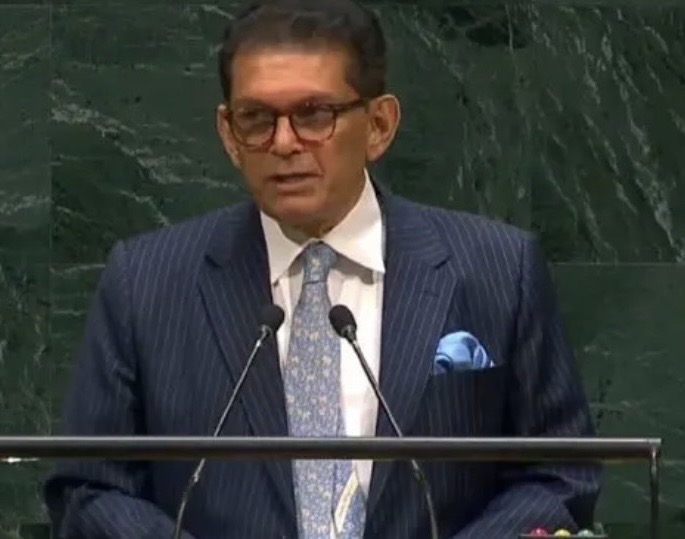
The United Nations has survived for 80 years, but its longevity alone cannot be considered a measure of success, UN General Assembly President Khalilur Rahman said on Tuesday.
Speaking at the opening of the general debate of the 81st session of the UN General Assembly, he said the organisation must acknowledge its failures and limitations and pursue deep reforms to restore global public trust.
The UN began in 1945 with 50 member states and now has 193. But surviving for decades does not necessarily mean it has been successful, Khalilur said.
“Outside these walls, people are not asking whether the United Nations is still here. They are asking whether it is working,” he said.
Khalilur highlighted growing inequality in global financing. Development assistance fell 23 per cent in one year to around $175 billion, while global military spending reached nearly $3 trillion. He said military spending has risen for 11 consecutive years.
He also pointed to progress in some areas.
Nearly 1 billion people gained access to safe drinking water over the past decade, while 92 per cent of the world's population now has access to electricity. Internet use also increased from 40 per cent to 74 per cent during the period.
Khalilur outlined three ways to rebuild public trust in the UN: honestly acknowledging its limitations and failures, pursuing deep structural reforms beyond minor budgetary changes, and involving businesspeople, scientists and civil society more closely in decision-making, particularly on artificial intelligence.
“Trust is not given; it is earned. Passive ownership is not enough. If we do not actively take responsibility for this institution, we cannot expect it to recover,” he said.
He also called for reform of the UN Security Council, saying Africa has played an important role in UN peacekeeping for eight decades but still has no permanent seat.
“For the sake of justice, fairness and the credibility of the United Nations, this needs to change,” Khalilur said. “Africa needs a seat at the table, not to be on the menu.”
Khalilur warned about the rapid expansion of artificial intelligence, saying AI is already being integrated into important systems around the world.
He called for a cautious and reliable framework for AI use, incorporating the views of scientists outside governments. He also warned that competition over AI regulation should not push the world towards dangerous circumstances.
Khalilur expressed concern over the rapid spread of hate speech across borders. He said women and girls, minorities, migrants, refugees and people with disabilities are being targeted by such narratives.
“Islamophobia, antisemitism, homophobia and misogyny are all different forms of hate,” he said.
He called for technology to be used to promote understanding among people and uphold human dignity rather than deepen fear and division.
Khalilur said the UN's long-term problems cannot be addressed through temporary measures.
“When a chronic illness requires deep diagnosis and a long-term treatment plan, we cannot keep treating it with temporary painkillers,” he said.
Calling for immediate action to rebuild trust in the UN, he acknowledged that the task would not be easy or happen overnight.
“But if we want this institution to remain effective for decades to come, the work of change must begin now,” he said.
sks







Published by the Editor on behalf of the Observer Ltd. from Globe Printers, 24/A, New Eskaton Road, Ramna, Dhaka.
Editorial, News and Commercial Offices : Aziz Bhaban (2nd floor), 93, Motijheel C/A, Dhaka-1000.
Phone: PABX- 41053001-06; Advertisement: 41053012; 01793317829, 01550707291, E-mail: [email protected], [email protected] Online: email: [email protected] 41053014; 01550707297 Advertisement: 01550707296


