



| HEADLINE |

|
Consumers brace for heat from pricey fuel
Published : Tuesday, 22 September, 2026 at 12:00 AM
Staff Correspondent


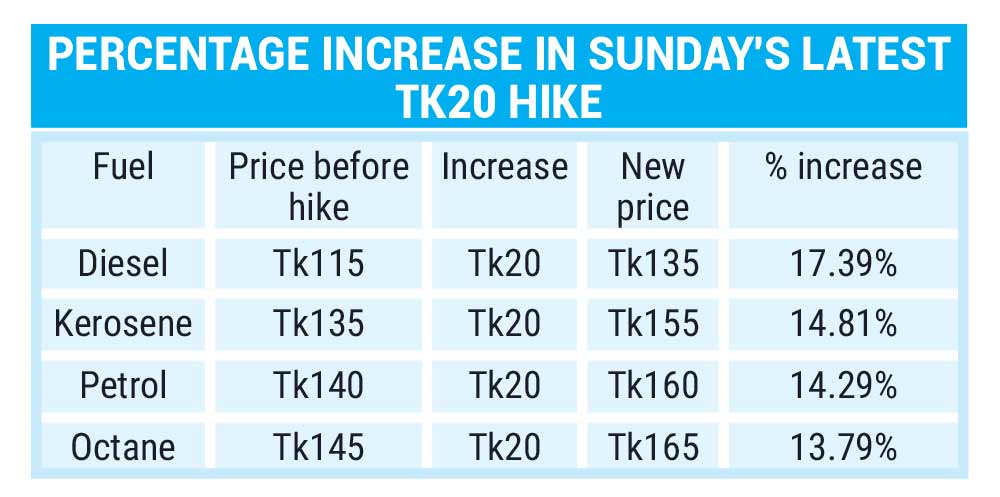 The Tk 20-a-litre fuel price hike has yet to make a visible impact on most commodity prices in Dhaka, but traders and consumers fear a fresh wave of price increases once higher transport costs begin filtering through the supply chain.
General consumers are urging the government to intervene to prevent further increases in the prices of essential kitchen-market items.
People said rising fuel and transportation costs could put unnecessary pressure on the prices of daily necessities, making it harder for low- and fixed-income families to manage their household expenses.
They called for effective market monitoring and necessary measures to keep the prices of essential commodities under control and provide some relief to consumers.
A visit to several retail markets in the capital on Monday found little change in the prices of rice, lentils, flour, sugar, edible oil, vegetables, fish and meat compared with the previous day.
Traders said the full impact of the fuel price hike had not yet reached the markets because much of the goods currently being sold had been transported before the new fuel prices came into effect.
However, retailers warned that the situation could change within a few days as wholesalers and transport operators begin paying higher fuel and freight costs.
Sajib Mia, a vegetable seller at Fakirapul market, said there was no immediate reason to increase prices on Monday.
“But if we have to buy goods at higher prices from the wholesale market in the coming days, retail prices will inevitably have to go up,” he said.
A grocer in Rampura said higher transport costs would affect the price of goods at every stage of the supply chain.
“When transportation costs rise, it does not only increase the initial cost of bringing goods to the market. Costs increase at every stage, from the wholesaler to the retailer, and eventually affect the final price,” he said.
The concern is particularly high among low- and fixed-income people, who fear that higher transport costs will further increase their cost of living while their incomes remain unchanged.
Many consumers said the government should focus on reducing waste and corruption rather than increasing fuel prices, especially when people are already under pressure from the rising cost of living.
S.M. Nazer Hossain, vice-president of the Consumers Association of Bangladesh (CAB), said the fuel price hike had created panic among consumers because fuel costs are closely linked to almost every aspect of daily life and economic activity.
He said higher fuel prices increase operating costs for industries, offices, businesses and households. These additional costs are ultimately passed on to consumers, increasing their financial burden.
He also warned that the interdependence between fuel prices and other goods and services could trigger another round of price increases for essential commodities.
According to Hossain, traders had previously increased the prices of different products citing various reasons, including the crisis involving Iran and successive increases in electricity and fuel costs.
He said prices of several essential items, including sugar, soybean oil, flour and cow’s milk, had already increased and could rise further following the latest fuel price hike.
The impact is expected to be felt first in the transportation sector. Diesel is heavily used to move agricultural products from production areas to district hubs and wholesale markets and then to retail markets.
As a result, the effect of the diesel price increase is unlikely to appear in the market all at once. Instead, it is expected to move gradually through different stages of the supply chain.
The government raised the prices of diesel, kerosene, petrol and octane by Tk 20 a litre, with the new rates taking effect from September 21. Diesel now costs Tk 135 a litre, up from Tk 115, while kerosene is Tk 155, up from Tk 135. The price of petrol has increased to Tk 160 from Tk 140, and octane to Tk 165 from Tk 145.
The government has cited rising international fuel prices and freight costs amid the ongoing conflict in the Middle East as the main reason for the latest adjustment. It has also pointed to mounting losses of the Bangladesh Petroleum Corporation (BPC).
For consumers, however, the key concern is what the higher fuel prices will mean for transport fares and the prices of daily necessities in the coming days.
Loading...
Loading...
Also read



Editor : Iqbal Sobhan Chowdhury
Published by the Editor on behalf of the Observer Ltd. from Globe Printers, 24/A, New Eskaton Road, Ramna, Dhaka.
Editorial, News and Commercial Offices : Aziz Bhaban (2nd floor), 93, Motijheel C/A, Dhaka-1000.
Phone: PABX- 41053001-06; Advertisement: 41053012; 01793317829, 01550707291, E-mail: [email protected], [email protected] Online: email: [email protected] 41053014; 01550707297 Advertisement: 01550707296
Published by the Editor on behalf of the Observer Ltd. from Globe Printers, 24/A, New Eskaton Road, Ramna, Dhaka.
Editorial, News and Commercial Offices : Aziz Bhaban (2nd floor), 93, Motijheel C/A, Dhaka-1000.
Phone: PABX- 41053001-06; Advertisement: 41053012; 01793317829, 01550707291, E-mail: [email protected], [email protected] Online: email: [email protected] 41053014; 01550707297 Advertisement: 01550707296


