



| HEADLINE |

|
Banks race to rescue City Group
Published : Monday, 21 September, 2026 at 12:00 AM
Shamsul Huda


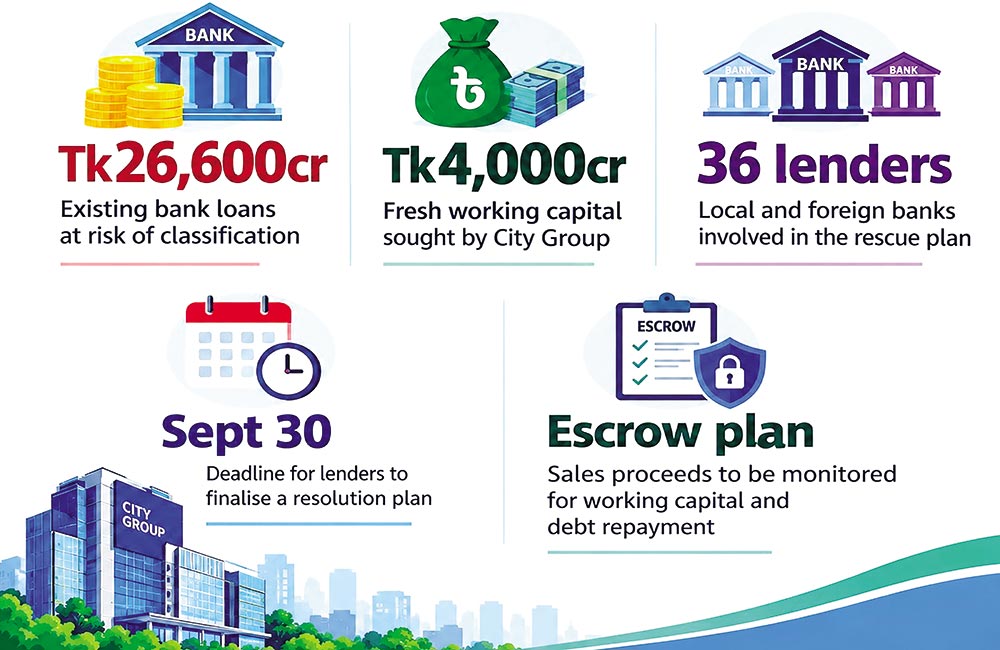 Efforts are under way to prevent country’s one of the leading companies City Group’s massive bank loans from becoming classified, with 36 local and foreign banks and other financial institutions working on a coordinated plan to keep the conglomerate’s businesses running and protect their exposure from turning bad.
The lenders are seeking regulatory clarity on whether they can safely provide around Tk4,000 crore in fresh working capital as City Group’s existing bank loans of more than Tk26,600 crore face the risk of classification after September.
The issue has become urgent as Bangladesh Bank has asked the lenders to complete a restructuring, rescheduling or other resolution plan by the end of this month and made it clear that the deferment on loan classification will not continue beyond September.
Bankers said City Group needs the fresh funds to import raw materials and keep production running. But lenders are concerned about extending new credit to a conglomerate already under heavy liquidity pressure and struggling to service its existing debt.
The key question for the banks is what would happen to the proposed Tk4,000 crore facility if the group’s existing Tk26,600 crore loans become classified after September.
If the new facility is sanctioned before the existing loans are classified, it would normally remain a separate credit facility. However, its future treatment would depend on City Group’s financial condition, the structure and purpose of the facility and the terms of any restructuring approved by Bangladesh Bank.
The distinction is important because rescheduling an existing loan and providing fresh working capital are separate credit decisions.
Bangladesh Bank’s restructuring rules allow eligible distressed or classified borrowers to receive support under certain conditions. However, restrictions also apply to new lending under some special arrangements.
Under the central bank's May 2026 instructions, for instance, a borrower receiving a special exit facility cannot obtain a new credit facility from the concerned bank until the exit loan is fully repaid, except for existing facilities.
The 36 lenders are therefore preparing to meet Bangladesh Bank's senior management this week to present their proposed support plan, according to City Bank Managing Director and ABB Chairman Mashrur Arefin.
He said the banks want to provide working capital so City Group can import commodities, continue production and maintain sales.
The proposed facility would be subject to applicable prudential rules, with lenders assessing the group's repayment capacity, cash flow and financial position rather than simply providing new funds to service old loans.
The timing of the new facility has consequently become crucial. Even if the Tk4,000 crore is sanctioned before September 30, it would not automatically become classified simply because City Group's earlier loans are later classified. But the earlier sanction would not permanently protect the new facility from classification if the group fails to repay it or if the approved restructuring framework requires different treatment.
The lenders are also considering an escrow and cash-flow monitoring system. Under the proposed arrangement, City Group's sales proceeds would flow into a central escrow account and be distributed through a predetermined waterfall, with part released for working capital and the remainder used for debt repayment.
The system would allow lenders to monitor cash generation and ensure sales proceeds are used according to the agreed working-capital and repayment plan.
For City Group, the immediate need is to secure funds to keep imports, production and sales moving. For the lenders, the challenge is to provide that liquidity without adding another layer of credit risk to their existing Tk26,600 crore exposure.
Loading...
Loading...
Also read



Editor : Iqbal Sobhan Chowdhury
Published by the Editor on behalf of the Observer Ltd. from Globe Printers, 24/A, New Eskaton Road, Ramna, Dhaka.
Editorial, News and Commercial Offices : Aziz Bhaban (2nd floor), 93, Motijheel C/A, Dhaka-1000.
Phone: PABX- 41053001-06; Advertisement: 41053012; 01793317829, 01550707291, E-mail: [email protected], [email protected] Online: email: [email protected] 41053014; 01550707297 Advertisement: 01550707296
Published by the Editor on behalf of the Observer Ltd. from Globe Printers, 24/A, New Eskaton Road, Ramna, Dhaka.
Editorial, News and Commercial Offices : Aziz Bhaban (2nd floor), 93, Motijheel C/A, Dhaka-1000.
Phone: PABX- 41053001-06; Advertisement: 41053012; 01793317829, 01550707291, E-mail: [email protected], [email protected] Online: email: [email protected] 41053014; 01550707297 Advertisement: 01550707296


