



| HEADLINE |

|
Fear grips city after series of crude-bomb blasts
Published : Saturday, 19 September, 2026 at 12:00 AM
Arifur Rahman Rabbi


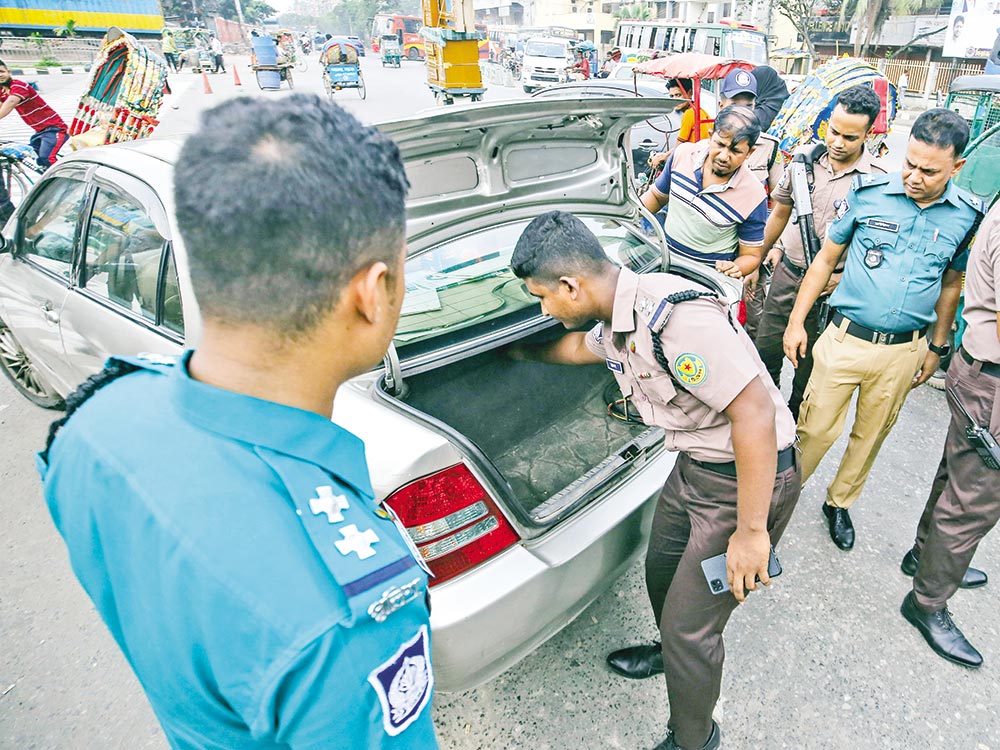 A series of cocktail bomb explosions in the capital in recent days has raised fresh security concerns amid growing political tensions.
Questions have also arisen over the purpose of the incidents and who may benefit politically after a cocktail exploded in front of the Supreme Court’s main gate on September 15, followed hours later by three explosions in the Dhaka University area.
The Supreme Court blast occurred around noon after International Crimes Tribunal-2 sentenced seven accused to death. Police said two men on a motorcycle threw the explosive and fled.
Home Minister Salahuddin Ahmed said the suspects had been identified through CCTV footage, but their identities and motives had not been conclusively established.
That night, three explosions occurred around Jagannath Hall and the TSC metro rail station. No casualties were reported. Dhaka Metropolitan Police’s Deputy Commissioner (Ramna Division) Sheikh Zahidul Islam told The Daily Observer that no one had been arrested and the investigation was ongoing. He said police suspected the incidents might have been intended to create instability.
Earlier, police reported two cocktail explosions on September 11 while dispersing a procession involving banned Awami League activities in Gulshan. Two people were detained and five cocktails recovered, with several others arrested later.
On July 6, a cocktail exploded on the stage of the 'July Jagarana to Build the Country' programme organised by the National Citizens Party (NCP) in Savar, injuring several people.
Against this backdrop, two cocktails exploded near Fortune Shopping Mall in Malibagh around noon on September 18. Police said unidentified people threw them from the Malibagh Flyover onto the road below. No one was injured. Police were analysing CCTV footage to identify those responsible.
Amirul Islam, officer-in-charge of Shahjahanpur Police Station, said the cocktails were thrown from the flyover in front of a police checkpoint and efforts were underway to identify those responsible.
Later in the evening, several crude bombs were also exploded in Jatrabari, creating panic among locals.
DMP Joint Commissioner (Crime) Md Faruk Hossain told The Daily Observer that the explosions could be intended to create political instability. He said police were working to prevent such incidents.
He said 188 checkpoints were operating across Dhaka, with motorcycles being checked and the bags of suspicious individuals searched. Police had also been deployed at flyovers and other important and sensitive locations.
However, he said police alone could not completely prevent such incidents because of manpower limitations and called for cooperation from the public and political parties.
Political and crime analysts said cocktail explosions can be used to create fear, portray the law-and-order situation as unstable or disrupt political programmes.
Intelligence agencies have claimed that Awami League leaders living in India and other countries are financing processions and maintaining communication through special apps. They also claim attempts are being made to keep party activists 'energised' through rumours on social media, including claims about Sheikh Hasina's possible return.
Dr Md Naim Akter Siddique, professor of political science at Jagannath University, said the timing, location and impact of the explosions needed to be analysed to determine who might benefit politically.
Regardless of who is behind them, he said, such incidents create fear among the public, making it important to identify those responsible, their motives and any political involvement.
Dr Md Omar Faruk, professor of criminology and police science at Mawlana Bhashani Science and Technology University, said the purpose of explosions occurring around the same time at important installations and university areas should be investigated. He said analysing the attackers' movements, the type of explosives used, CCTV footage and communication records could help establish their motives.
According to the Human Rights Support Society (HRSS), seven people were killed and more than 536 injured in 70 incidents of political violence across the country in August.
HRSS Executive Director Ijajul Islam said such incidents could be intended to signal that the banned political party and its affiliated organisations remain active, while also creating fear and portraying the police as weaker after August 5.
He said the incidents should not be taken lightly and called for those responsible, their motives and any political or organised involvement to be identified quickly. Effective preventive measures are also needed to prevent recurrence.
Authorities therefore need to investigate the incidents individually while also examining whether there is any coordination between them. A clearer picture of the motives and any political links will emerge only after the attackers are identified through investigation.
Loading...
Loading...
Also read



Editor : Iqbal Sobhan Chowdhury
Published by the Editor on behalf of the Observer Ltd. from Globe Printers, 24/A, New Eskaton Road, Ramna, Dhaka.
Editorial, News and Commercial Offices : Aziz Bhaban (2nd floor), 93, Motijheel C/A, Dhaka-1000.
Phone: PABX- 41053001-06; Advertisement: 41053012; 01793317829, 01550707291, E-mail: [email protected], [email protected] Online: email: [email protected] 41053014; 01550707297 Advertisement: 01550707296
Published by the Editor on behalf of the Observer Ltd. from Globe Printers, 24/A, New Eskaton Road, Ramna, Dhaka.
Editorial, News and Commercial Offices : Aziz Bhaban (2nd floor), 93, Motijheel C/A, Dhaka-1000.
Phone: PABX- 41053001-06; Advertisement: 41053012; 01793317829, 01550707291, E-mail: [email protected], [email protected] Online: email: [email protected] 41053014; 01550707297 Advertisement: 01550707296


