



| HEADLINE |

|
BRICS 2026: Is the Dollar Dying?
The Truth Behind De-Dollarisation
Published : Saturday, 19 September, 2026 at 12:00 AM
Faruk Ahmed


As BRICS builds a parallel payments architecture and expands local-currency trade, the world is entering a new era of monetary competition. Yet the greenback remains the unrivalled king of global finance. What does this quiet financial revolution mean for Bangladesh?
The world's most powerful currency is facing its biggest geopolitical challenge in decades �" but reports of its death are greatly exaggerated.
The 18th BRICS Summit in New Delhi has reignited one of the defining questions of the global economy: Is the US dollar losing its grip on international finance? From Beijing to Brasília, Moscow to Mumbai, leaders of the Global South are accelerating efforts to reduce dependence on the dollar and Western-controlled financial infrastructure. Yet behind the headlines lies a far more complex reality.
This is not the collapse of the dollar. It is the rise of a multipolar financial order.
BRICS is no longer pursuing the dramatic dream of launching a single common currency comparable to the euro. Instead, it is building something potentially more consequential �" an alternative financial plumbing system that allows countries to trade, settle payments and borrow without making the US dollar the default intermediary.
For emerging economies such as Bangladesh, the implications extend far beyond geopolitics. They touch foreign exchange reserves, trade financing, remittances, debt management and the future of digital finance.
The Quiet War Against Dollar Dominance
For nearly eight decades, the US dollar has been the backbone of the international monetary system. Around 57.13 per cent of global foreign exchange reserves remain denominated in dollars, despite a gradual decline from about 72 per cent at the beginning of this century. It dominates commodity pricing, international borrowing, cross-border settlements and central bank reserves.
That dominance gives Washington extraordinary financial influence.
The turning point came in 2022 when Russian banks were disconnected from much of the SWIFT payment network and hundreds of billions of dollars of Russian sovereign reserves were frozen after Moscow invaded Ukraine. For many developing nations, the episode demonstrated that access to dollar-based financial infrastructure could become a geopolitical weapon.
BRICS interpreted that lesson differently from the West. Instead of confronting the dollar directly, the bloc began constructing escape routes around it.
BRICS changes strategy �" no currency, but a new payment ecosystem
Perhaps the biggest surprise from the New Delhi summit was what BRICS did not announce.There is no BRICS currency.
Indian officials made that explicit, while the summit declaration instead committed members to strengthening local-currency settlements, cross-border payment connectivity and digital financial infrastructure. Analysts describe the move as a pragmatic shift from symbolism to implementation.
Rather than minting a new currency, BRICS is focusing on three pillars: Expanding trade settlements in national currencies such as the yuan, rupee, ruble and real, creating interoperable payment systems including BRICS Pay and digital settlement platforms and increasing lending in local currencies through the New Development Bank.
This is a technological and institutional revolution rather than a monetary revolution.
 Why Replacing the Dollar Is Extraordinarily Difficult
The enthusiasm surrounding de-dollarisation often ignores one fundamental distinction: a payment currency is not a reserve currency.
Countries can settle bilateral trade in local currencies without creating a new global monetary order. A reserve currency requires enormous liquidity, unrestricted convertibility, trusted legal institutions and vast supplies of safe financial assets for central banks and investors.
China illustrates the dilemma.
Although Beijing has aggressively expanded the international use of the yuan through its Cross-Border Interbank Payment System (CIPS), the yuan still faces capital controls and limited convertibility. Investors cannot access Chinese financial markets as freely as US Treasury markets.
The BRICS bloc itself contains economies with sharply different inflation rates, exchange-rate regimes, monetary policies and capital-market structures, making a common currency politically and economically improbable.
The dollar's greatest strength is not America alone; it is the world's trust in the institutions surrounding it.
India's Balancing Act in The New Financial Order
India emerged as the summit's most cautious architect.
While hosting BRICS, New Delhi simultaneously reassured global markets that it has "no interest in weakening the US dollar". Instead, India wants wider international use of the rupee without becoming part of an anti-dollar monetary bloc.
This reflects India's delicate geopolitical position.Its trade ties with China remain complicated, its strategic partnership with the United States is deepening, and its financial integration with Gulf economies continues expanding.
India's preferred strategy is selective de-dollarisation �" reducing exposure where beneficial while preserving access to the global dollar system.
The Hidden Challenges of Local-Currency Trade
The theory sounds attractive. But the practice is far messier.
India's booming oil trade with Russia exposed the weakness of bilateral currency settlements. Russian exporters accumulated massive rupee balances they struggled to spend because India's imports from Russia were relatively small and capital controls limited broader use of the currency.
The lesson is simple.
Removing the dollar from a transaction does not remove the need for a trusted settlement mechanism.Without deep financial markets and globally accepted assets, local-currency trade can create new imbalances instead of solving old ones.
A new global financial architecture is emerging
What BRICS is constructing resembles a parallel operating system for global finance.
The New Development Bank is expanding local-currency lending to reduce exchange-rate risks for borrowers. Cross-border digital payment interoperability aims to make transactions faster and cheaper. Central Bank Digital Currencies are increasingly viewed as tools for sovereign payment independence.
The ambition is not to destroy SWIFT tomorrow.It is to ensure countries have alternatives when geopolitical tensions disrupt access to existing networks.This gradual diversification could become one of the most significant structural changes in international finance since the Bretton Woods system.
What It Means for Bangladesh
For Bangladesh, this global monetary transition arrives at a fragile economic moment.
The country remains heavily dependent on dollar-denominated trade, foreign borrowing and imported energy. Its foreign exchange reserves have come under pressure over the past several years, while the taka has experienced repeated depreciation against the dollar.
A more diversified global payment ecosystem offers opportunities �" but also risks.
Bangladesh imports billions of dollars' worth of fuel, food grains, machinery and industrial raw materials each year. Wider use of yuan, rupees or other currencies could reduce transaction costs in selected bilateral trade, particularly with China and India.
A substantial share of Bangladesh's sovereign and corporate external debt remains dollar-denominated. Any prolonged dollar appreciation raises repayment costs. Local-currency lending through multilateral institutions could reduce exchange-rate exposure over time.
Bangladesh receives one of the world's largest remittance inflows. Faster cross-border payment infrastructure and digital settlement networks could lower transfer costs and improve financial inclusion.
Bangladesh has already emerged as a regional leader in mobile financial services through platforms such as bKash, Nagad and Rocket. A future global ecosystem of interoperable digital payment systems could create opportunities for Bangladeshi fintech firms to integrate into regional payment corridors.
Yet Bangladesh cannot afford to abandon the US dollar.
More than four-fifths of its export earnings come from the ready-made garments sector, where invoices are overwhelmingly denominated in dollars or euros. International reserves, commodity imports and development financing still revolve around the greenback.
The challenge is diversification without destabilisation.
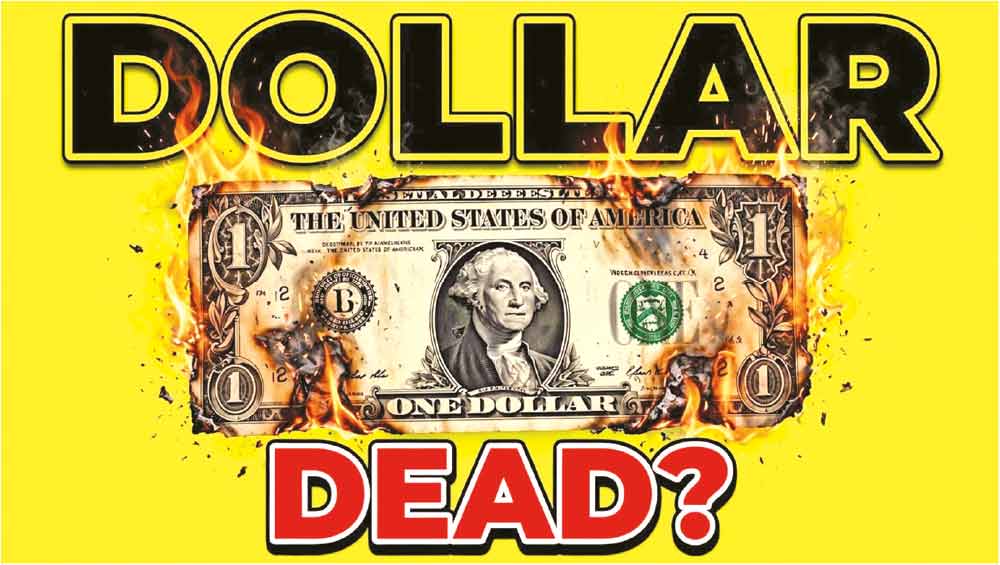
Is The Dollar Dying?
The evidence says no.But it also says the era of uncontested dollar supremacy is gradually fading.
The New Delhi Declaration reflects an important shift. BRICS is no longer promising a dramatic replacement for the dollar; it is building institutions that make exclusive dependence on it less necessary.
That distinction matters.
De-dollarisation is not a single event but a slow redistribution of financial influence across currencies, payment systems and regional financial centres. The dollar will likely remain the world's principal reserve currency for years because no rival currently matches its liquidity, credibility and institutional depth.
What is changing is the world's willingness to rely on only one financial highway.
Bangladesh's Strategic Choice
For Bangladesh, the message is neither to celebrate de-dollarisation nor fear it.
The country should strengthen reserve management, diversify trade settlement mechanisms where commercially viable, accelerate cross-border digital payment connectivity, and reduce excessive dependence on any single currency without undermining financial stability.
The BRICS experiment is unlikely to bury the dollar.But it may reshape the architecture through which money moves around the world �" and that quiet transformation could prove more significant than any headline predicting the end of the greenback.
The battle is no longer about replacing the dollar overnight. It is about ensuring the dollar is no longer the only gateway to global finance.
(The writer is a seasoned financial journalist with nearly four decades of experience in banking, capital markets and economic policy. He is the Consulting Editor of The Daily Observer and may be reached at [email protected].)
Loading...
Loading...
Also read



Editor : Iqbal Sobhan Chowdhury
Published by the Editor on behalf of the Observer Ltd. from Globe Printers, 24/A, New Eskaton Road, Ramna, Dhaka.
Editorial, News and Commercial Offices : Aziz Bhaban (2nd floor), 93, Motijheel C/A, Dhaka-1000.
Phone: PABX- 41053001-06; Advertisement: 41053012; 01793317829, 01550707291, E-mail: [email protected], [email protected] Online: email: [email protected] 41053014; 01550707297 Advertisement: 01550707296
Published by the Editor on behalf of the Observer Ltd. from Globe Printers, 24/A, New Eskaton Road, Ramna, Dhaka.
Editorial, News and Commercial Offices : Aziz Bhaban (2nd floor), 93, Motijheel C/A, Dhaka-1000.
Phone: PABX- 41053001-06; Advertisement: 41053012; 01793317829, 01550707291, E-mail: [email protected], [email protected] Online: email: [email protected] 41053014; 01550707297 Advertisement: 01550707296


