



| HEADLINE |

|
PM plans for energy security, electric train, gas exploration
Published : Thursday, 10 September, 2026 at 12:00 AM
Staff Correspondent


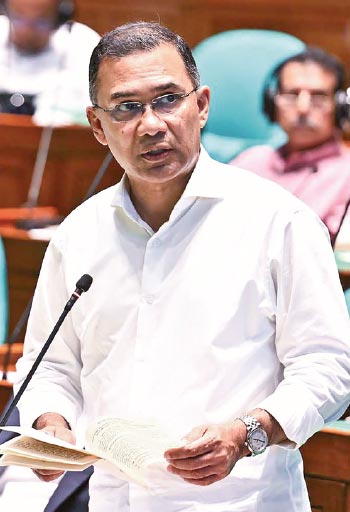 Prime Minister Tarique Rahman has announced an ambitious package of energy, gas exploration, renewable power and railway development initiatives, including the drilling of 150 new wells by 2030-31, construction of additional LNG terminals and the introduction of electric trains on the Dhaka-Chattogram corridor.
Speaking during the question-and-answer session in Parliament on Wednesday, the Prime Minister outlined a series of short- and long-term measures aimed at strengthening energy security, reducing dependence on imported fuel and improving industrial and transport infrastructure.
* 150 new wells will be drilled by 2031
* A third LNG terminal will be built
* Electric train to ply Dhaka-Ctg route
New LNG terminals: The government has invited an international bidding round, launched on May 24, for exploration and extraction of oil and gas in 26 offshore blocks. The deadline for submitting bids has been set for November 2026. It is also preparing a Bangladesh Onshore Model PSC 2026 to attract international investment in onshore oil and gas exploration.
To increase domestic gas supplies, the government plans to drill 150 new wells by 2030-31. Alongside this, surveys covering 4,500 line kilometres of 2D seismic data and 4,200 square kilometres of 3D seismic data are being conducted to identify new gas resources.
Bangladesh currently has two floating LNG terminals capable of supplying an average of around 935 million cubic feet of gas per day. To strengthen emergency supply capacity, work is underway to establish a new floating LNG terminal at Kutubjom in Maheshkhali and a land-based LNG terminal at Matarbari. The Kutubjom terminal is expected to supply regasified LNG from 2028, while the land-based facility is targeted for 2030.
The government is also assessing the feasibility of establishing another floating LNG terminal in the deep sea, potentially near Payra or Mongla ports or along the southwestern coast, to address future emergencies.
Bhola gas development: The Prime Minister said bringing Bhola’s gas to the mainland by pipeline would take at least seven years. Instead, the government plans to promote gas-based industrialisation within Bhola, including a large fertiliser plant and a new 500MW power plant.
A separate 400MW gas-fired power plant is also planned in Bhola. Meanwhile, the government is working to convert around 60 million cubic feet of gas per day from the Veduria and Ilisha fields into LNG and transport it by lighterage to the Khulna power hub.
Bhola and surrounding islands have also been designated as a central zone for the country’s blue economy, with emphasis on fisheries, hilsa conservation, coastal agriculture, climate-resilient infrastructure and maritime security.
Renewable energy targets: The government has identified renewable energy as a top priority and adopted a National Renewable Energy Development Strategy for 2026-2030. It has set a target of meeting at least 20% of national electricity generation from renewable sources by 2030 and 30% by 2040.
Solar power will receive the greatest emphasis. The plan includes 5,500MW from rooftop solar systems and another 4,500MW from large-scale ground-based solar projects. An additional 450-550MW is expected from wind, waste-to-energy, hydropower, floating solar and agrivoltaic projects.
To encourage investment, customs duty, regulatory duty, supplementary duty, advance tax and the additional 2% advance income tax have been waived on key renewable-energy equipment, including solar panels, inverters, specialised batteries and structures.
Under a special tariff announced on September 1, rooftop solar generation using batteries has been capped at Tk 8 per unit, while the purchase price for surplus electricity supplied to the national grid has been fixed at Tk 10.50 per unit, including incentives. Consumers installing eligible rooftop systems by February 28, 2027, will be able to sell surplus power at the rate until February 28, 2030, under the Net Metering Guideline 2025.
Electric trains: The government is also preparing to introduce electric trains on the Dhaka-Chattogram railway corridor. A feasibility study and detailed design for electric traction have already been completed, with implementation awaiting financing.
At the same time, plans are underway to modernise the entire corridor into a dual-gauge double-track railway. Feasibility studies and detailed designs have been completed for the Tongi-Akhaura and Laksam-Chattogram sections.
The Laksam-Chattogram project proposal is in the final approval process, while preparation of the Tongi-Akhaura proposal is nearing completion.
The government is also considering construction of a direct Dhaka-Comilla chord line to shorten the railway distance between the capital and Chattogram. A feasibility study and detailed design are underway.
Prime Minister said the combined initiatives are intended to increase train speeds and capacity, reduce travel time and establish a modern, environmentally friendly rail system connecting Bangladesh’s two major economic centres.
Loading...
Loading...
Also read



Editor : Iqbal Sobhan Chowdhury
Published by the Editor on behalf of the Observer Ltd. from Globe Printers, 24/A, New Eskaton Road, Ramna, Dhaka.
Editorial, News and Commercial Offices : Aziz Bhaban (2nd floor), 93, Motijheel C/A, Dhaka-1000.
Phone: PABX- 41053001-06; Advertisement: 41053012; 01793317829, 01550707291, E-mail: [email protected], [email protected] Online: email: [email protected] 41053014; 01550707297 Advertisement: 01550707296
Published by the Editor on behalf of the Observer Ltd. from Globe Printers, 24/A, New Eskaton Road, Ramna, Dhaka.
Editorial, News and Commercial Offices : Aziz Bhaban (2nd floor), 93, Motijheel C/A, Dhaka-1000.
Phone: PABX- 41053001-06; Advertisement: 41053012; 01793317829, 01550707291, E-mail: [email protected], [email protected] Online: email: [email protected] 41053014; 01550707297 Advertisement: 01550707296


