



| HEADLINE |

|
Dr Khalil to assume UNGA presidency today
Published : Tuesday, 8 September, 2026 at 12:00 AM
Diplomatic Correspondent


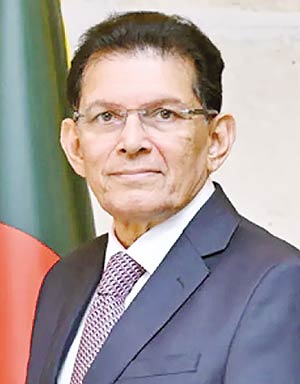 Bangladesh’s Foreign Minister Dr Khalilur Rahman is set to assume the presidency of the 81st United Nations General Assembly (UNGA) today (Tuesday), marking Bangladesh’s return to the post after four decades.
Former foreign minister Humayun Rasheed Choudhury was the first Bangladeshi to hold the position, presiding over the 41st session in 1986-87.
Khalilur was elected on June 2 through a secret ballot, securing 99 votes against 91 received by Cyprus’s candidate Andreas S Kakouris. The presidency was allocated to the Asia-Pacific Group under the UN’s regional rotation system.
In his acceptance speech, Khalilur acknowledged the serious challenges facing the international system.
“Multilateralism is under pressure and the United Nations continues to face significant financial stress,” he said, warning that such challenges could undermine public confidence in the world body’s ability to deliver.
He pledged to work with all member states to strengthen the UN’s effectiveness, credibility and relevance.
His priorities include restoring trust in multilateralism, advancing peace and security, accelerating sustainable development, protecting human rights, promoting the interests of women, girls and vulnerable countries, and improving UN peace operations.
The year-long presidency comes at a time when conflicts, climate emergencies, development setbacks and declining confidence in multilateralism are putting the international system under pressure.
“The election of our Foreign Minister, Dr Khalilur Rahman, as President of the United Nations General Assembly is a significant diplomatic achievement for the country,” State Minister for Foreign Affairs Shama Obaed Islam said on Monday.
She described the election as an “immensely proud moment”, attributing the success partly to what she called international confidence in Bangladesh following its return to elected democratic governance.
Meanwhile, State Minister for Foreign Affairs Humaiun Kobir said Khalilur’s election demonstrated Bangladesh’s ability to play a constructive role in promoting international peace and stability.
Describing Bangladesh as a “soft power” and an “emerging tiger”, he said the country engages internationally through cooperation, dialogue and goodwill rather than coercion.
Former ambassador to the United States M Humayun Kabir viewed the election as an expression of international confidence in Bangladesh at an important point in its democratic journey.
Kabir, however, noted that the UNGA president is required to serve all 193 member states impartially rather than represent the national interests of any particular country.
Loading...
Loading...
Also read



Editor : Iqbal Sobhan Chowdhury
Published by the Editor on behalf of the Observer Ltd. from Globe Printers, 24/A, New Eskaton Road, Ramna, Dhaka.
Editorial, News and Commercial Offices : Aziz Bhaban (2nd floor), 93, Motijheel C/A, Dhaka-1000.
Phone: PABX- 41053001-06; Advertisement: 41053012; 01793317829, 01550707291, E-mail: [email protected], [email protected] Online: email: [email protected] 41053014; 01550707297 Advertisement: 01550707296
Published by the Editor on behalf of the Observer Ltd. from Globe Printers, 24/A, New Eskaton Road, Ramna, Dhaka.
Editorial, News and Commercial Offices : Aziz Bhaban (2nd floor), 93, Motijheel C/A, Dhaka-1000.
Phone: PABX- 41053001-06; Advertisement: 41053012; 01793317829, 01550707291, E-mail: [email protected], [email protected] Online: email: [email protected] 41053014; 01550707297 Advertisement: 01550707296


