



| HEADLINE |

|

Bangladesh must abandon low-cost growth model before LDC graduation
Published : Sunday, 6 September, 2026 at 12:00 AM
Shamsul Huda


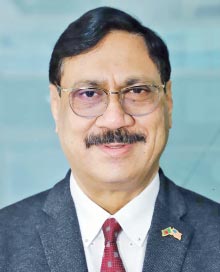 Bangladesh must urgently abandon its low-cost, labour-dependent growth model and transform itself into a skills-driven, productivity-led economy before the country loses the protective advantages that have underpinned its development, leading businessman Syed Ershad Ahmed has warned.
The former president of the Foreign Investors’ Chamber of Commerce and Industry (FICCI) and AmCham made the observation in an exclusive interview with the Daily Observer, stressing that Bangladesh’s looming graduation from the Least Developed Country (LDC) category should be treated not as a threat but as a once-in-a-generation opportunity to rebuild the economy around people, productivity, investment and strong institutions.
“Bangladesh’s biggest investment after LDC graduation should not simply be in physical infrastructure but in its people�"particularly the country’s large young population. Even if we get the extension, we have only three more years to prepare,” he said.
Bangladesh is approaching a defining moment in its economic journey. It was scheduled to graduate from the LDC category on November 24, 2026, although the government has sought a three-year extension.
“The central question is no longer whether Bangladesh can maintain GDP growth. The bigger question is whether the economy can create enough productive jobs, raise worker skills, diversify exports and make investment more attractive,” Ahmed said.
He believes Bangladesh has several powerful foundations for such a transformation, particularly its youthful population. Around 65 per cent of the country’s 170 million people are below the age of 35, creating one of the world’s largest potential pools of young workers.
The central question is no longer whether Bangladesh can maintain GDP growth. The bigger question is whether the economy can create enough productive jobs, raise worker skills, diversify exports and make investment more attractive
But these strengths could quickly turn into vulnerabilities unless productivity rises sharply, Ahmed warned.
“The garment sector alone cannot absorb the millions of young people who will enter the labour market in the coming years. We, therefore, need to develop technology, startups, agro-processing, green energy and other higher-value sectors,” he said.
Only around 15 per cent of Bangladesh’s workforce has received formal training, according to the International Labour Organisation.
Ahmed said the figure must rise rapidly as artificial intelligence and automation begin to reshape industries and eliminate demand for routine and low-skilled jobs.
“Rote learning is becoming obsolete,” he said, calling for a fundamental shift towards creativity, problem-solving, technical competence and ethics.
He believes the transformation must begin at the very foundation of the education system�"in primary schools.
“Children need more than textbooks and uniforms. They need discipline, manners, basic health and hygiene knowledge, communication skills and a strong foundation in literacy and numeracy,” he said.
Teachers, he added, should focus on developing children’s character and capabilities rather than simply delivering classroom lectures.
 The children entering school today will become the workers, entrepreneurs, engineers and technology professionals expected to drive Bangladesh’s economy through the 2030s and beyond.
At the same time, he warned that the country cannot expect to reap a demographic dividend unless it addresses persistent health and nutrition problems.
A large young population will not automatically translate into faster growth if children enter adulthood suffering from malnutrition, poor health and inadequate education, he said.
Bangladesh continues to face significant challenges in child nutrition and healthcare, while public health spending remains low compared with several regional economies. Healthcare, therefore, must be viewed as an investment in future productivity, Ahmed argued.
He also called for population planning to return to the centre of national policymaking, saying Bangladesh’s limited land and natural resources make effective family planning essential for sustainable long-term development.
On the broader economy, Ahmed identified high inflation, banking-sector weaknesses and policy uncertainty as major threats to the country’s growth prospects.
The banking sector’s mounting non-performing loans have weakened the flow of credit to productive businesses, while persistent inflation continues to erode household purchasing power.
Bangladesh must restore confidence in the financial system and ensure that bank credit flows towards productive investment instead of remaining trapped in bad loans, he said.
Although foreign-exchange reserves have improved, Ahmed urged policymakers to remain cautious, arguing that lasting reserve strength must ultimately be built on stronger exports, higher remittances, increased foreign investment and sound management of the external sector.
Investment confidence will be equally critical in the post-LDC era.
Investors need predictable policies, effective institutions and confidence that contracts and property rights will be protected, he said.
“Businesses cannot plan for the next 10 or 20 years if policies keep changing,” Ahmed said.
For him, the rule of law is therefore not merely a political or legal issue-it is fundamentally an economic one.
A businessman will invest when contracts are enforceable. A small entrepreneur will borrow when banks treat borrowers fairly. Workers will become more productive when they feel secure, he said.
Ahmed also warned that prolonged political conflict could inflict serious damage on economic development.
Political competition is normal in a democracy, he said, but treating political opponents as enemies weakens state institutions and undermines national stability.
“Governments come and go, but institutions must remain strong,” he said.
The Election Commission, judiciary, media and law-enforcement agencies must therefore be allowed to operate independently and fairly, he added.
He also stressed that Bangladesh cannot build a sustainable economy around large corporations alone. Farmers, small shopkeepers, factory workers and small entrepreneurs are equally vital to the country’s economic future.
Small and medium-sized enterprises need better access to finance, farmers need fair prices and technology, and workers need skills and social protection, he said.
Ahmed ultimately sees the post-LDC challenge as far greater than simply replacing lost trade preferences.
Bangladesh must decide what kind of economy and society it wants to build, he said.
The choices, in his view, are stark: conflict or dialogue, revenge or rule of law, corruption or good governance, division or harmony, and unemployment or skilled employment.
The country’s future, he said, will not belong to any single political party. It will depend on the strength of its institutions, the contribution of civil society and, above all, the ability of its 170 million people to participate productively in the economy.
“A nation’s greatest asset is not minerals or weapons. It is the character, knowledge, skills and mutual trust of its people,” Ahmed said.
That, he believes, should be the defining principle of Bangladesh’s post-LDC journey: less obsession with headline growth figures and far greater emphasis on people, productivity, opportunity and trust.

Loading...
Loading...
Also read



Editor : Iqbal Sobhan Chowdhury
Published by the Editor on behalf of the Observer Ltd. from Globe Printers, 24/A, New Eskaton Road, Ramna, Dhaka.
Editorial, News and Commercial Offices : Aziz Bhaban (2nd floor), 93, Motijheel C/A, Dhaka-1000.
Phone: PABX- 41053001-06; Advertisement: 41053012; 01793317829, 01550707291, E-mail: [email protected], [email protected] Online: email: [email protected] 41053014; 01550707297 Advertisement: 01550707296
Published by the Editor on behalf of the Observer Ltd. from Globe Printers, 24/A, New Eskaton Road, Ramna, Dhaka.
Editorial, News and Commercial Offices : Aziz Bhaban (2nd floor), 93, Motijheel C/A, Dhaka-1000.
Phone: PABX- 41053001-06; Advertisement: 41053012; 01793317829, 01550707291, E-mail: [email protected], [email protected] Online: email: [email protected] 41053014; 01550707297 Advertisement: 01550707296


