



| HEADLINE |

|

Riding the Real Banalata Express Amid World Cup Frenzy
Published : Saturday, 5 September, 2026 at 12:00 AM
Mahmudul Islam


 Among the passengers trickling through the platform gate at Dhaka Railway Station, the four young men chatting near the entrance hall stand out in their football jerseys. Three of them sport Argentina's blue and white stripes, and the other one wears Brazil's classic yellow. These colours had started dominating the streets of Dhaka even before the FIFA World Cup kicked off in Mexico 10 days ago.
Bangladeshis are obsessed with Argentina and Brazil, which is reflected in the jerseys they wear. Germany and Portugal also enjoy strong support, though on a smaller scale. Caught up in the frenzy, I bought three less common jerseys - Saudi Arabia, Croatia, and Japan - from the ever-chaotic Gulistan market ahead of the global tournament.
My Saudi Arabian jersey is forest green, while the Banalata Express that I will board today to travel to Chapainawabganj has dark green carriages with red and white stripes. My colleague, graphic designer Deen Mohammad, arrives in a grey crew-neck shirt and blue jeans. Using his iPhone, he snaps photos of me sitting in the doorway, my feet resting on the metal steps.
On the platform, a woman in a salwar kameez vends folded paper maps, a rarity in the age of smartphones. I wait impatiently for my other travel companion Asif Imtyage, a well-known train travel vlogger running the YouTube channel Lets Go To. He called a while ago from Motijheel metro station, but with our departure only minutes away, I am worried that he will miss the train.
At last, he arrives, and the train rolls at 1:30pm, chugging past the busy Khilgaon level crossing (LC) gate. Ashar, the first month of the monsoon, has already begun, but it has not rained in Dhaka yet. With the scorching summer heat lingering, our only respite in the non-air-conditioned carriage is the air coming through the windows and the ceiling fans.
My phone rings. It is Asif, and his seat behind us is empty. Before answering, I glance around the carriage, assuming he is playing a prank.
But he is not. Someone has accidentally locked him inside the toilet. When I reach the vestibule and free him, there is no one else around.
Deen and I head for the buffet car. When I ask the counterman for a soft drink, an on-board policeman sitting nearby says the refrigerator is out of service and not even cold water is available. This comes as a big disappointment, but given my broad experience of train journeys across Bangladesh, I am not surprised.
“The refrigerator of the non-stop train has stopped,” quips Deen, who has a sharp sense of humour and is good at telling well-timed jokes. Hailing from Feni’s Sonagazi upazila, he has been working in the print media since 2010. He has never been to western Bangladesh and is enjoying today’s ride.
A team of three travelling ticket examiners (TTEs) arrives after we return to our carriage. One of them is a woman, and this is the first time I see a female TTE in my life. The male TTE inspecting my digital ticket has a defective eye and says Bangladesh Railway has a few female TTEs.
“This is a difficult job even for a man,” I say.
“Yes. We have the same duties as magistrates, but we are not as strict. Passengers sometimes behave rudely, and I want to deal with them strictly. Yet, I do not do that,” he says, returning my phone.
This diesel-run train has got a life beyond the railways after the release of the Banalata Express movie in March this year. Based on renowned novelist Humayun Ahmed’s Kichukkhon, the family drama weaves together the stories of several strangers who meet on a train on a winter night. The real Banalata Express now carries not only its passengers but also the emotions and memories of the film’s fictional characters.
In the star-studded movie, Sabila Nur portrays a physics graduate named Chitra. On the real train, I encounter Md Hasib, a student of chemistry at Nawabganj Government College, in the doorway. A native of Chapainawabganj, he has a faint moustache, neatly trimmed short hair, and a youthful face.
“I am going to start a bachelor’s programme at Sejong University in South Korea this September. I had to pass a Korean language test to apply for admission. The passing mark in the 200-mark test is 140. I scored 150,” he says.
His extensive preparations indicate a strong interest in Korea. He started learning the language in 2024 in Chapainawabganj and recently took the test in Dhaka. He is also interested in working in Korea after graduation and believes his language skills will help him land a job.
“It was easy to get a student visa in the past. Now it is hard because of irregularities by some applicants. The embassy heavily scrutinises all documents,” he says.
We approach the Jamuna Railway Bridge, a dark maroon truss bridge opened last year with the promise of speeding up Dhaka’s rail communication with northern districts. Accompanied by gusty winds, a fine drizzle begins to fall when the train rattles over the bridge. This is the loveliest moment of the journey so far.
The rain stops, leaving behind refreshingly cool air. The train halts at Jamtail station in Sirajganj to let an oncoming one pass. A bearded man wearing the dark blue edition of the Brazil jersey vends chicken khichuri in small boxes on the platform, and another one chants “singara, singara”.
Crop fields, haystacks, and vegetation spread across the rural landscape beyond Ullapara. In a month, most of this will disappear under water to become part of the Chalan Beel. That will be a spectacular sight for train passengers but a source of great hardship for villagers, who will remain marooned for around three months and rely on boats to get around.
Here on the train, I see a passenger enduring a different kind of hardship. Dressed in a checked shirt and a lungi, the barefoot man is curled up in a corner of a gangway, one of the riskiest places aboard. With his eyes shut, he sways gently as the metal plates beneath him shake rhythmically.
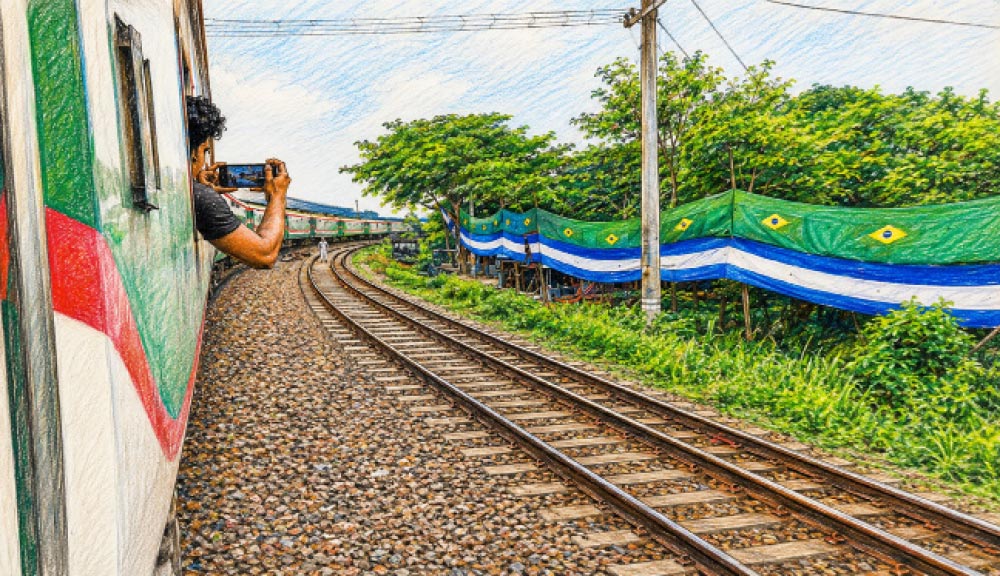
The World Cup fever is no less intense in the districts the train has traversed so far. I have noticed sizeable crowds watching football matches in playgrounds and rural fields. But the scene in Pabna’s Ishurdi perfectly captures Bangladesh's longstanding Brazil-Argentina rivalry.
Fans of both countries have put up two enormous flags that stretch alongside the tracks. Carefully fastened to poles and trees, they hang overhead in parallel. The train, rounding the sharp Ishurdi Bypass curve, seems to be trundling towards the entrance to a football carnival that is going on behind the flags.
Hurtling past Azimnagar station and Abdulpur Junction in Natore, the train enters the Rajshahi district, known for its rich silk history. Several centuries ago, the silk industry attracted traders from as far away as Europe. Though the glory has faded, the Bangladesh Sericulture Development Board is working on reviving it.
Several years ago, Rajshahi residents would take pride in living in one of the cleanest Bangladeshi cities. Clean roads and air, tree-lined median strips, and efficient drainage massively improved liveability. But a sharp deterioration of these qualities has now stripped Rajshahi of much of its former charm.
I imagine the contrast between the city’s current state and the afternoon view outside the train window. The latter is very scenic as we are still in predominantly rural areas. While the city folks enjoy the amazing views of the Padma River from embankments, I soak in the endless green fields, ponds, and mango trees.
Harian, a quaint station in the district, still has the old red-brick buildings, one of them roofed with corrugated metal sheets. Deen and Asif spot a female railway worker on the platform holding the green flag. Then appear the red and white buildings of the University of Rajshahi.
Many passengers stream out of the doors when the train reaches Rajshahi station at 6:30pm. As we cut through the heart of the city after a 20-minute halt, I see shops, multi-storey housing units, and traffic waiting at LC gates. Once the lush greenery is back, mango trees dominate the landscape.
Chapainawabganj holds the title of Bangladesh’s mango capital, and Kansat becomes the country's busiest mango marketplace every summer. Go to Kansat at that time, and you will see vehicles transporting tonnes of mangoes in crates. Traders even carry mangoes on bicycles as they balance two large bamboo baskets laden with fresh fruits.
Darkness has already descended. Passengers get to see the train’s full length once again after Ishurdi, this time as more like a long string of lights arcing around the Amnura Bypass curve in the dark. Inaugurated in 2017, the bypass was a key requirement to launch direct Dhaka-Chapainawabganj rail services.
The train pulls into its terminus around half an hour late. This is also the end of the railway line, but the Kansat market is still far away, accessible only by roadways. Tomorrow, we will witness the mango bonanza there.
Mahmudul Islam is a journalist and train travel writer

Loading...
Loading...



Editor : Iqbal Sobhan Chowdhury
Published by the Editor on behalf of the Observer Ltd. from Globe Printers, 24/A, New Eskaton Road, Ramna, Dhaka.
Editorial, News and Commercial Offices : Aziz Bhaban (2nd floor), 93, Motijheel C/A, Dhaka-1000.
Phone: PABX- 41053001-06; Advertisement: 41053012; 01793317829, 01550707291, E-mail: [email protected], [email protected] Online: email: [email protected] 41053014; 01550707297 Advertisement: 01550707296
Published by the Editor on behalf of the Observer Ltd. from Globe Printers, 24/A, New Eskaton Road, Ramna, Dhaka.
Editorial, News and Commercial Offices : Aziz Bhaban (2nd floor), 93, Motijheel C/A, Dhaka-1000.
Phone: PABX- 41053001-06; Advertisement: 41053012; 01793317829, 01550707291, E-mail: [email protected], [email protected] Online: email: [email protected] 41053014; 01550707297 Advertisement: 01550707296


