



| HEADLINE |

|

Mecca Defence Fact
Should Bangladesh fall into a trap?
Published : Wednesday, 2 September, 2026 at 7:52 PM
Observer News Analysis


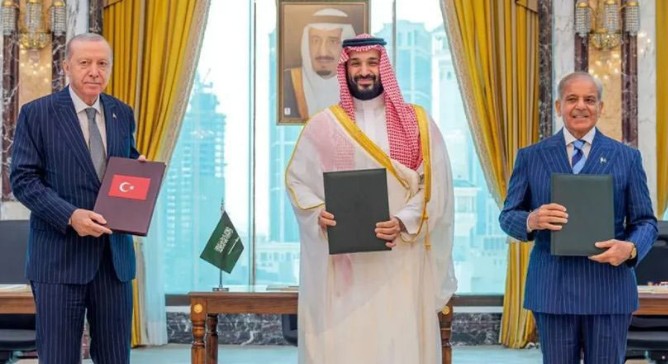
When a country joins a military alliance, it does not merely sign a document; it also places some of its future choices in the hands of others. At first glance, such an arrangement may appear reassuring friendship, brotherhood, mutual cooperation and collective security. But a closer look raises difficult questions. The debate over bringing Bangladesh into the “Mecca Joint Defence” pact is therefore far more than a matter of diplomatic courtesy. It concerns the country’s security, sovereignty, economy and long-standing foreign policy.
As a Muslim-majority country, Bangladesh may naturally find the prospect of security cooperation with Saudi Arabia, Türkiye and Pakistan appealing. But states cannot be governed by sentiment. Their survival ultimately depends on the hard realities of geography, economics, military capability and national interest.
The most consequential feature of the Mecca Pact is its commitment to collective defence. The pact is modelled on Article 5 of NATO: an armed attack on one member is to be treated as an attack on the others. Türkiye’s Foreign Minister Hakan Fidan has described the provision as technically identical to NATO’s Article 5. This leaves Bangladesh facing a straightforward but uncomfortable question: what happens if India and Pakistan go to war?
There can be no easy evasion. If Pakistan comes under attack, would Bangladesh be expected to fight alongside Pakistan? If India attacks Pakistan, would that attack have to be regarded as an attack on Bangladesh as well? Could Bangladesh declare that it does not want war and remain neutral? Or would its obligations under the pact require it to send troops?
Unless these questions are answered clearly in advance, Bangladesh should think twice before joining any military alliance.
“Friendship to all, malice towards none” has long been a defining principle of Bangladesh’s foreign policy. Some may regard such a policy as a sign of weakness. For a country like Bangladesh, however, it is less a weakness than a prudent strategy for preserving peace and stability. Its military capability is not such that it can sustain a prolonged conflict with several powers at once. Its real strength lies in maintaining a balance in its external relations.
Geography makes this balance all the more important. India surrounds Bangladesh on roughly three sides, Myanmar lies along one corner, and the Bay of Bengal forms its southern frontier. If India and Myanmar were to close their land, air and sea routes during a conflict, how much practical assistance could a distant ally actually bring? Through which air corridor would weapons arrive? Through which sea route would ships come? In wartime, supplies cannot be delivered through friendships written on paper.
Bangladesh’s own history offers a sobering lesson. During the India-Pakistan war of 1965, Bangladesh was then East Pakistan. Although it was part of the same state as Pakistan, East Pakistan was effectively left undefended. What Pakistan did or failed to do to protect important areas such as Dhaka and Chittagong is a history worth remembering. We were then part of the same country as Pakistan; we were not outside a military alliance. Yet when danger came, East Pakistan was essentially left to fend for itself.
Today, Bangladesh is an independent country. Thirty lakh people gave their lives for that independence, while more than two lakh women suffered sexual violence at the hands of the Pakistani army and its collaborators. Bangladesh can trade with Pakistan and maintain diplomatic relations with it. But to go to war against India on Pakistan’s behalf while setting aside Bangladesh’s own history of independence would that not be an act of self-destruction? Creating such a situation in the first place would run counter to Bangladesh’s national interest.
So where, precisely, does the Mecca Pact fit into Bangladesh’s security needs?
At present, Bangladesh faces no direct military threat. Saudi Arabia has one set of security concerns, Pakistan another and Türkiye yet another. The Iran-Saudi rivalry, the India-Pakistan dispute and Türkiye’s security politics surrounding Israel are their realities. Bangladesh’s reality is different. It would be unwise to turn another country’s security calculus into our own.
Consider a hypothetical situation: Myanmar attacks Bangladesh tomorrow. Would Pakistan go to war against Myanmar? Would Saudi Arabia send troops to defend Bangladesh? Would Türkiye arrive with military assistance through the Bay of Bengal? Such questions of practical reality are far more unforgiving than the language of a treaty.
The history of military alliances is hardly reassuring. CENTO, SEATO and NATO each have their own histories and interests. The security of a powerful state is not necessarily the same as that of a weaker one. On paper, all members may be equal; in practice, military strength, economic weight and geopolitical importance are not distributed equally.
The recent mutual defence agreement between Saudi Arabia and Pakistan also deserves scrutiny. The agreement included a commitment to assist each other in the event of an attack by a third party. Yet even after Saudi Arabia sought Pakistan’s help in the face of Iranian attacks, Pakistan did not directly enter the war on Saudi Arabia’s behalf, according to reports. The reason is simple: states do not ordinarily risk their own survival for friendship. Pakistan did not. Why, then, should Bangladesh?
A state may have friends. But it has no right to commit suicide.
Bangladesh may have disagreements with India over the border, water, extradition and trade, among other issues. But reflexive anti-India rhetoric is no substitute for strategy. Economic warfare can at times be more damaging than military conflict. Bangladesh’s fuel, electricity, gas, fertiliser, water and trade routes are all tied to the realities of its neighbourhood. India is a major neighbour. Turning it into an enemy and seeking shelter under the security umbrella of a distant power would not make Bangladesh safer; it could instead become a path to self-destruction.
There is also uncertainty over the renewal of the Ganges water-sharing treaty. If joining a military alliance were to further complicate relations with a neighbour, why should 180 million people bear the cost?
Bangladesh’s demographic and economic importance is also a significant reason for the invitation to join the Mecca Pact. Nearly 4.5 million Bangladeshis work in Saudi Arabia, which is an important source of remittances for Bangladesh. It is also being argued that Bangladesh’s large Muslim population would enhance the pact’s political and symbolic weight.
But another country’s needs are not necessarily our needs.
Bangladesh’s national interest should be measured first by security, followed by sovereignty, the economy and the independence of its foreign policy. Egypt, too, has approached this question cautiously. It fears that joining the pact could weaken its position of neutrality in regional conflicts. It has chosen to wait and observe how the alliance performs when confronted with a real crisis.
Bangladesh should do the same. The first step should be to make the full text of the Mecca Pact public.
The precise meaning of the collective-defence clause, the extent of the provision for withdrawal, and whether Bangladesh would retain the right to remain neutral must all be clarified. In particular, there should be a written scenario analysis of Bangladesh’s position in the event of a conflict between India and Pakistan. Taking a decision while leaving Bangladesh’s obligations in such a situation undefined would be dangerous.
Bangladesh does not want to be anyone’s enemy not Pakistan’s, not India’s, not Saudi Arabia’s, not Türkiye’s and not Iran’s. What Bangladesh needs is peace, trade, water, energy, employment, investment and a secure future. Strengthening its own borders, economy and the security of its citizens is far more important than sending its soldiers to someone else’s battlefield.
If, in the name of friendship, Bangladesh enters an agreement in which a friend’s enemy can one day become its own enemy, that is not friendship. It is binding oneself to someone else’s conflict.
Bangladesh must think a hundred times before assuming such an obligation to go to war. The central question surrounding the Mecca Pact is therefore not the unity of the Muslim world. It is this: where does Bangladesh’s interest lie?
Will Bangladesh become part of someone else’s security calculus, or will it determine its own security priorities?
Bangladesh must not lose that sense of judgment. Above all, it must not allow itself to be drawn into a vicious trap.
sks

Loading...
Loading...
Also read









Editor : Iqbal Sobhan Chowdhury
Published by the Editor on behalf of the Observer Ltd. from Globe Printers, 24/A, New Eskaton Road, Ramna, Dhaka.
Editorial, News and Commercial Offices : Aziz Bhaban (2nd floor), 93, Motijheel C/A, Dhaka-1000.
Phone: PABX- 41053001-06; Advertisement: 41053012; 01793317829, 01550707291, E-mail: [email protected], [email protected] Online: email: [email protected] 41053014; 01550707297 Advertisement: 01550707296
Published by the Editor on behalf of the Observer Ltd. from Globe Printers, 24/A, New Eskaton Road, Ramna, Dhaka.
Editorial, News and Commercial Offices : Aziz Bhaban (2nd floor), 93, Motijheel C/A, Dhaka-1000.
Phone: PABX- 41053001-06; Advertisement: 41053012; 01793317829, 01550707291, E-mail: [email protected], [email protected] Online: email: [email protected] 41053014; 01550707297 Advertisement: 01550707296


