



| HEADLINE |

|

8 categories excluded under Family Card guideline
Published : Monday, 31 August, 2026 at 10:00 AM
Observer Online Report


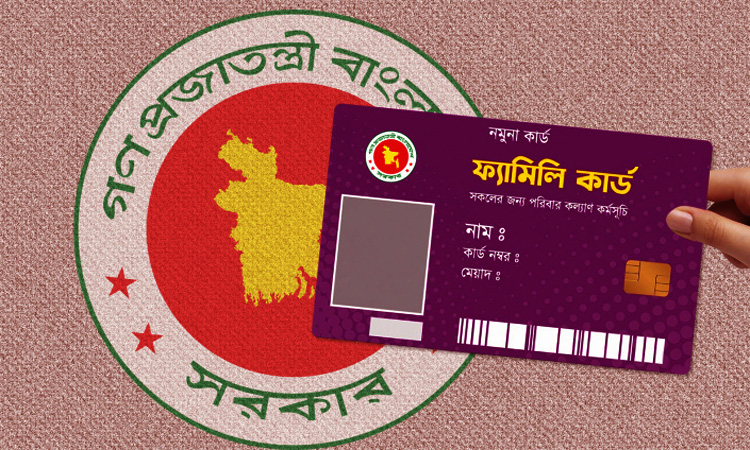
Collected Photo
The government issued the ‘Family Card Implementation Policy, 2026’ to bring poor, and lower-middle-income families under an integrated social safety net program.
The Ministry of Social Welfare published the guidelines to scale up the pilot project into a national program.
The policy aims to empower approximately 20 million female heads of households by delivering monthly cash assistance directly via the Government-to-Person (G2P) system.
Under the new guidelines, eight categories of individuals or families are listed on a "Negative List" and will remain ineligible for the Family Card:
1. Families scoring above the government-defined PMT threshold.
2. Female heads of households working in government, autonomous, semi-government, state-owned enterprises, or MPO-enrolled educational institutions receiving regular salaries.
3. Female heads receiving government pensions or retirement benefits, excluding special pensions for disabled children.
4. Families holding over Tk 5 lakh in national savings certificates, bank deposits, fixed deposits, or financial investments.
5. Families owning BRTA-registered three- or four-wheeled motor vehicles, including cars, jeeps, pickups, buses, trucks, and microbuses.
6. Families owning large commercial enterprises or active commercial licenses.
7. Families with members who are regular taxpayers with taxable income.
8. Families owning 0.50 acres or more of arable land, or non-agricultural/commercial space valued above Tk 5 lakh.
Each eligible family will receive a permanent, unique identification number called 'One-ID' to build an integrated data governance framework.
Selected female household heads cannot receive duplicate benefits from other government social safety net programs.
Existing benefits under TCB Smart Family Card, Food Friendly Program, Vulnerable Women Benefit (VWB), old-age allowance, or disability allowance will be canceled or suspended upon enrolling in the Family Card scheme.
However, other members of the family may continue receiving conventional government social benefits.
Applicant information will undergo automated verification through API connections across national databases, including NLA, NBR, BRTA, the Land Ministry, and commercial banks.
Additionally, the government integrated artificial intelligence and machine learning technologies to detect data discrepancies, income misreporting, or fraud within the Dynamic Social Registry.
-SA
Loading...
Loading...
Also read



Editor : Iqbal Sobhan Chowdhury
Published by the Editor on behalf of the Observer Ltd. from Globe Printers, 24/A, New Eskaton Road, Ramna, Dhaka.
Editorial, News and Commercial Offices : Aziz Bhaban (2nd floor), 93, Motijheel C/A, Dhaka-1000.
Phone: PABX- 41053001-06; Advertisement: 41053012; 01793317829, 01550707291, E-mail: [email protected], [email protected] Online: email: [email protected] 41053014; 01550707297 Advertisement: 01550707296
Published by the Editor on behalf of the Observer Ltd. from Globe Printers, 24/A, New Eskaton Road, Ramna, Dhaka.
Editorial, News and Commercial Offices : Aziz Bhaban (2nd floor), 93, Motijheel C/A, Dhaka-1000.
Phone: PABX- 41053001-06; Advertisement: 41053012; 01793317829, 01550707291, E-mail: [email protected], [email protected] Online: email: [email protected] 41053014; 01550707297 Advertisement: 01550707296


