



| HEADLINE |

|

The C-Section Trap
A Mother’s Dignity Under the Scalpel
Published : Saturday, 22 August, 2026 at 12:00 AM
Foyjunnesa Sharmin


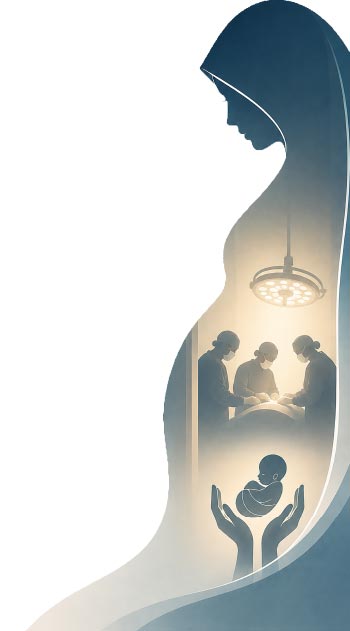 Imagine standing in a dimly lit hospital corridor in rural Bangladesh, listening to the ticking of a wall clock. Inside the labour room, a young mother is in distress. For nine months, her family has carefully planned for this day, choosing loose-fitting clothes and hoping for a birth that respects ‘Purdah’, the deeply held cultural and religious practice of privacy and modesty. But suddenly, the doctor delivers chilling news- the baby’s heart rate is dropping.
An emergency Caesarean section is the only way out. Then comes the moment that makes the family freeze-the only available surgeon on duty tonight is a man. In a split second, a sacred spiritual boundary collides head-on with a medical crisis. For a devout family, this realization brings a wave of panic and anxiety. It forces them into a heartbreaking, immediate conflict- how do you choose between preserving a mother’s modesty and saving her life?
An estimated 1.7 million unnecessary C-sections are performed annually, driven less by medical necessity than by private hospitals’ profit motives, weak government oversight and the failure to support natural labour. The routine push towards scheduled surgery often leaves families little choice over who performs the procedure, bringing commercial interests into direct and avoidable conflict with their deepest spiritual values.
When complications such as sudden haemorrhage or fetal distress occur, time can mean the difference between life and death. Yet female gynaecologists remain scarce in rural sub-districts, with most concentrated in urban areas. Forcing a labouring mother to travel for hours in search of a female surgeon can expose her to uterine rupture, fetal brain damage or maternal death, while leaving families to make an agonising choice under extreme pressure.
The crisis is compounded by a lack of transparency. Despite the country’s digital ambitions, hospitals rarely publish staff rosters or the gender composition of medical teams. Women attending months of antenatal care are often not told whether emergency or night-shift surgeons will be male or female. This failure to provide information prevents families from making informed decisions early in pregnancy and leaves them confronting a potentially traumatic choice only after active labour has begun.
We cannot solve this crisis by shaming families for their religious beliefs, nor can we solve it by ignoring clinical safety. True justice in healthcare means restructuring the system so that it treats a mother's body with absolute dignity.
To heal this dilemma between medical survival and personal modesty, Bangladesh should bring amendments inmaternal healthcare laws:
The Medical Practice and Private Clinics and Laboratories (Regulation) Ordinance, 1982.This outdated law must be explicitly amended to make Digital Roster Transparency a mandatory condition for hospital licensing, with private clinics publicly listing on-duty obstetricians, anaesthetists and nurses by name and gender. Non-compliance should attract heavy fines and immediate licence suspension.
The Bangladesh Medical and Dental Council (BMDC) Act, 2010 and its Code of Professional Conduct.The BMDC code must be retrofitted to enshrine The Right to a Chaperone as a statutory patient right. The law must codify a mandatory "Maternal Protection Protocol." In life-threatening emergencies requiring a male surgeon or anaesthetist, hospitals should ensure a female medical chaperone or family member is continuously present, with documented informed consent and prior disclosure of the operating team’s gender composition.
The Bangladesh Nursing and Midwifery Council Act, 2016.To permanently dismantle the commercialized C-section racket, the law must be amended to legally decentralize maternal care. Amend the Act to give registered female midwives independent authority over normal, non-surgical deliveries and require female midwifery units at sub-district health complexes, reducing unnecessary C-sections and reserving surgery for genuine emergencies.
Protecting a mother’s life should never mean sacrificing her dignity. By fixing our broken laws and commercialized medical practices, Bangladesh can transform its labor rooms from places of cultural conflict into spaces of deep compassion, safety, and respect. Bringing a child into this world is a blessing and a beautiful transitional journey for a woman stepping into motherhood. These small changes may make this motherhood experience into an in credible journey for a woman.
Loading...
Loading...



Editor : Iqbal Sobhan Chowdhury
Published by the Editor on behalf of the Observer Ltd. from Globe Printers, 24/A, New Eskaton Road, Ramna, Dhaka.
Editorial, News and Commercial Offices : Aziz Bhaban (2nd floor), 93, Motijheel C/A, Dhaka-1000.
Phone: PABX- 41053001-06; Advertisement: 41053012; 01793317829, 01550707291, E-mail: [email protected], [email protected] Online: email: [email protected] 41053014; 01550707297 Advertisement: 01550707296
Published by the Editor on behalf of the Observer Ltd. from Globe Printers, 24/A, New Eskaton Road, Ramna, Dhaka.
Editorial, News and Commercial Offices : Aziz Bhaban (2nd floor), 93, Motijheel C/A, Dhaka-1000.
Phone: PABX- 41053001-06; Advertisement: 41053012; 01793317829, 01550707291, E-mail: [email protected], [email protected] Online: email: [email protected] 41053014; 01550707297 Advertisement: 01550707296


