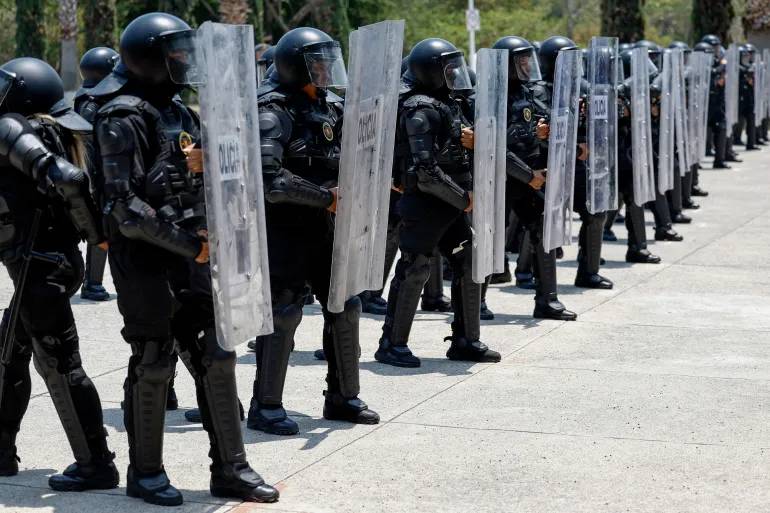
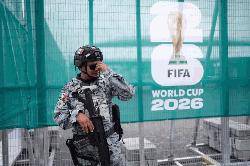
Security forces in Mexico have been undergoing training, led by Spain’s National Police riot units ahead of the World Cup 2026. AFP
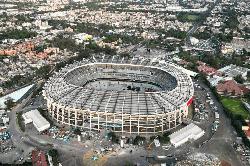
With less than a week before the opening match of FIFA 2026 World Cup to be held at Mexico City Stadium in Mexico City- acute security crises, labour disputes, and human rights protests are converging to challenge Mexico’s preparedness as a tournament cohost.
While global attention has largely focused on organizational dynamics in the United States, recent localized violence and domestic unrest have elevated safety concerns for international fans, athletes, and media personnel traveling to the region.
Escalating Cartel Violence and Mass Shootings A catastrophic armed attack in Tehuitzingo, located in the state of Puebla just 200 kilometers from the capital, resulted in the deaths of 10 individuals, including a minor. The incident underscores the persistent volatility driven by organized crime networks, which spiked following the targeted killing of Jalisco New Generation Cartel (CJNG) leader Nemesio “El Mencho” Oseguera by state security forces earlier this year.
The Puebla massacre follows a sequence of security breaches affecting tourism infrastructure, including an armed assault at the Teotihuacan archaeological site that left a Canadian tourist dead and 13 others injured.
In response, the administration of President Claudia Sheinbaum has committed to deploying a force of 100,000 personnel- comprising National Guard troops, localized police units, and private security contractors. Concurrently, US Department of Homeland Security Secretary Markwayne Mullin is scheduled for an unannounced diplomatic visit to Mexico to evaluate transnational security protocols. Human Rights Demonstrations and Activism
Civil society organizations and human rights collectives are leveraging the global media spotlight of the tournament to protest systemic institutional failures. On May 17, members of the search collective United Forces for Our Disappeared in Nuevo Leon (FUNDENL) staged a demonstration football match outside the government palace in Monterrey to condemn the country’s ongoing disappearance crisis, which currently totals 133,960 unresolved missing persons cases according to official data.
International advocacy bodies, including Amnesty International and Human Rights Watch, have criticized FIFA for failing to implement direct protection mechanisms for independent journalists and local populations within host cities. Activists argue that heavy state spending on sports infrastructure directly diverts resources away from judicial investigations and forensic search operations. Threatened Labor Strikes to Disrupt Tournament Launch
Operational disruptions also loom from organized labor. The National Coordination of Education Workers (CNTE), a major Mexican teachers’ union, has rejected a government-proposed 9% wage increase, demanding instead a 100 per cent salary baseline adjustment and the total reversal of previous educational reforms.
Union leadership has threatened to initiate a comprehensive national strike on June 11, the day Mexico is scheduled to play South Africa in the tournament opener. Union representatives stated that if structural negotiations fail to progress before the opening match, targeted labor stoppages will deliberately interfere with transit and tournament logistics, threatening to stall operations before the first ball rolls.
Published by the Editor on behalf of the Observer Ltd. from Globe Printers, 24/A, New Eskaton Road, Ramna, Dhaka.
Editorial, News and Commercial Offices : Aziz Bhaban (2nd floor), 93, Motijheel C/A, Dhaka-1000. Phone: PABX- 41053001-06; Online: 41053014; Advertisement: 41053012.
E-mail: district@dailyobserverbd.com, news@dailyobserverbd.com, advertisement@dailyobserverbd.com, For Online Edition: mailobserverbd@gmail.com